Watch a racing yacht heel in a gust and the mast does something that looks impossible. It bends, curving like a fishing rod under the load of the sails, and then it springs back, straight and true, as the gust passes. A wooden mast would have snapped, and an aluminium mast would have bent and stayed bent. The carbon mast just takes it, time after time.
That flex is designed in, by the way its materials are laid up, layer by layer, with different fibres running in different directions. A carbon mast is not a tube of one material. It is a stack of carbon cloth, resin, core and metal, each doing a job the others cannot, and the whole thing weighs about half what an aluminium mast of the same strength would weigh.
Here is what those materials are, and why each one earned its place.

The Materials Behind the Yacht Carbon Mast
1. Carbon fibre tow, the threads that carry the load
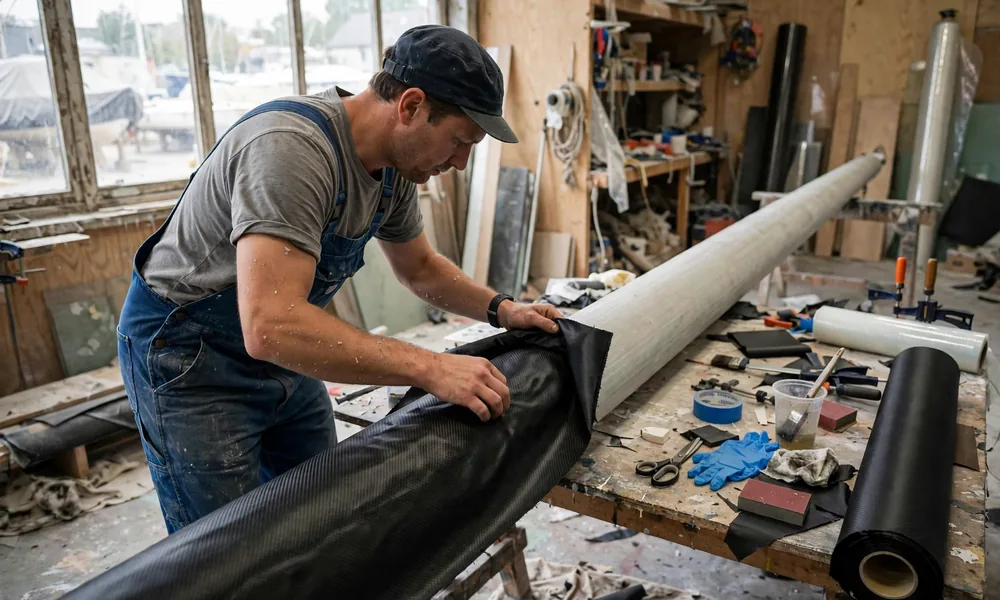
The heart of the mast is carbon fibre, starting life as tow: bundles of thousands of hair-thin filaments, each stronger in tension than steel at a fraction of the weight. The tow is woven into cloth or laid as tape, fibres running where the loads run: along the mast for bending, around it against crushing, and at forty-five degrees against twisting. The recipe is a trade secret for every spar maker, and the full breakdown is set out in the yacht carbon mast specs explained, from wall thickness to bend characteristics.
2. Epoxy resin, the glue that makes cloth into a spar
Carbon cloth on its own is floppy, like fabric. It becomes a mast when it is soaked in epoxy resin and cured under heat and pressure, and the resin does far more than hold the fibres together: it transfers loads between them, protects them from moisture, and gives the spar its smooth, hard surface. Spar makers use prepreg cloth, where the resin is already in the fibres in exact proportions, because hand-wetting gives uneven results. The laminate is cured in an autoclave or an oven, with the temperature cycle controlled to the degree, since resin cured too cool stays soft and resin cured too hot turns brittle.
3. Foam and honeycomb core, the lightweight skeleton inside
A hollow carbon tube would be strong but prone to buckling, the way an empty drinks can crumples when squeezed. To stop that, the mast walls carry a core of structural foam or Nomex honeycomb between the carbon skins. The core is very light, but holding the two skins apart makes the wall far stiffer for almost no extra weight, as a corrugated box is stiffer than a flat sheet. It also gives the mast a place to anchor fittings, since screws and bolts can bite into a solid core where they would crush a hollow wall.
4. Titanium and stainless fittings, the metal that meets the carbon
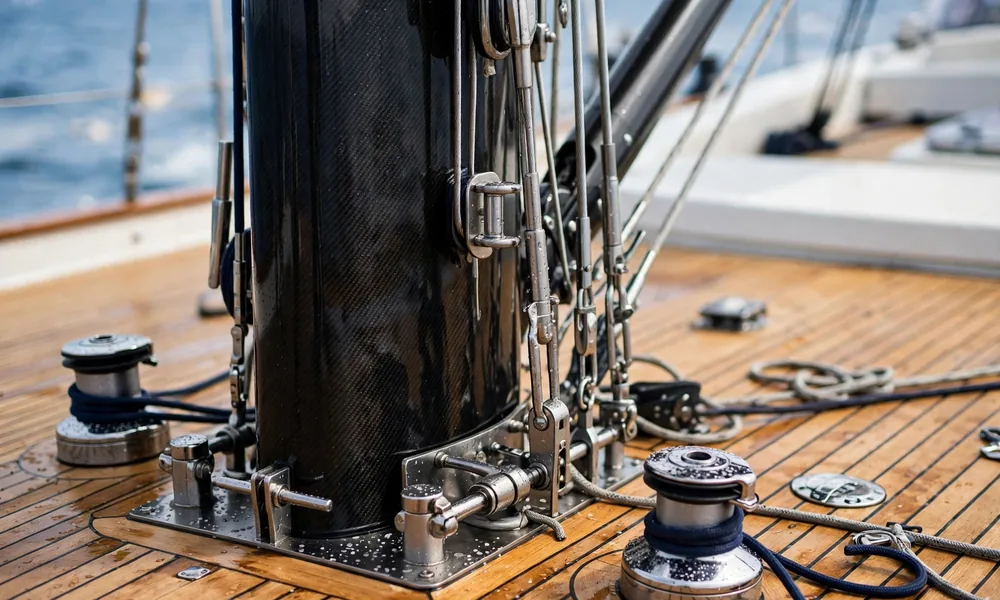
Wherever the mast meets the rest of the yacht, metal takes over: masthead crane, spreader roots, gooseneck, halyard exits. These fittings are usually titanium or 316 stainless steel, because carbon and aluminium do not get on. Put aluminium against carbon in salt water and it corrodes quickly, a reaction called galvanic corrosion. Titanium avoids the problem almost entirely, which is why it is used for the most loaded fittings despite its cost, while stainless is used where the fitting can be insulated from the carbon with glass cloth or barrier paste.
5. Aramid reinforcement, the layer that stops a crack spreading
Carbon fibre is superb in tension but brittle: hit a carbon mast hard enough and it can crack, and a crack in pure carbon can run fast. Spar makers add layers of aramid fibre, the material used in bulletproof vests, in the outer skin or around vulnerable areas like the spreader roots. Aramid does not break the way carbon does; it frays and absorbs energy, stopping a small impact from becoming a broken mast. It is a small part of the total weight, but it lets a carbon mast survive a dropped winch handle or a flogging sail that would have written off an earlier design.
6. UV-resistant clear coat, the skin that keeps the sun out
Carbon and epoxy both hate ultraviolet light. Left bare in the sun, epoxy chalks and weakens, and the mast slowly loses strength. So every carbon mast is finished with a clear coat or paint that blocks UV, usually a two-part polyurethane, and on many racing yachts the mast is painted white or silver to reflect heat. The finish must be maintained: a scratch through the clear coat is not cosmetic, it is an open door for sunlight and salt water. The rigging that pulls on the mast has its own material story, and the yacht sail rigging materials explain how the wires and ropes are chosen to match the spar. Keep the coating intact and a carbon mast lasts decades; let it go and the sun will do in a few seasons what the sea could not.
Yacht Carbon Mast Materials
| Material | Where it is used | Why it is chosen |
|---|---|---|
| Carbon fibre tow and cloth | Mast walls, laid in chosen directions | Stronger than steel in tension, far lighter |
| Epoxy resin, prepreg | Binding fibres into a solid laminate | Transfers loads, seals out moisture, cures hard |
| Foam or Nomex honeycomb core | Inside the mast walls | Stops buckling, stiff for almost no weight |
| Titanium and 316 stainless steel | Fittings, masthead, spreaders | Strong, and safe against carbon in salt water |
| Aramid fibre | Outer skin, vulnerable areas | Absorbs impact, stops cracks spreading |
| Polyurethane clear coat | Outer finish | Blocks UV, keeps the epoxy from degrading |
What Does a Yacht Carbon Mast Cost?
A carbon mast is one of the most expensive single parts of a yacht. The raw carbon fibre for a 15-metre mast is estimated at roughly $8,000 to $15,000, but the finished spar, with fittings, paint and labour, is estimated at roughly $40,000 to $90,000 for a performance cruising yacht, and several times that for a large racing yacht with a custom bend profile. A superyacht mast can cost as much as a house, which is why why a superyacht mast is so expensive runs through the labour and tooling behind the price. The saving is performance: a lighter mast means less ballast, less heel and a faster boat, and for owners chasing that, the price is the point.
A Rare Fact
The first carbon masts were so secret that makers would not let owners see them being built. In the 1980s, when carbon spars first appeared on racing yachts, layup schedules were treated like military secrets, and rival teams sent spies to photograph masts through fences. Today the technology is common, but a top racing mast is still built by hand, layer by layer, and no two are quite alike.
A yacht carbon mast looks like a simple black pole from the dock, but it is a stack of materials that each cover a weakness in the next. The carbon takes the load, the resin holds it together, the core stops it buckling, the aramid stops cracks, and the clear coat keeps the sun out. Bend it, load it, sail it hard, and it springs back.