Stand on the deck of a superyacht and look up. The mast rises above you like a tower, taller than a ten-storey building on the largest yachts, and it carries sails the size of tennis courts. It looks simple — a long pole, some wires, a few fittings — but a superyacht mast is one of the most expensive single parts of the boat. The reason is that a mast is not a pole. It is a precision structure that must be light, strong, flexible in exactly the right ways, and able to survive a storm at sea with a crew’s lives depending on it.
Everything about a mast is a compromise. It must be tall enough to carry a huge sail area, light enough not to capsize the boat, stiff enough to hold its shape in a gale, and flexible enough to bend without breaking. Here is why the price is so high.

1. Carbon Fibre: The Only Material That Will Do
For decades, yacht masts were made from aluminium, but the largest and fastest yachts now use carbon fibre, and carbon fibre is expensive. The mast is built from layers of carbon cloth laid into a mould, cured in an autoclave, and finished to a mirror smoothness — the same process that makes racing car parts, scaled up to a tube tens of metres long. Carbon fibre saves that weight, and the saving is worth the price.
2. One Mast, One Mould, One Boat
No two superyacht masts are the same. Each one is designed for a specific boat, a specific sail plan and a specific owner, which means each mast gets its own mould, its own engineering and its own build. There is no production line and no economy of scale. The naval architects who design the mast, the engineers who calculate its loads, and the builders who lay up the carbon all work on a single object that will never be repeated. Bespoke work is always expensive, and a mast is about as bespoke as engineering gets.
3. The Rigging Costs Almost as Much as the Mast
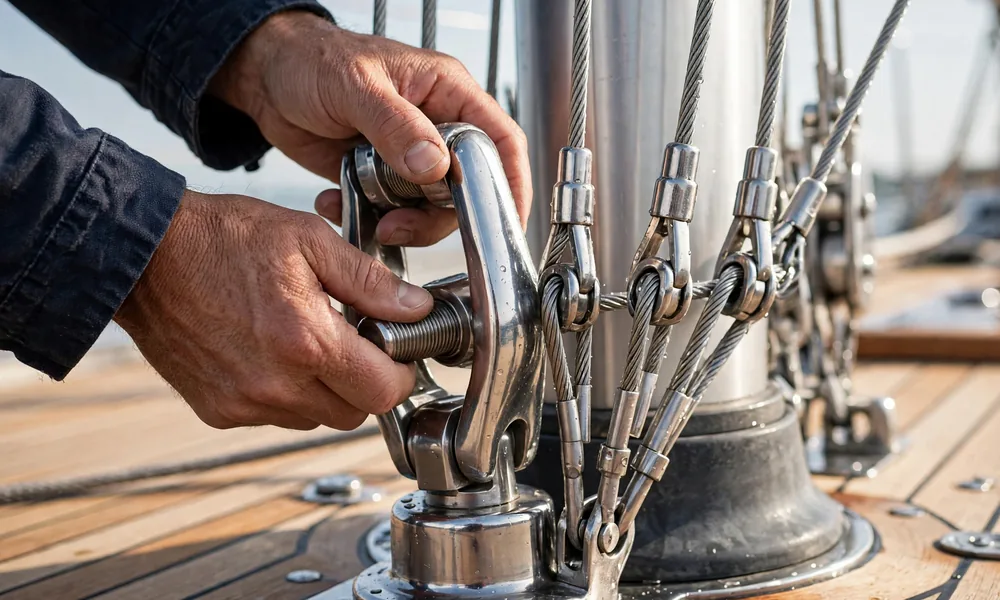
The mast is only half the system. Holding it up is the rigging: stainless steel or carbon cables, called stays and shrouds, that run from the masthead to the deck and the bow. These cables carry enormous loads — the force of a sail in a gale is measured in tonnes — and they must be strong, light and resistant to salt water. Modern rigging uses rod rigging, machined from solid stainless steel, or carbon cables that cost even more, and every fitting is a precision-machined part. The turnbuckles, the chainplates, the masthead crane and the spreaders are all custom-made, and they are all safety-critical: if a single stay fails, the mast can come down.
4. Stepping the Mast: A Crane, a Crew and a Calm Day
Getting a mast onto a yacht is a production in itself. The mast is transported horizontally on a truck or a barge, lifted by a large crane, and lowered vertically into the boat while a team of riggers guides it with ropes. The operation needs a calm day, a clear yard and a crane big enough to lift a load that is both heavy and awkwardly long. Once the mast is in place, the rigging is tensioned — a careful process of tightening each stay to a precise load, measured with gauges, so the mast stands straight and the loads are shared evenly. The story of how a superyacht mast works shows how much of the system is about tension, not just height.
5. Sails the Size of Tennis Courts
A mast is useless without sails, and the sails for a superyacht are themselves a major cost. A mainsail for a large yacht can measure hundreds of square metres, made from laminated membranes of carbon and aramid fibres, cut by computer and assembled by sailmakers over weeks. The sails are shaped to a precise aerodynamic curve, reinforced at every load point, and fitted with battens, reefing systems and furling gear that must work flawlessly in a storm. A mast that cannot carry its sails is just a pole.
6. Inspection and Maintenance Never Stop
A mast lives in salt water, under constant load, and it must be inspected regularly. Every year or two, the mast is unstepped — taken down by crane — and examined for cracks, corrosion and wear, with ultrasound and dye-penetrant testing used to find damage invisible to the eye. Rigging is replaced on a schedule, often every ten years or so, whether it looks worn or not, because a stay that fails at sea can bring the mast down and endanger the crew. The materials behind a superyacht mast explain what the inspectors are looking for.
7. Only a Handful of Builders in the World
There are very few companies in the world that can build a superyacht mast, and they are booked years in advance. The skills — carbon layup at this scale, mast engineering, rigging — live in small teams, and the facilities, from the autoclaves to the crane yards, cost a fortune to build and run. Each mast is a one-off, priced like a one-off, and the builders charge accordingly. The joinery below deck is part of the same world of bespoke craft — the materials behind superyacht interior joinery show how much of a yacht is built by hand.

Superyacht Mast at a Glance
| Specification | Detail |
|---|---|
| Height | Often 40–90 metres above the water on large sailing yachts (estimate) |
| Main material | Carbon fibre composite, cured in an autoclave |
| Weight | Several tonnes for a large mast, far lighter than aluminium (estimate) |
| Rigging | Stainless steel rod or carbon cable stays and shrouds |
| Sail area carried | Often 500–1,500 square metres across all sails (estimate) |
| Build time | Months of design and build for a single mast (estimate) |
| Service life | Decades with regular inspection, rigging replaced about every 10 years |
What Does It Cost?
A superyacht mast is priced by the project, not by the metre, but the scale is clear from the yachts that carry them. A carbon fibre mast for a large sailing superyacht can cost 1 to 5 million dollars (estimate), with the rigging, sails and fitting adding considerably more. The price reflects a one-off mould, months of skilled labour, an autoclave cure, precision rigging, a crane lift and a fitting process that needs a calm day and a specialist team. The mast is the most expensive single spar on the boat, and it is also the one the whole yacht is built around.
A Rare Fact
The tallest masts on the largest sailing superyachts are so high that they cannot pass under some bridges, and their owners must plan voyages around them. The mast of a large sailing yacht can stand more than 90 metres above the water — taller than the Statue of Liberty from base to torch. The mast is not just the most expensive part of the yacht; it is the part that decides where the yacht can go.