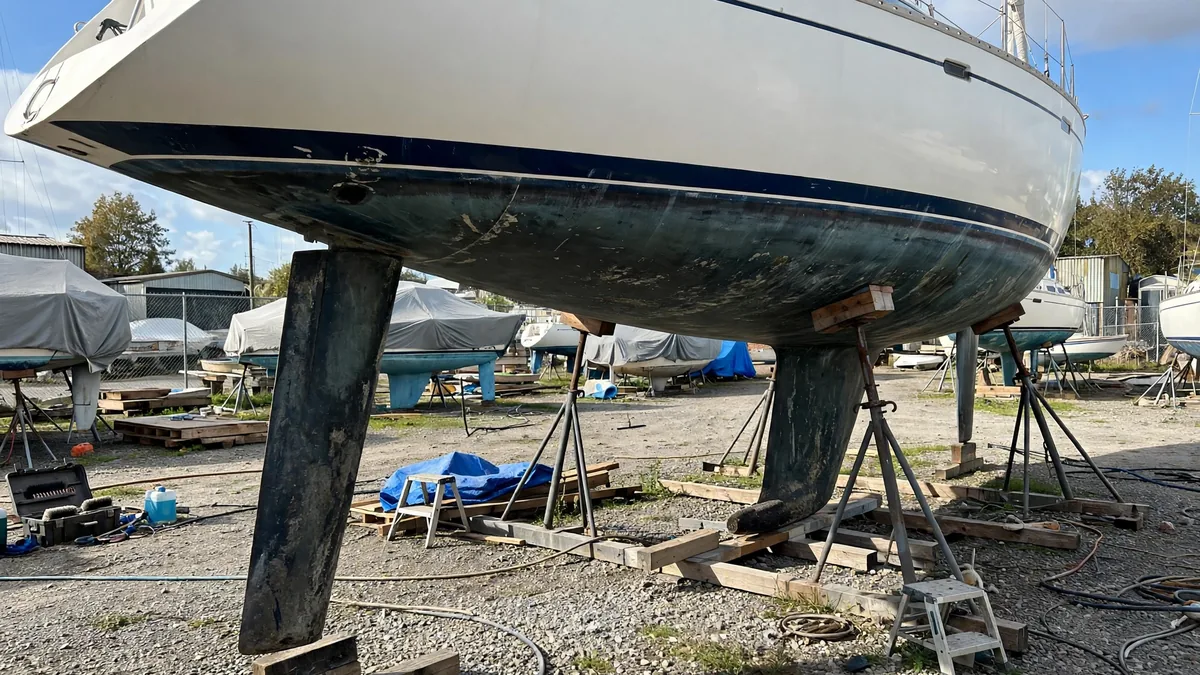
Every sailor knows the moment: the wind fills the sails, the yacht heels, and for a second it feels as though the boat might just keep going over. It never does. Below the waterline, hidden from view, a heavy fin keeps the yacht upright, pulling the centre of gravity down low and turning the wind’s push into forward motion instead of a capsize.
That fin is the keel, the least glamorous and most important part of a yacht. It is also the simplest by weight: mostly a lump of metal, cast into a fin or bulb and bolted to the hull’s bottom. But the choice of that metal, and how it is attached and protected, decides whether the yacht stays upright in a storm or loses its keel altogether, and that has happened, with terrible results.
Here is what they are, and why each one earned its place.
The Materials Behind the Yacht Keel
1. Lead, the heavy metal that keeps yachts upright
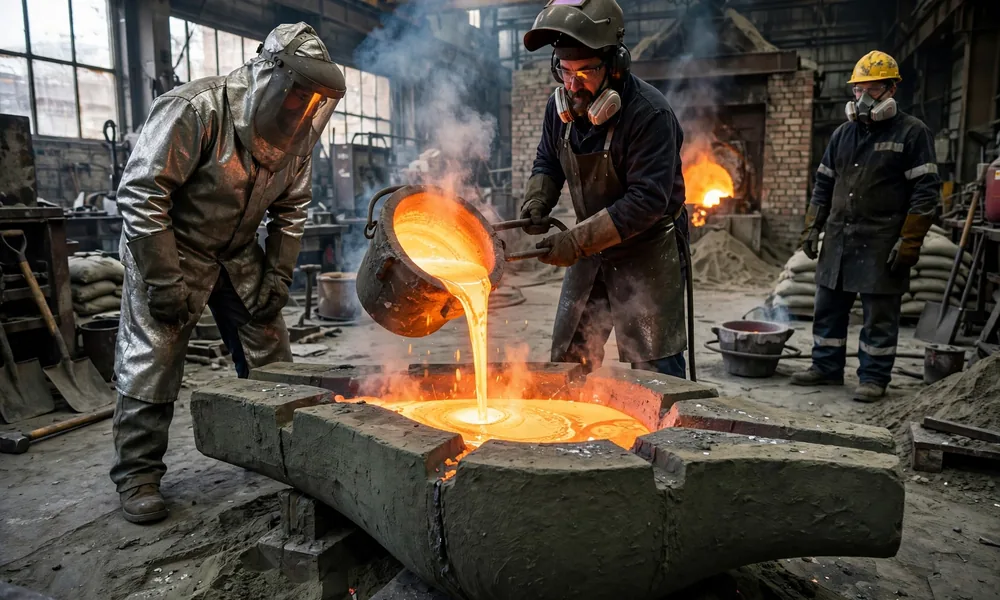
Most modern yacht keels are lead, for density: lead weighs about eleven times as much as water, so a keel can carry huge weight in a small, low volume, as deep as possible. A lead keel is usually cast as a bulb, or a fin with a bulb at the bottom, and the shape is tuned like a wing, to give lift as well as weight. Lead is also soft, a virtue in a grounding: it deforms instead of cracking, and can be hammered back into shape. Its weakness is cost, and its handling is hazardous, which is why it is cast in a foundry, not a boatyard. The full account of how fin and bulb are built is in how a yacht keel is made, from mould to first lift onto the hull.
2. Cast iron, the cheaper keel that still sails
Older and cheaper yachts often have cast iron keels: iron is about two-thirds the density of lead, so an iron keel must be bigger for the same weight, and it rusts, which lead does not. Builders accept the trade-off: iron is far cheaper and easier to cast, and a well-kept iron keel can last the life of the boat. The catch is maintenance: the keel must be sandblasted, primed and painted regularly, and any chip lets rust start underneath, lifting the paint in blisters.
3. Steel, the fin that carries the bulb
Many modern keels are not a solid lump at all, but a steel fin, a flat plate of high-strength steel, with a lead bulb bolted to the bottom. The steel carries bulb and bending loads into the hull, while the lead does the ballasting. The fin is usually welded from plate and faired smooth, so it cuts through the water cleanly. Steel fins are thinner than cast keels, which makes the yacht faster, but they are more highly loaded, and one bent in a grounding must be checked carefully, because steel can crack where lead would only dent. The fin’s shape is part of the yacht’s hydrodynamics, and the fins that steady a yacht work on the same principles, as the yacht stabilizer fins materials explain.
4. Stainless steel keel bolts, the fixings that must never fail
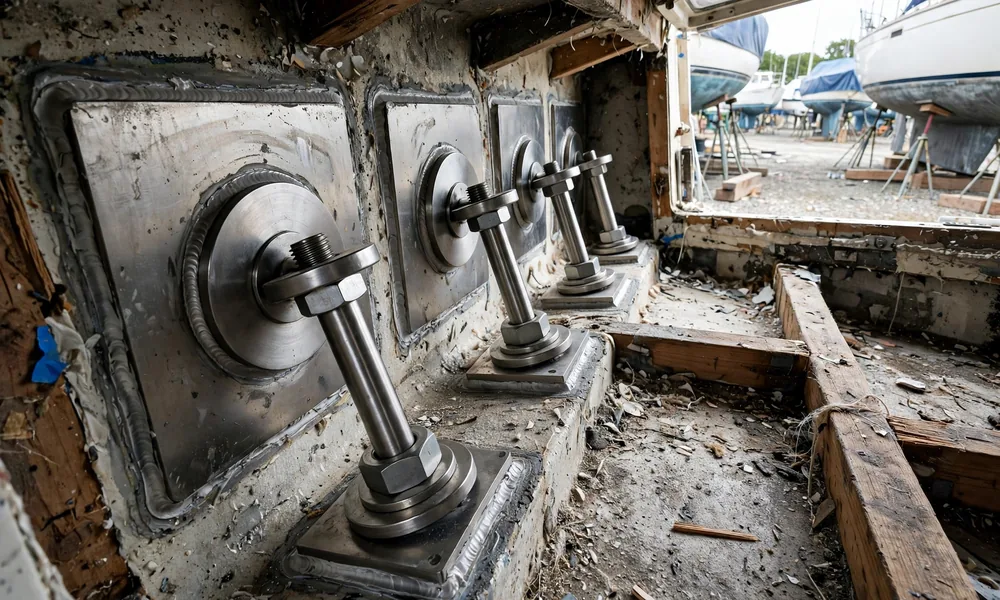
The keel is bolted to the hull, and those bolts are the most safety-critical fasteners on the yacht: usually large stainless steel studs, often 316 grade, set through the hull into a reinforced stub, with big backing plates to spread the load. The bolts must survive constant immersion, cyclic loading as the yacht heels and slams, and groundings that try to tear the keel off. They are inspected at every haul-out, and any sign of crevice corrosion, the hidden attack that eats stainless steel where oxygen cannot reach, means replacement. There is no redundancy: if enough bolts fail, the keel falls off, one of the few failures at sea that is almost always fatal.
5. Composite fairing, the smooth skin over the metal
A raw cast keel is rough, pitted and far from the smooth foil shape the designer intended, so it is faired: coated with epoxy filler, sanded to profile, and finished with a hard epoxy barrier coat. On some racing yachts the keel is a composite shell over a steel frame, lead inside, giving the designer complete freedom over the shape. The fairing is not cosmetic: a rough keel creates drag, and a fairing damaged by a grounding can let water in and start corrosion underneath.
6. Antifouling paint, the coat that keeps the keel clean
The last layer is antifouling paint, which matters more than it looks: a keel covered in weed and barnacles is slower, and on a fin keel the growth can change the foil shape enough to spoil the yacht’s balance. The paint is usually copper-based antifouling, as on the hull, over an epoxy barrier coat. The keel is repainted at every haul-out, the old paint sanded back, which is also when it is inspected for damage, rust or loose bolts. The stabilizer fins beside it are priced the same way, and why yacht stabilizer fins are so expensive shows how much of a yacht’s underwater gear is really precision engineering in a hostile environment.
Yacht Keel Materials
| Material | Where it is used | Why it is chosen |
|---|---|---|
| Lead | Keel bulb and fin casting | Very dense and compact, deforms rather than cracks |
| Cast iron | Keels on older and cheaper yachts | Cheap and easy to cast, but rusts and needs paint |
| High-strength steel | Fin carrying a lead bulb | Thin, stiff, carries bending loads into the hull |
| 316 stainless steel | Keel bolts and backing plates | Strong, resists salt water, carries the keel |
| Epoxy filler and barrier coat | Fairing the keel to its foil shape | Smooths the casting, seals out water, cuts drag |
| Copper antifouling paint | Outer coat on the keel | Stops weed and barnacles, keeps the foil clean |
What Does a Yacht Keel Cost?
A keel is priced by its metal, and lead is not cheap: the lead for a 12-metre yacht’s keel is estimated at roughly $3,000 to $6,000, and the finished keel, cast, faired and bolted on, is estimated at roughly $8,000 to $20,000, depending on size and shape. A steel fin with a lead bulb costs more, the welding and fairing being labour-intensive, and a racing keel with a composite shell can be estimated at roughly $30,000 to $60,000. The keel bolts alone are estimated at roughly $1,000 to $3,000 a set, the one part of the bill no owner should try to save money on.
A Rare Fact
One of the fastest yachts ever built had a keel of depleted uranium, a metal nearly twice as dense as lead. It was banned almost immediately, not because it was radioactive in any meaningful way at that thickness, but as an unfair advantage and a hazard if the boat was lost.
A yacht keel looks like a lump of metal from the dock, but it does the most with the least. The lead pulls the boat upright, the steel carries it, the bolts hold it, and the paint keeps it clean. Keep them sound and the yacht will stand up to the worst the wind can do. Let one go, and the wind will win.


