Every superyacht has a small boat hiding somewhere, usually tucked into a garage in the stern or hanging from davits on the deck, and it is the hardest-working boat on board. It ferries guests ashore, carries shopping and luggage, tows the water toys, and runs errands in weather the big yacht would never notice. It gets beached, bumped against docks, and left in the sun for months. It has to be light enough to lift, tough enough to abuse, and pretty enough to sit beside a hundred-million-dollar yacht without embarrassing it.
That boat is the tender, and its materials are a balancing act no other boat has to perform. It must be rigid like a yacht and soft like a dinghy, carry an outboard and a dozen people, and weigh less than a small car. The answer is a mix of rubber, fibreglass, carbon and teak that looks simple and is anything but.
Here is what a superyacht tender is made of, and why each material earned its place.

The Materials Behind the Superyacht Tender
1. Hypalon and PVC, the tubes that bounce instead of breaking
The most recognisable part of a tender is its tubes, the fat inflatable collar around the hull, and they are made from Hypalon, a synthetic rubber, or PVC, a tough plastic fabric. Hypalon, properly called chlorosulfonated polyethylene, is the premium choice: it resists sunlight, salt, fuel and abrasion for a decade or more, and it stays flexible in the cold. PVC is cheaper and lighter, and it welds cleanly, which makes repairs easy, but it ages faster in tropical sun and can go stiff after years of ultraviolet exposure. The tubes are separate air chambers, so one puncture never sinks the boat, and they let it bounce off docks and rocks with a scuff. The tubes also spread the weight wide, so the tender feels steady with a dozen people aboard.
2. GRP and carbon fibre, the hull that carries the load
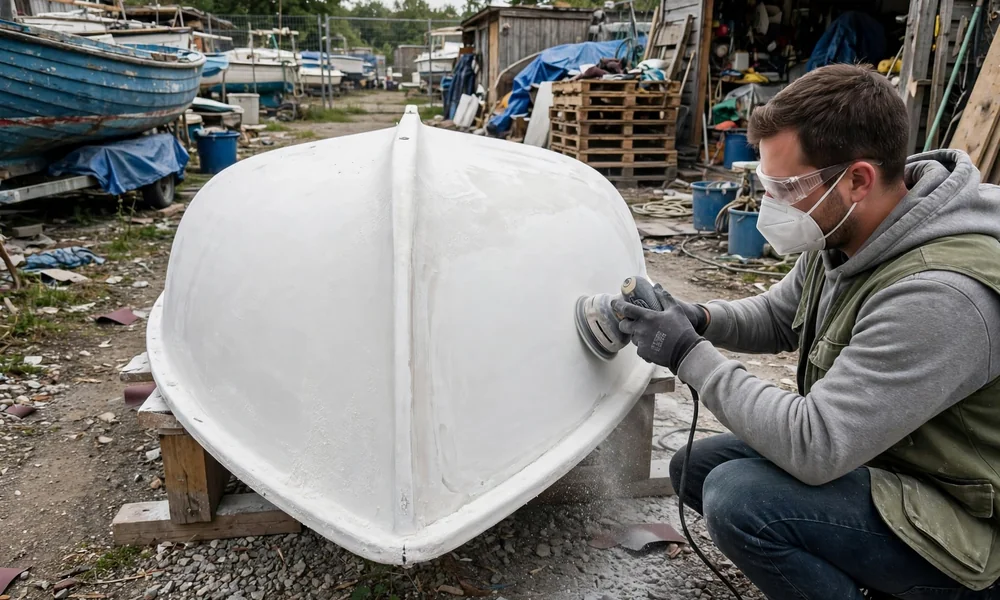
Below the tubes is a rigid hull, usually glass-reinforced plastic, or GRP, and on the most expensive tenders, carbon fibre. GRP is fibreglass cloth set in resin, light, strong, and easy to mould into the deep-V shape that lets a tender cut through chop without slamming. It does not rust or rot, and any boatyard can repair it. Carbon fibre does the same job at half the weight, which matters for a crane with a strict limit, but it costs several times as much. The deck and floor have a foam core, stiff underfoot without adding weight. A yacht’s own teak deck of a yacht sits on GRP for the same reasons.
3. Teak, the deck that grips and looks the part
The deck of a superyacht tender is often teak, laid in narrow strips over the GRP floor. Teak is chosen for two reasons that rarely come together: it grips when wet, so guests do not slip stepping aboard in bare feet, and it looks right beside a superyacht, whose own decks are teak. Teak is naturally oily, so it resists rot and salt water without varnish, and it stays cool enough to walk on in the sun. It is heavy and expensive, so on a tender it is a deck and a few trim pieces. Synthetic teak is appearing on some tenders: similar looks, no oiling, less weight.
4. Aluminium and stainless steel, the fittings that survive salt
Every fitting on a tender, the cleats, the lifting eyes, the fuel tank, the steering console, is aluminium or stainless steel, because anything else would rust within a season. Grade 316 stainless steel is used for cleats and fastenings: strong, salt-proof, and polished to match the yacht. Aluminium is used for the fuel tank, the console frame and the outboard bracket, where weight matters more than polish. The lifting eyes are bolted through the hull into backing plates: the whole boat hangs from them at every launch. A failed lifting eye is how tenders end up on the seabed.
5. The outboard engine, aluminium and the power behind the boat
Most superyacht tenders are driven by an outboard engine, and the outboard is itself a study in materials: an aluminium alloy block and cowling, stainless steel shafts, and a propeller that may be aluminium or stainless steel depending on the power. The aluminium is anodised and painted against salt, and the engine is hosed down after every use. The propeller turns the engine’s power into thrust, and the bronze and steel of a yacht’s own propeller face the same salt-water battle on a bigger scale, as the story of the yacht propeller explains. On a tender the outboard is usually 40 to 150 horsepower, enough to plane with a full load.
6. Foam, fabric and the details that make it a yacht’s boat
Inside the tubes and under the floor is closed-cell foam, which keeps the tender afloat even if the hull is holed, and the seating is marine vinyl over foam, chosen because it dries fast and does not grow mould. The ropes are braided polyester or Dyneema, a fibre stronger than steel for its weight. Even the fenders are soft, so the tender never scratches the yacht it serves. The tender is the yacht in miniature, and the same seamanship that rigs a yacht’s sails governs its lines and strops, which is why the rigging of a yacht sail is worth knowing before you handle a tender’s ropes.
| Material | Where it is used | Why it is chosen |
|---|---|---|
| Hypalon rubber | Inflatable tubes, premium tenders | Resists sun, salt and fuel for a decade or more |
| PVC fabric | Inflatable tubes, lighter tenders | Cheaper, lighter, welds cleanly for easy repair |
| GRP fibreglass | Hull and deck | Light, strong, easy to mould and repair anywhere |
| Carbon fibre | Top-spec hulls | Half the weight of GRP, but costly and specialist to repair |
| Teak | Deck and trim | Grips when wet, resists rot, matches the mother ship |
| 316 stainless steel | Cleats, hinges, fastenings | Strong, resists salt water, polishes beautifully |
| Aluminium alloy | Fuel tank, console, outboard | Light, rust-proof, easy to shape |
What Does a Superyacht Tender Cost?
A superyacht tender is priced by its hull and its finish. A good production rigid inflatable tender is estimated at roughly $30,000 to $150,000, depending on size and engine, and a custom carbon-fibre tender built to match a specific yacht is estimated at roughly $250,000 to $600,000. A new set of tubes is estimated at roughly $8,000 to $25,000, replaced every seven to twelve years. The outboard adds an estimated $8,000 to $25,000, and relaying the teak deck is estimated at roughly $5,000 to $15,000. That is the price of being both tough and beautiful.
A Rare Fact
The tender is the most-used boat on a superyacht, launched and recovered dozens of times in a single season, and the tubes are the part that wears out first, not the hull. A GRP hull can last thirty years while its tubes are replaced three times, which is why crews judge a tender by its tubes.

A superyacht tender looks like a toy beside its mother ship, but it is a serious boat built from serious materials. The rubber tubes bounce, the fibreglass hull carries, the teak grips, and the stainless steel holds it all together in salt water. Treat it as the working boat it is, and it will ferry you ashore for decades.


