Ask a sailor what keeps a yacht safe and they will name the keel, the rig or the engine. Almost nobody mentions the rudder. The rudder is the one part of the boat that does its job silently, underwater, out of sight, for years at a time, until the day it does not. Then, suddenly, it is the only part that matters. A yacht without a working rudder goes wherever the wind decides.
The rudder is a blade, a shaft and bearings, living permanently underwater in salt, under loads that change with every wave. The materials it is made from decide whether it steers sweetly for twenty years or snaps off on a dark night in a storm. This is the story of those materials.
Here is what a yacht rudder is made of, and why each material earned its place.

The Materials Behind the Yacht Rudder
1. GRP and foam, the blade that must be light and stiff
The rudder blade itself is usually glass-reinforced plastic, GRP, built around a foam core. The GRP skins are laid up in a mould in a wing shape: the foil generates lift, and that lift turns the boat. The foam core holds the two skins apart, making the blade stiff without adding weight, the same sandwich construction used in the hull and the deck. GRP is chosen because it does not rust, it can be moulded into a precise foil shape, and it can be repaired in any boatyard. Even if the skin cracks, the foam stops the blade filling with water and getting heavy. Racing yachts use carbon blades, stiffer and lighter, but carbon is brittle in a grounding. A well-shaped blade steers with two fingers; a badly shaped one fights the helm all day.
2. Stainless steel, the stock that carries the load
The rudder stock, the shaft joining blade to steering, is almost always grade 316 stainless steel. The stock is the most highly loaded part of the whole rudder: every tonne of force the blade generates passes through it, and it also carries the weight of the blade itself. Stainless steel is strong, salt-proof, and machinable to the tight tolerances the bearings demand. It is welded to a steel armature inside the blade, which spreads the load so the blade does not twist off the stock. A stock too thin will bend in a broach and jam the rudder. The keel below it carries the same kind of load, and the yacht keel shows how lead, steel and bolts work together to carry weight that would crush lesser materials.
3. Bronze, the fittings that never rust
The fittings on a rudder, the gudgeons and pintles on older boats, the bearing housings and the propeller shaft bracket on modern ones, are often bronze. Bronze does not rust in salt water, and it is compatible with stainless steel, so the two do not eat each other. The propeller above the rudder is bronze for the same reason, and the story of the yacht propeller explains why bronze has survived a century of new materials. On a rudder, bronze is used where a part must be strong, precise, and left underwater for years. It is costly, so it is used sparingly.
4. Bearings, the quiet parts that decide how the helm feels
The stock turns in two bearings: one where it enters the hull, one at the bottom of the skeg. The bearings are often made from a self-lubricating plastic such as Delrin or Vesconite, a hard, slippery material that needs no grease and does not swell in water. Plastic bearings last longer than the old greased bronze ones, need no maintenance, and give a lighter helm. The top bearing is sealed with a lip seal and packing gland against leaks. A good bearing is invisible; a worn one clunks, the boat wanders, and the autopilot works twice as hard. The fins that steady a yacht face the same bearing problem, and yacht stabilizer fins use the same thinking to keep their hydraulics moving smoothly in salt water.
5. Epoxy and antifouling paint, the skin that keeps the water out
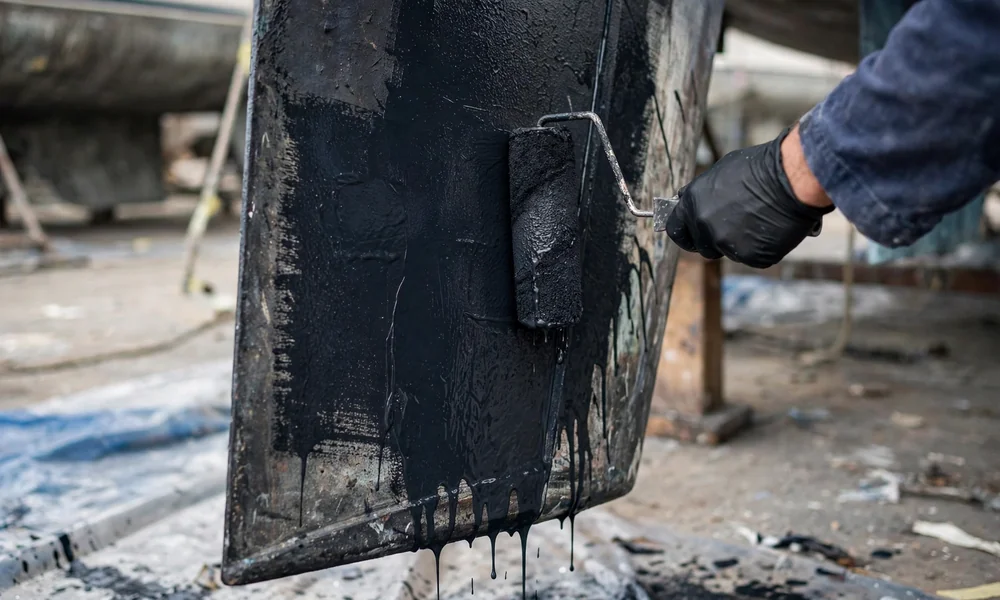
The blade is sealed with epoxy, a resin that soaks into the GRP and locks out water, and then painted with antifouling paint, the dark, rough coat that stops weed and barnacles growing on the blade. Antifouling slowly releases copper to stop weed settling, and must be renewed every year or two: weed destroys the foil shape and doubles steering load. The epoxy barrier coat matters just as much: unsealed GRP absorbs water, blisters, and weakens.
6. The tiller or wheel, the part the sailor touches
At the top of the stock is the steering itself: a tiller, usually laminated wood or aluminium, or a wheel, usually stainless steel with a wooden or leather rim. A wooden tiller is warm, flexes slightly to absorb shock, and tells the sailor what the rudder is doing. A wheel is used on larger yachts, where the leverage of a tiller is not enough, and it connects to the stock through cables or a hydraulic system. Either way, the steering is the sailor’s only connection to the blade, chosen for feel as much as strength.
| Material | Where it is used | Why it is chosen |
|---|---|---|
| GRP fibreglass | Rudder blade skins | Moulds into a precise foil, does not rust, easy to repair |
| Foam core | Inside the blade | Stiffens the blade without weight, stays afloat if holed |
| 316 stainless steel | Rudder stock and armature | Strong, salt-proof, machined to bearing tolerances |
| Bronze | Fittings and bearing housings | Never rusts in salt water, compatible with stainless steel |
| Delrin and Vesconite | Rudder bearings | Self-lubricating, no grease, light helm with no play |
| Epoxy and antifouling | Blade coating | Seals out water, stops weed destroying the foil shape |
| Wood and leather | Tiller and wheel rim | Warm, flexible, transmits feel from the blade |
What Does a Yacht Rudder Cost?
A yacht rudder is priced by its size and its stock. A GRP rudder blade for a mid-sized yacht is estimated at roughly $2,000 to $8,000, depending on size and shape, and a stainless steel stock is estimated at roughly $1,500 to $5,000. The bearings add an estimated $500 to $2,000, and a full replacement, blade, stock, bearings and antifouling, fitted and aligned, is estimated at roughly $8,000 to $25,000. That is a lot for a part nobody sees, but cheap against losing steering at sea.
A Rare Fact
The rudder is the only underwater part a skipper can break without hitting anything. In a hard broach in heavy weather, when a wave throws the stern sideways and the sails fill with a bang, the load on the rudder can spike to several tonnes in a single second, enough to bend a stainless steel stock or tear a blade off its frame. It is a common reason for rescue at sea, and why sailors inspect the rudder at every haul-out.

A yacht rudder looks like a simple fin, a flat blade under the stern, but it is a chain of materials each doing a job the others cannot. The GRP blade makes the lift, the steel stock carries it, the bronze fittings survive the salt, the plastic bearings keep the helm light, and the paint keeps the shape clean. Check them every haul-out, and the rudder will steer you home for decades.


