The surgeon watched the robot arm hover over the patient and felt, for the first time in a long career, almost unnecessary. The arm moved with a patience no human hand could match, pausing for a fraction of a second, adjusting by a distance smaller than the width of a hair, and then continuing its work as smoothly as water finding its way downhill. It did not tremble, it did not tire, and it did not rush. In the corner of the room, a second arm was assembling a watch movement, placing gears the size of grains of sand into a case worth more than a house. Two very different jobs, one shared machine: a luxury robot arm, the most precise hand ever built.
A robot arm is easy to misunderstand. People picture a clumsy metal limb from a car factory, all noise and jerking motion. A luxury arm is the opposite. It is quiet, it is fast, and it is accurate to a fraction of a millimetre, again and again, for years at a time. It builds the circuit boards in your phone, polishes the lenses in a telescope, and handles materials that would shatter if a human finger touched them. The price of the best arms runs into six figures, and the reason is not the metal. It is the numbers: the repeatability, the payload, the reach, and the speed, all held together at once.
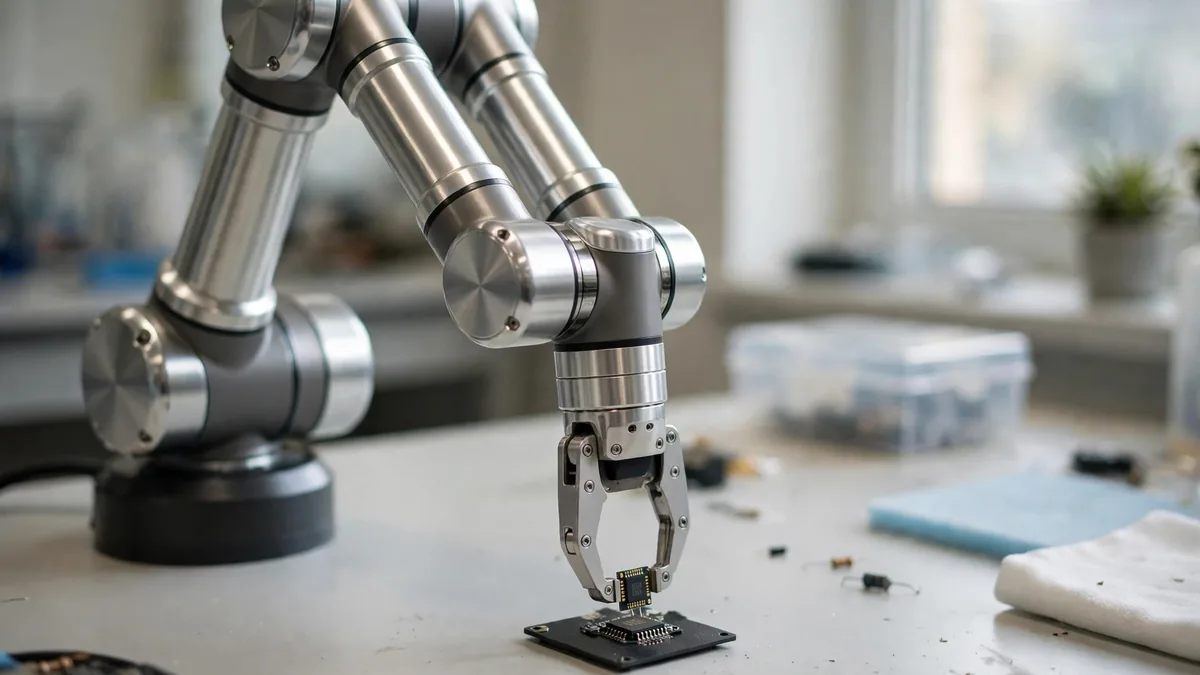
The Numbers That Matter
| Specification | Detail |
|---|---|
| Axes | Six joints, giving the arm the same freedom of movement as a human shoulder, elbow and wrist, able to reach around obstacles and work from almost any angle |
| Reach | Typically 800 to 1,300 millimetres from base to fingertip, with compact models shorter and large workshop arms reaching further |
| Payload | An estimated 5 to 20 kilograms at the wrist for a luxury precision arm, carried without losing accuracy or speed |
| Repeatability | Around 0.02 to 0.05 millimetres, meaning the arm returns to the same point with an error smaller than a human hair |
| Speed | Joint speeds of up to 300 degrees per second, with the tip of the arm moving faster than the eye can easily follow |
| Drive | Harmonic-drive gearboxes at every joint, with almost no backlash, paired with high-torque servo motors and absolute encoders |
| Weight | An estimated 25 to 60 kilograms for the arm itself, built from machined aluminium and steel, mounted on a rigid base |
| Control | Real-time controller updating the position of every joint hundreds of times per second, with force sensing at the wrist |
| Protection | Sealed joints rated against dust and liquid, so the arm can work in clean rooms, food plants and wet workshops |
| Price | An estimated $50,000 to $250,000 for a complete luxury arm with controller, depending on reach, payload and accuracy |
How It Works
Step 1: The controller plans the path
Every movement begins in the controller, a small computer that knows the exact position of every joint and the shape of everything around the arm. The operator gives it a target, such as the centre of a circuit board, and the controller works out how each of the six joints must turn to get the gripper there. It plans a smooth path that avoids obstacles, keeps the arm balanced, and never asks a joint to move faster than it safely can. The whole calculation takes a fraction of a second.
Step 2: The servo motors drive the joints
Each joint is driven by a servo motor, a motor that knows exactly how far it has turned. The controller sends each motor a stream of tiny commands, hundreds every second, and the motor follows them precisely. If anything pushes the arm off course, the motor corrects it before a human eye could notice.
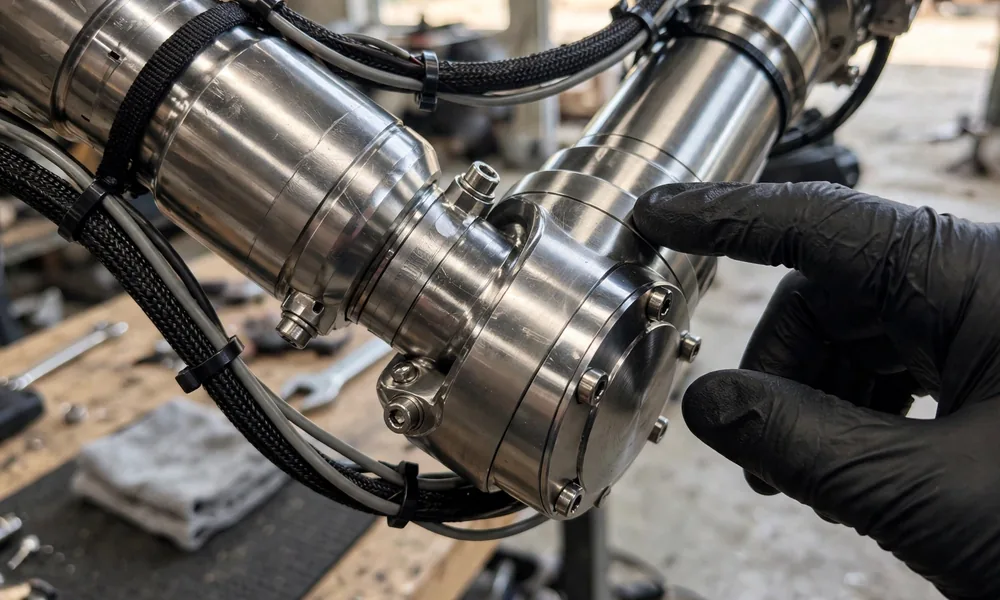
Step 3: The encoders report the true position
On every joint sits an encoder, a sensor that measures the exact angle of the joint in real time. The controller compares what the encoder reports with where the joint should be, and if there is any difference at all, it corrects it instantly. This closed loop is what gives the arm its famous repeatability: it is not guessing where it is, it is measuring, all the time.
Step 4: The wrist feels what it touches
At the end of the arm, between the last joint and the gripper, sits a force and torque sensor. It measures how hard the arm is pushing and twisting, many times per second, and it lets the arm handle fragile things gently. Polishing a lens, the arm presses with a feather-light, perfectly even force. Picking up a glass vial, it grips just hard enough and no harder. If the arm bumps into something unexpected, the sensor feels it and the arm stops before anything is damaged.
Step 5: The gripper holds the work
The gripper is the arm’s hand, and luxury arms use grippers that can be swapped in seconds: two-finger grippers for small parts, vacuum cups for flat glass and circuit boards, delicate tweezers for watch components. Some grippers sense the size of the object they hold and adjust their grip automatically. The best workshops keep a whole rack of them beside the arm, and the arm changes its own hand between jobs without a person touching it.
Step 6: The whole system learns and repeats
Once a job is programmed, the arm repeats it exactly, hour after hour, without drifting. Modern luxury arms go further: they record every movement, and if a part is slightly out of position, a camera at the wrist sees it and the arm adjusts on the fly. The result is a machine that does not just repeat, it adapts, and it keeps its accuracy for years because the gearboxes and bearings are built to survive millions of cycles without wearing loose.
The same precision thinking runs through other luxury machines. Our guide to how a luxury drone is made shows how tiny motors and sensors are assembled to similar tolerances, and how a luxury 3D printer is made explains the frame and motion system that a robot arm often works beside. For another study in precision engineering, the luxury carbon-ceramic brake specs show how exact numbers change what a machine can do.
What It Costs
A complete luxury robot arm costs an estimated $50,000 to $250,000, and the spread is mostly about accuracy and reach. The gearboxes alone can cost more than a family car, because only a handful of factories in the world can make harmonic drives to the required precision, and each one is tested individually before it ships. Then come the servo motors, the encoders, the force sensor and the controller, each of them built to tolerances that would be absurd in a normal machine. The buyers are not paying for a metal arm. They are paying for the guarantee that it will place a part exactly where it belongs, ten thousand times a day, for a decade.
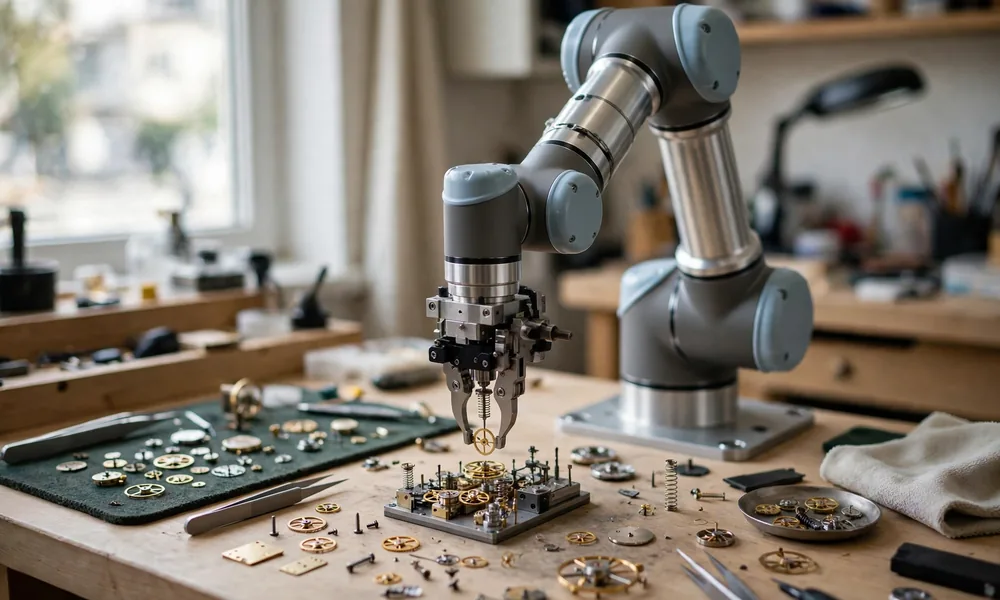
A Rare Fact
Here is the detail that surprises most people: the most precise robot arms in the world are so accurate that their own weight is a problem. When a long arm reaches out horizontally, gravity bends its metal by a measurable amount, enough to miss a target by a fraction of a millimetre. So the controller carries a mathematical model of the arm’s own flexing, and it deliberately aims slightly high to compensate, the way a marksman aims above a distant target. The arm is, in effect, correcting for its own sag in real time, and it does it so well that the error left behind is smaller than the thickness of a sheet of paper.


