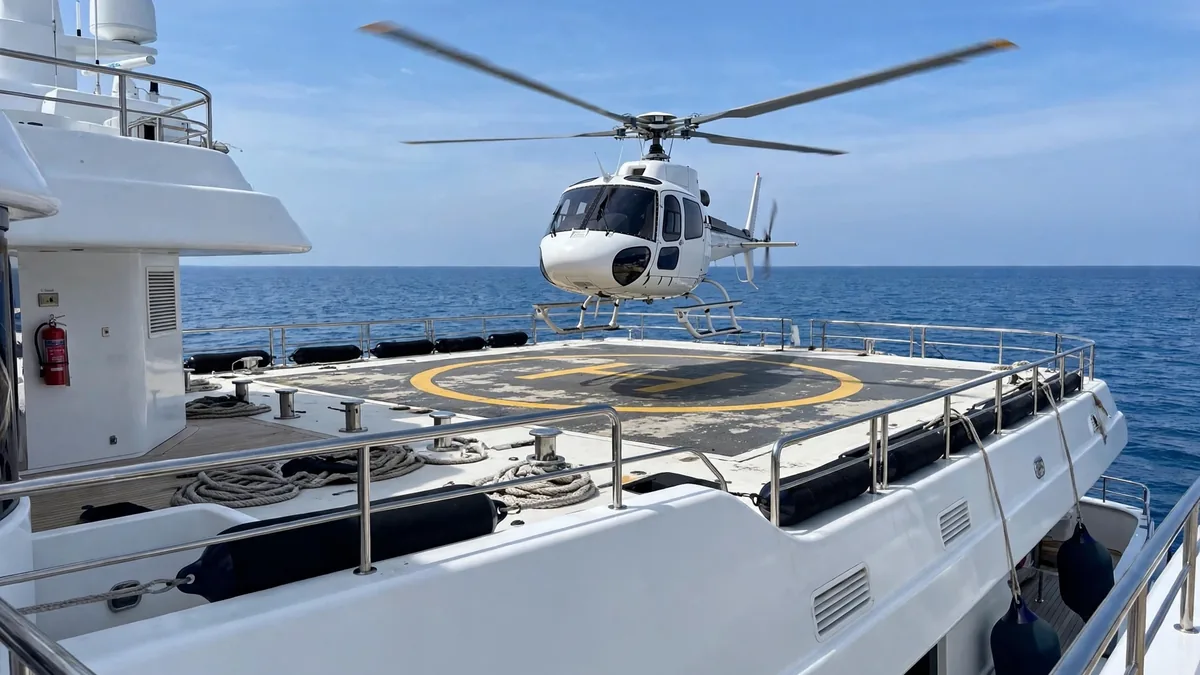
The superyacht is rolling gently in a swell off the coast, and the helicopter approaching it is the size of a small bus. The pilot lines up on a circle painted on the deck, no wider than the rotor blades above him, while the yacht’s crew stand ready with fire hoses and tie-down straps. The deck beneath him is moving, the wind is gusting off the sea, and there is no second runway. He descends, touches down, and the helicopter is held fast within seconds.
That landing pad is a superyacht helicopter deck, known in the industry as a helideck, and it is far more than a flat patch of deck with a painted circle. It is a working airfield squeezed onto a moving ship: a certified landing surface, a fire station, a fuel store, and a hangar, all built to take the weight and the violence of a helicopter landing at sea.
Building one on a yacht means solving problems that land-based helipads never face. The deck moves, the wind is unobstructed, salt eats everything, and the space is shared with sunbathers, tenders, and swimming pools. Here is how it all works.
How It Works
Step 1: The deck itself takes the weight
The helideck is a reinforced platform, usually at the bow or on the upper deck, built into the yacht’s structure. Its surface is aluminium or steel, coated with a non-slip finish, and it is designed to take the full weight of the helicopter plus the shock of a hard landing, often rated for a machine of up to 7 or 8 tonnes. The painted circle, the touchdown and lift-off area, is sized to the rotor diameter of the largest helicopter the deck is certified for, and its markings are kept clean and bright so the pilot can judge his position at a glance. Building such a deck is a costly exercise, as why superyacht helicopter deck is so expensive explains.
Step 2: Nets, lights, and tie-downs
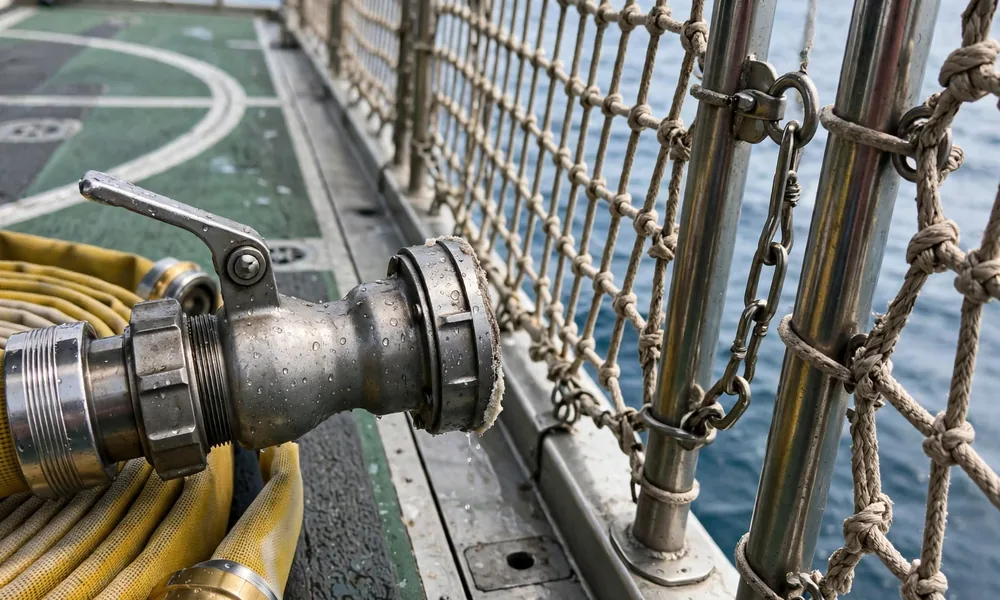
Around the landing circle is a safety net, a ring of strong netting that catches anything, or anyone, that slides towards the edge. The deck is fitted with recessed tie-down points, small steel eyes set flush into the surface, and the moment the helicopter lands, the crew run in with straps and chains to lash it down before the next wave rolls the yacht. At night, the deck is lit by perimeter lights set flush into the surface and a floodlight system that does not blind the pilot.
Step 3: Firefighting on standby
Every helideck carries its own firefighting system, because a helicopter carries fuel, hot exhausts, and spinning blades, and there is nowhere to run on a yacht. Foam monitors, hoses, and extinguishers are stationed around the deck, and a fixed foam system can flood the landing area in seconds. The crew train for the moment a landing goes wrong: a fuel spill, a fire, a rotor strike. Safety rules demand that the yacht’s crew, not the helicopter’s, handle the deck, and they rehearse the drill again and again.
Step 4: Fuel and the hangar below
Many large yachts carry aviation fuel, stored in dedicated tanks deep in the hull, away from accommodation and the engine room. Fuel is pumped up to the deck through sealed lines, and the helicopter is refuelled by trained crew using bonded hoses that prevent static sparks. Some yachts also have a hangar, a garage below or beside the deck where the helicopter can be stored out of the salt air, lowered on a lift or wheeled in on rails. Storing a helicopter at sea takes planning, much like stowing the yacht’s other heavy equipment, as how yacht anchor system works shows.
Step 5: Landing on a moving ship
The landing itself is a partnership between the pilot and the yacht’s captain. Before the helicopter arrives, the captain turns the yacht into the wind and holds a steady course and speed, giving the pilot a stable platform and a predictable wind. If the motion exceeds the helicopter’s limits, the landing is delayed or called off. The whole operation is choreographed by radio, and it happens in minutes.
Step 6: Certification and the rules
None of this is informal. A yacht helideck must meet the standards of a classification society and the aviation authority of its flag state, covering the deck strength, the firefighting system, the lighting, the fuel installation, and the crew training. The yacht’s crew must hold helicopter landing officer qualifications, and the yacht must carry the right insurance. The rules exist because a helideck is an airport, and an airport on a moving ship is one of the most demanding pieces of engineering on any yacht. The mast above the deck, carrying antennas and lights, must also be built to survive the rotor wash, and its specifications are laid out in superyacht mast specs explained.
| Deck rating | Typically up to 7 or 8 tonnes, helicopter dependent |
| Surface | Non-slip coated aluminium or steel, slightly cambered |
| Safety net | Ring of strong netting around the landing circle |
| Tie-downs | Recessed steel points, strapped within seconds of landing |
| Firefighting | Foam monitors, hoses, extinguishers, fixed foam system |
| Fuel | Dedicated aviation fuel tanks with bonded refuelling hoses |
| Lighting | Flush perimeter lights and floodlights for night landings |
| Certification | Classification society and flag-state aviation approval |
What Does a Superyacht Helicopter Deck Cost?
A helicopter deck is estimated to add roughly $2 million to $10 million to a superyacht’s build cost, depending on the size of the yacht, whether a hangar is included, and the weight of helicopter it must take. The deck structure, the firefighting system, the fuel installation, and the certification all add up, and a hangar with a lift can cost as much as the deck itself. The price is repaid in freedom: a yacht with a helideck can pick up guests from an airport and have them aboard within the hour, and it can reach anchorages no road ever will.
A Rare Fact
The first yacht helidecks were little more than a painted circle on a reinforced hatch, and pilots landed on them at their own risk, with no nets, no foam, and no certification. The rules that govern helidecks today were written in response to accidents, and they are strict for a reason: a helicopter landing on a moving ship combines two of the most unforgiving environments in transport, the sea and the air. Modern helidecks are among the most regulated square metres on any yacht, and the crew who run them train as seriously as any airport fire team.

The next time a helicopter settles onto a yacht’s deck, it is worth remembering what is under the pilot’s feet. The deck looks like a painted circle. In reality it is a small airport, a fire station, and a fuel depot, all sharing a few square metres of a moving ship, and it works because every part of it was built for the worst day, not the best.


