Hold a sheet of it in your hand and it feels wrong. It is a fabric, soft enough to fold, light enough to lift with two fingers — and yet it can stop a bullet, hold a racing boat together, and survive temperatures that would melt most metals. A vest made from it weighs less than a winter coat. A panel made from it can be thinner than a coin and still be trusted with a human life.
Kevlar is the brand name for an aramid fibre, a synthetic material spun from chemicals into threads stronger, weight for weight, than steel. Woven into cloth and set in resin, it becomes a composite: a material that is part fabric, part plastic, and far stronger than either on its own. It is used in body armour, helmets, aircraft, boats, racing cars and spacecraft — anywhere weight matters and failure is not an option.
The surprise is the price. A square metre of Kevlar composite can cost many times more than the same area of fibreglass, and a finished part can cost more than a good used car. Here is where the money goes.
Why Kevlar Composite Costs So Much
1. A fibre spun from chemistry, not grown or mined
Kevlar does not come out of the ground. It is made by dissolving chemicals, spinning the solution into fibres, and drawing those fibres out under heat and tension until their molecules line up in near-perfect order. That alignment is what makes the fibre so strong — and it is hard to achieve. The spinning process runs at high temperature, uses strong solvents, and must be controlled to a fine tolerance, because a small flaw in the fibre becomes a weak point in the finished part. The factories that do it are few, the process is patented and closely guarded, and the starting chemicals are not cheap.
2. Five times stronger than steel, weight for weight
A Kevlar fibre is about five times stronger than steel at the same weight, and it does not rust, does not melt easily, and barely stretches under load. That performance is the reason it is chosen — and the reason it is expensive. Every gram of it replaces several grams of metal, which matters in a helmet, a racing car or an aircraft, where weight is money. But the strength only exists if the fibre is made perfectly, handled carefully and never damaged in processing. A single nicked fibre in a panel is a flaw that can grow, so the whole chain from factory to finished part is built around protecting the material.
3. Weaving that must be flawless
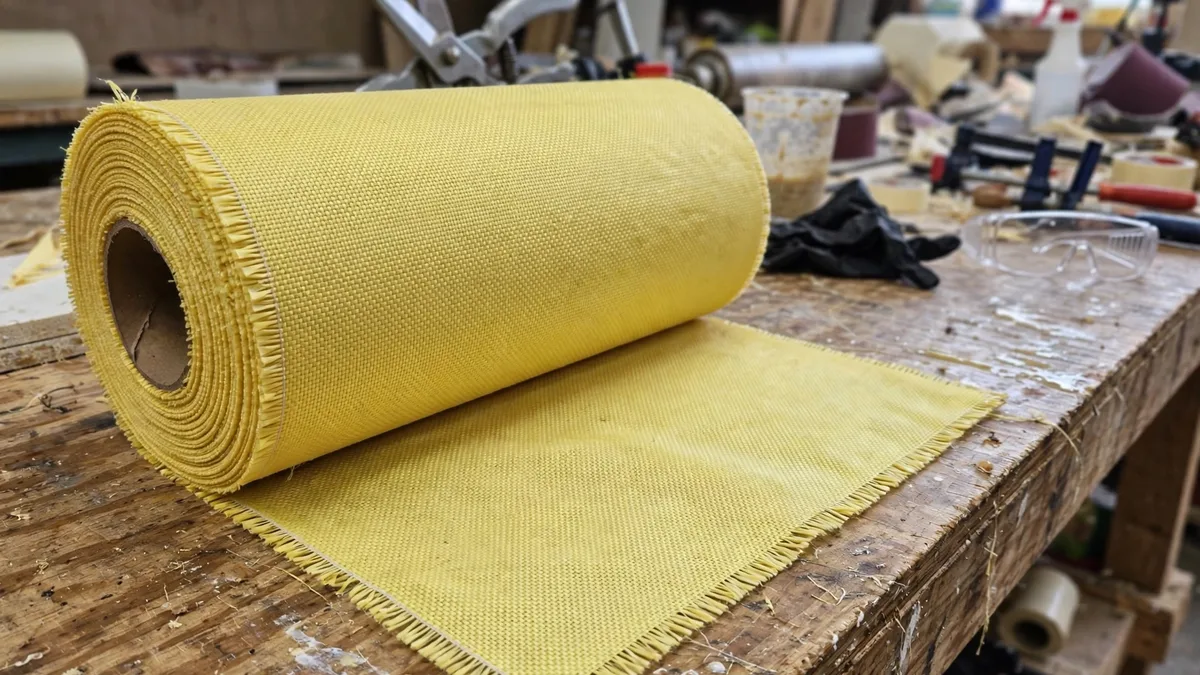
Before Kevlar becomes a composite it is woven into cloth, and the weaving matters as much as the fibre. The threads must lie flat, evenly spaced, with no twists, gaps or broken filaments. Kevlar is hard on weaving equipment: it is abrasive, it resists bending, and it dulls blades and guides faster than other fibres. Special looms, special cutters and skilled operators are needed, and the cloth is inspected closely, because a weaving fault is locked into the finished part forever. A roll of perfect Kevlar cloth is a precision product, not a textile.
4. Hand lay-up, layer by layer
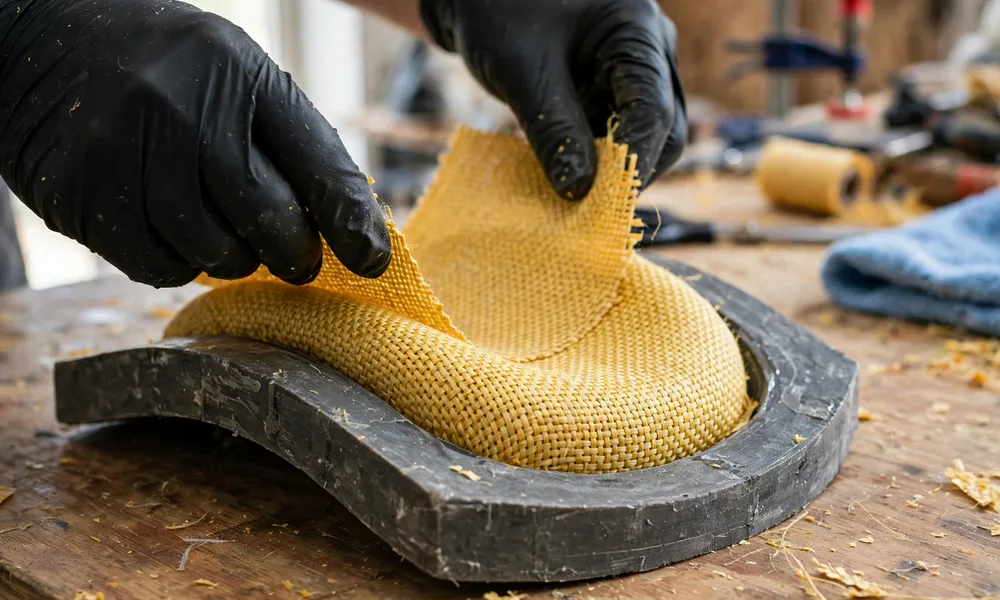
Most Kevlar composite parts are still made by hand. A worker lays sheets of cloth into a mould, one layer at a time, brushing each layer with resin, rolling out air bubbles, and checking the fibre direction — because the part is only strong in the directions the fibres run. A curved helmet or a boat hull can take dozens of layers and many hours of careful work. The job cannot be rushed: trapped air becomes a void, a wrong fibre direction becomes a weak spot, and a finished part with a hidden flaw is scrap. Skilled laminators are rare, their work is slow, and their time is expensive.
5. Curing under heat and pressure
Once laid up, the part must be cured — baked in an oven or an autoclave, a giant pressure cooker, at a controlled temperature for hours. The heat hardens the resin and bonds the layers into a single solid. The autoclave itself is a major piece of equipment, big enough to hold a boat hull or an aircraft panel, and it costs a fortune to buy and run. Curing schedules are long and energy-hungry, and a part that cures wrong — too fast, too slow, too hot — is ruined. The cure is where a pile of expensive cloth either becomes a valuable part or becomes waste.
6. Testing that destroys the product
A Kevlar part that protects a life must be proven, and proving it is expensive. Samples from every batch are tested to destruction: pulled, bent, shot at and burned, so the maker knows the real strength of what they sold. Body armour is tested against bullets, helmets against impacts, aircraft panels against fire and fatigue. The testing destroys valuable material, takes time, and requires certified laboratories. But without it, nobody would trust a fabric vest to stop a bullet — and the certificate is part of what the buyer is paying for.
Kevlar Composite Specifications
| Specification | Typical figure |
|---|---|
| Fibre | Aramid, para-aramid type |
| Tensile strength | Around 3,000 MPa |
| Density | About 1.44 g per cubic cm |
| Strength vs steel | About 5 times stronger, weight for weight |
| Decomposition | Around 450 to 500 degrees C |
| Typical forms | Woven cloth, chopped fibre, honeycomb core |
| Main uses | Armour, helmets, boats, aircraft, racing cars |
What Kevlar Composite Costs
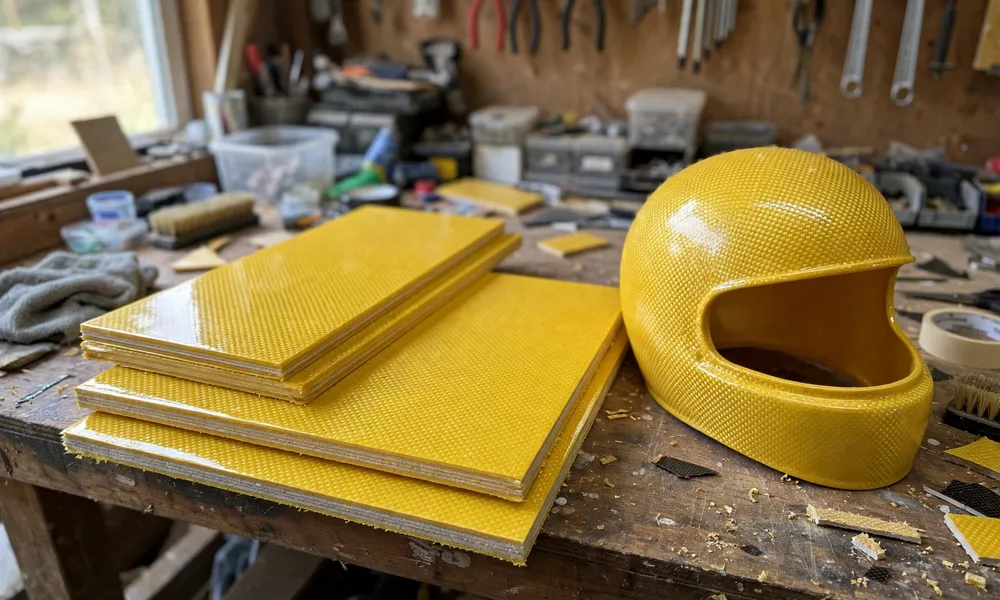
Prices are estimates and vary with grade, weave and quantity. Raw Kevlar cloth typically costs around $20 to $60 per square metre, against a few dollars for fibreglass cloth, and finished composite parts cost far more once labour, resin, curing and testing are added. A Kevlar motorcycle jacket can cost $400 to $800, a ballistic vest $800 to $2,000, and a custom Kevlar boat hull tens of thousands of dollars more than the same hull in fibreglass. The material is only the beginning: the handwork, the curing and the testing are where the price really grows.
A Rare Fact About Kevlar
Kevlar was invented by accident. In 1965, chemist Stephanie Kwolek was working on a lighter fibre for tyres when a cloudy, low-viscosity solution she was about to throw away spun into fibres so strong they bent the testing machine. Her colleagues told her the solution would clog the spinner — she tried it anyway, and the result was a fibre stronger than steel. Kwolek was inducted into the National Inventors Hall of Fame, and the material she nearly discarded now protects soldiers, police officers, astronauts and racing drivers.
Kevlar composite is expensive because almost nothing about it is ordinary: a fibre spun from chemistry, woven like a precision textile, laid up by hand, cured under pressure and tested to destruction. It looks like cloth and behaves like armour, and that gap between how it looks and what it does is the whole story. For how it is made, see how Kevlar composite is made, the figures in carbon fibre weave specifications, and how carbon nanotube composite works.