Stand on the dock beside a cruise ship at dawn and the first thing you notice is the silence. Four thousand passengers are asleep above you and the great white hull rises like a block of flats. Then you feel it rather than hear it: a low tremor through the concrete, a deep note you sense in your chest. Somewhere below the waterline, in a steel room the size of a warehouse, the engines that move this floating town are already awake.
A cruise ship engine is not a bigger version of a car engine. It is a machine the size of a house, built in pieces so large they travel by special road convoy, and assembled inside the ship by cranes before the decks are built over it. A single engine can weigh more than a thousand tonnes and produce enough power to light a small town — and the ship usually carries four or five of them.
The cost comes from the scale, the materials, and the fact that the engine must run for weeks at a time, in the middle of the ocean, with no breakdown allowed. Here is where the money goes.

Why the Cruise Ship Engine Costs So Much
1. Pistons the size of dustbins
The cylinders of a large marine engine are so big that a mechanic can climb inside one to inspect it. Each piston is close to a metre across, the crankshaft weighs as much as a locomotive, and the engine turns slowly — around a hundred revolutions a minute — while producing enormous torque. Every part is cast, forged and machined to tolerances measured in fractions of a millimetre, because at this scale a tiny error becomes a huge force. Pouring and cooling castings that weigh tens of tonnes without cracking is a craft only a handful of factories in the world can do well.
2. Steel that must survive fire and salt together
Inside the cylinders, temperatures reach hundreds of degrees while fuel burns under enormous pressure. Outside, the engine sits in a steel room at sea, where salt air creeps into everything. The metals must resist heat, pressure, corrosion and fatigue all at once, so the engine uses special alloy steels, heat-resistant liners and coatings developed for this exact job. Cheap steel would warp, crack or rust through in a season. The right steel lasts decades — and it is priced accordingly.
3. Fuel that is thick as tar
Large cruise ships traditionally burn heavy fuel oil, a thick residue from refining that is cheap to buy and hard to use. Before it can burn, it must be heated, filtered, centrifuged and injected at high pressure, so the engine needs a whole fuel treatment plant of its own: heaters, separators, pumps and fine filters. Modern ships are moving to cleaner liquefied natural gas, which needs cryogenic tanks kept at minus 162 degrees and double-walled pipes through the whole ship. Either way, the fuel system is a major piece of engineering, and part of the engine’s price.
4. An engine that is built inside the ship
You cannot buy a cruise ship engine and bolt it in like a car engine. The engine is too big to fit through any door, so it is lowered into the hull by crane while the ship is still being built, in pieces, and assembled in place. The bedplate alone — the steel frame the engine sits on — is welded to the ship’s structure and machined flat in position. If an engine ever needs a major rebuild at sea, the crew does it in place, lifting pistons out with the engine room crane. The engine and the ship are one structure, and that is why the installation is slow, skilled and expensive.
5. Power for a floating town, not just a propeller
On a modern cruise ship the engines often do not drive the propellers directly. Instead they drive generators, and the electricity powers electric motors that turn the propellers — plus the air conditioning, the kitchens, the water makers, the lights and the lifts for four thousand people. The engine must run smoothly at a steady speed for weeks, responding to the hotel load as passengers wake, eat and shower. The generators, switchboards and control systems between the engine and the ship are a power station in miniature, built to marine standards throughout.
6. Exhaust cleaning the size of a building
A cruise ship cannot pour untreated exhaust into the air over a port city, so modern ships carry exhaust cleaning systems — scrubbers that wash the exhaust gas, filters that catch soot, and catalytic systems that cut nitrogen oxides. Some scrubber towers are several storeys tall and weigh hundreds of tonnes, with pumps, tanks, sensors and a crew trained to run them. Meeting emissions rules is now a large share of the whole propulsion package, and it grows with every new regulation.
7. A tiny club of builders
Only a few companies in the world build engines this size: a handful of names in Germany, Finland, Japan and South Korea. Each engine is effectively a one-off, designed for a specific ship, tested for hundreds of hours on a test bed before delivery, and supported for thirty years or more. The makers keep spare parts, service engineers and drawings for decades after the last engine of a type is sold. With so few buyers and so much support, the price of each engine carries the cost of the whole specialist business behind it.

Cruise Ship Engine Specifications
| Specification | Typical figure |
|---|---|
| Engine type | Two-stroke or four-stroke marine diesel, or dual-fuel |
| Power per engine | 10,000 to 20,000 kW |
| Engines per ship | Four to six |
| Weight per engine | 500 to 1,000 tonnes |
| Speed | 100 to 600 rpm depending on type |
| Cylinder bore | Up to around 960 mm |
| Service life | 25 to 30 years |
What a Cruise Ship Engine Costs
Prices are estimates, and shipyards do not publish them, but industry figures put a single large marine engine at roughly $10 million to $25 million, depending on size, fuel type and emissions equipment. A full propulsion and power package for a large cruise ship — engines, generators, electric motors, propellers and exhaust cleaning — can cost $150 million to $300 million. The engines are the most expensive single machines on board, expected to earn their keep for three decades of near-continuous running.
A Rare Fact About Cruise Ship Engines
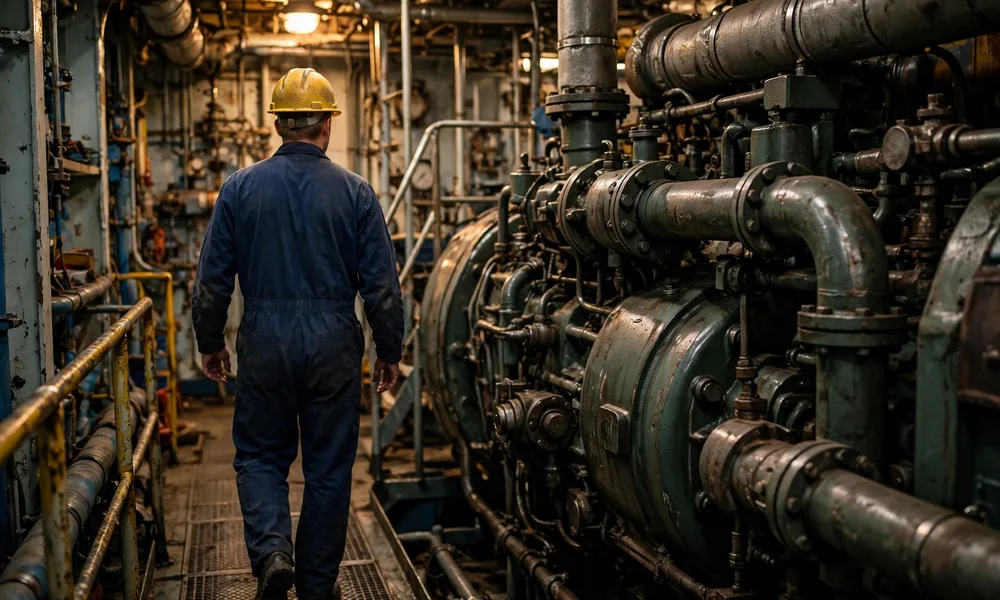
The largest marine engines ever built are so tall that their cylinders stand three storeys high, and a single cylinder can produce more power than a whole train. The crankshaft weighs more than two hundred tonnes, yet it spins on bearings with a film of oil thinner than a human hair. If that oil film ever failed, the metal would weld itself together in seconds — so the lubrication system is treated with the same seriousness as the engine itself.
A cruise ship engine is easy to forget because it is buried deep in the hull, behind steel doors, doing its work out of sight. It is a power station, a foundry product and a precision machine in one, built to run for weeks without stopping in the middle of an ocean. That is a very hard job — and the reason it costs what it does. For more on how these machines are put together, see how a cruise ship engine works, the figures in cruise ship engine specifications, and inside cruise ship engine production.