The surfer came up out of the white water with his board in one hand and a small camera in the other, and the camera was still recording. It had been under the wave, slammed into the sand, dragged through salt water and shaken for an hour — and the little red light was still blinking. Nobody on the beach thought twice about it. A camera that survives that is just doing its job.
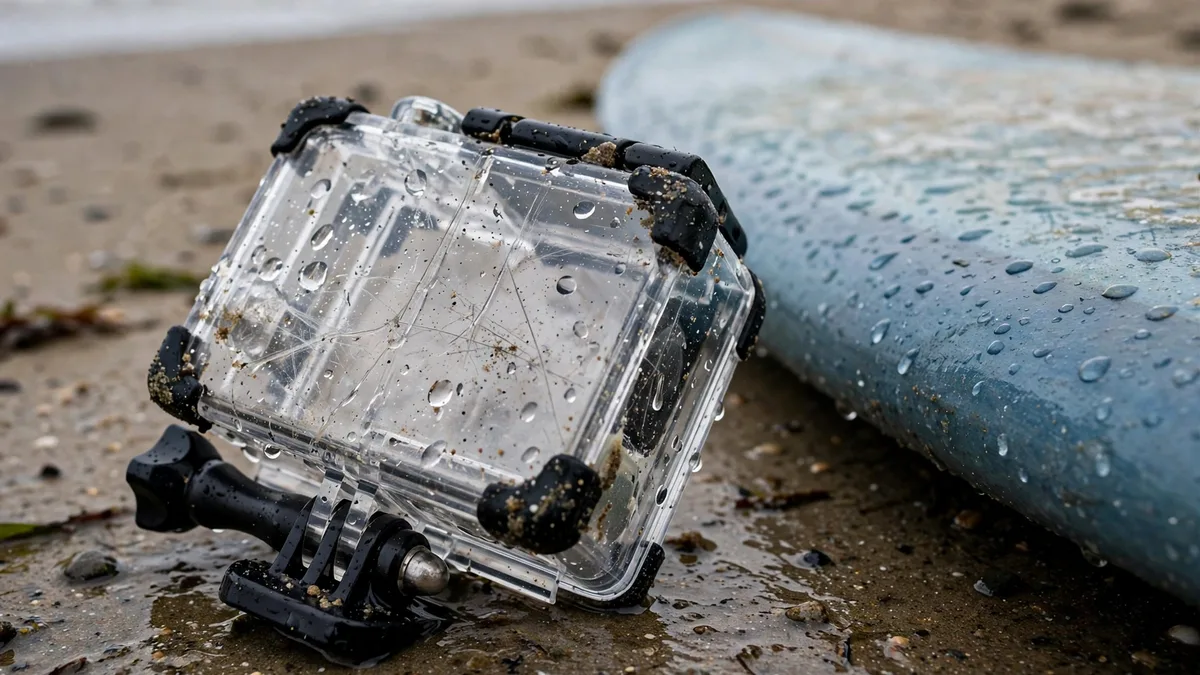
What survives is not the camera. It is the housing: a clear case that wraps the camera in a waterproof shell, with a lens port, buttons that work through the wall, and a seal that must not leak even once. The camera inside is a mass-produced gadget. The housing around it is a precision instrument, and it often costs as much as the camera it protects.
A housing has to be clear enough to shoot through, strong enough to survive a drop onto rock, sealed enough to dive to forty metres, and simple enough to open and close on a wet boat with cold hands. Here is where the money goes.
Why the Action Camera Housing Costs So Much
1. A lens port that must be optically perfect
The front of the housing is a flat or domed piece of glass or acrylic that the camera shoots through, and it must be optically perfect. Any distortion, scratch or flaw shows up in every frame. Domed ports, used underwater, correct the way light bends in water and restore the camera’s wide field of view — but the dome must be a precise curve, polished to a mirror finish, and coated to resist scratches and fog. The port is made from optical-grade material, ground and polished like a camera lens, and it is often the single most expensive part of the whole housing.
2. Seals that must not leak, ever
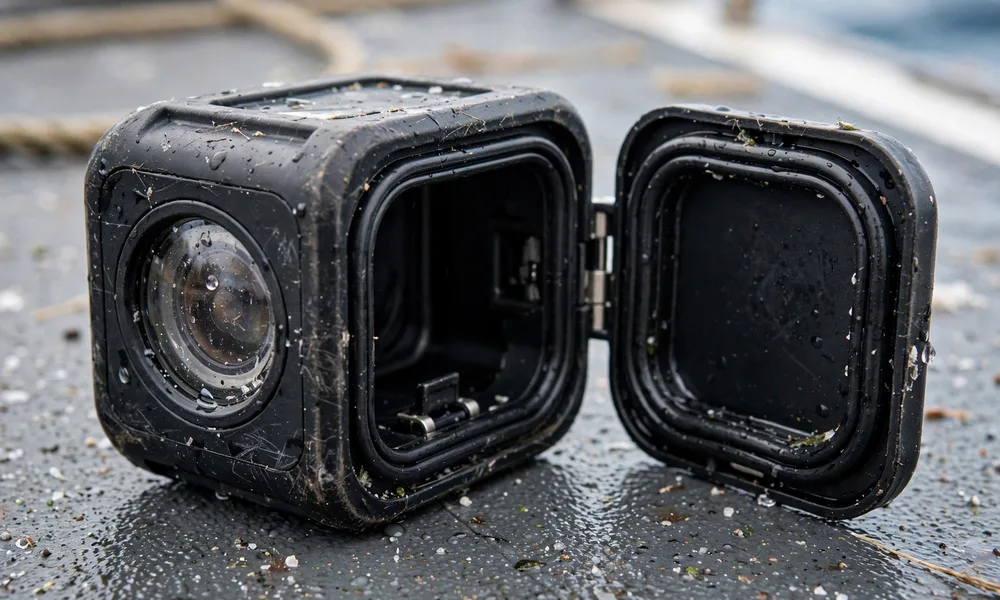
A housing is sealed by O-rings: thin loops of rubber that sit in grooves and squeeze tight when the case closes. It sounds simple, and it is — until you remember that one grain of sand, one hair or one nick in the rubber means salt water inside, and a dead camera. The O-rings are made to tight tolerances, the grooves are machined smooth, and the seal faces are inspected for the smallest flaw. Good housings use double seals and a vacuum system that warns the user before a dive if the seal is not perfect. The seal is the whole product: if it fails, nothing else matters.
3. Pressure that grows with every metre
Water pressure doubles roughly every ten metres of depth. At forty metres, the pressure on the housing is five times what it is at the surface, squeezing every face, every button and every seal. The case must be thick enough not to flex — because flexing breaks the seal — yet thin enough to stay light and clear. The shape is engineered to spread the load, the walls are reinforced where they need to be, and every housing is pressure-tested before it ships. A case that is fine in a swimming pool can implode at depth, so the rating on the box is earned by testing, not claimed by marketing.
4. Buttons that work through a wall
The user still needs to press the camera’s buttons, and those buttons are inside a sealed box. So the housing has mechanical push-rods, levers and dials that pass through the wall without letting water in — each one a tiny engineering problem of its own, with its own seals, springs and tolerances. A shutter button must feel right through gloves, a mode dial must click firmly, and none of them may stick after a week in salt water. Designing a set of controls that works blind, underwater, with cold hands, takes prototypes, testing and patience — and it is why cheap housings feel vague and expensive ones feel exact.
5. Materials that fight salt, sun and drops
A housing lives in the worst conditions a camera will ever meet: salt water, sand, sun, and hard knocks. The body is usually polycarbonate or aluminium, chosen for toughness and corrosion resistance, and the clear parts are coated against scratches and ultraviolet damage. Aluminium housings are machined from a solid block, anodised against corrosion, and assembled by hand. Polycarbonate housings are moulded to high precision and must be perfectly clear, with no bubbles or flow marks. Either way, the materials are chosen to survive years of abuse, not a single holiday.
6. A small market with no room for error
Action camera housings are a niche product. The buyers are surfers, divers, skiers and filmmakers — a small market, and a demanding one, because a leak means a ruined camera and a ruined trip. Makers build in small batches, test each unit, and support each model for years. There is no mass-market volume to spread the cost of design, moulds and testing, and a single bad batch can destroy a brand’s reputation overnight. So the price carries the cost of testing every unit, honouring warranties, and keeping the quality high enough that a diver will trust it forty metres down.
Action Camera Housing Specifications
| Specification | Typical figure |
|---|---|
| Depth rating | 40 to 60 m for most housings, deeper for pro models |
| Body material | Polycarbonate or anodised aluminium |
| Lens port | Optical glass or coated acrylic, flat or domed |
| Seals | Silicone O-rings, often double-sealed |
| Controls | Mechanical push-rods and dials through the case |
| Weight | 200 to 600 g depending on material |
| Extras | Vacuum leak check, mounts, anti-fog inserts |
What an Action Camera Housing Costs
Prices are estimates and vary with brand, depth rating and material. A basic polycarbonate housing for a popular action camera typically costs $50 to $150, while a well-made aluminium housing costs $300 to $800, and professional housings for cinema cameras can cost $3,000 to $10,000 or more. Domed lens ports, vacuum leak systems and spare O-ring kits add to the bill. It is a lot for a clear box — until the camera comes back from forty metres down, dry and still recording, and the footage is the whole reason the trip happened.
A Rare Fact About Action Camera Housings
The first underwater camera housings were built by divers in the 1940s from war-surplus parts, and the early ones leaked so often that photographers carried their cameras in rubber bags and accepted the risk. The modern O-ring seal, the domed port and the vacuum check all came from that long history of flooded cameras. Today’s housings are tested in pressure chambers that simulate depths no diver will ever reach — because the housing must survive not just the dive it is rated for, but the dive that goes wrong.
An action camera housing is expensive because it has to be two opposite things at once: invisible to the camera and invincible to the sea. It is an optical instrument, a pressure vessel and a set of controls, all in a box small enough to hold in one hand. That is a hard combination to build — and the reason it costs what it does. For the materials behind the case, see action camera housing materials, the figures in camera autofocus motor specifications, and how a camera autofocus motor works.