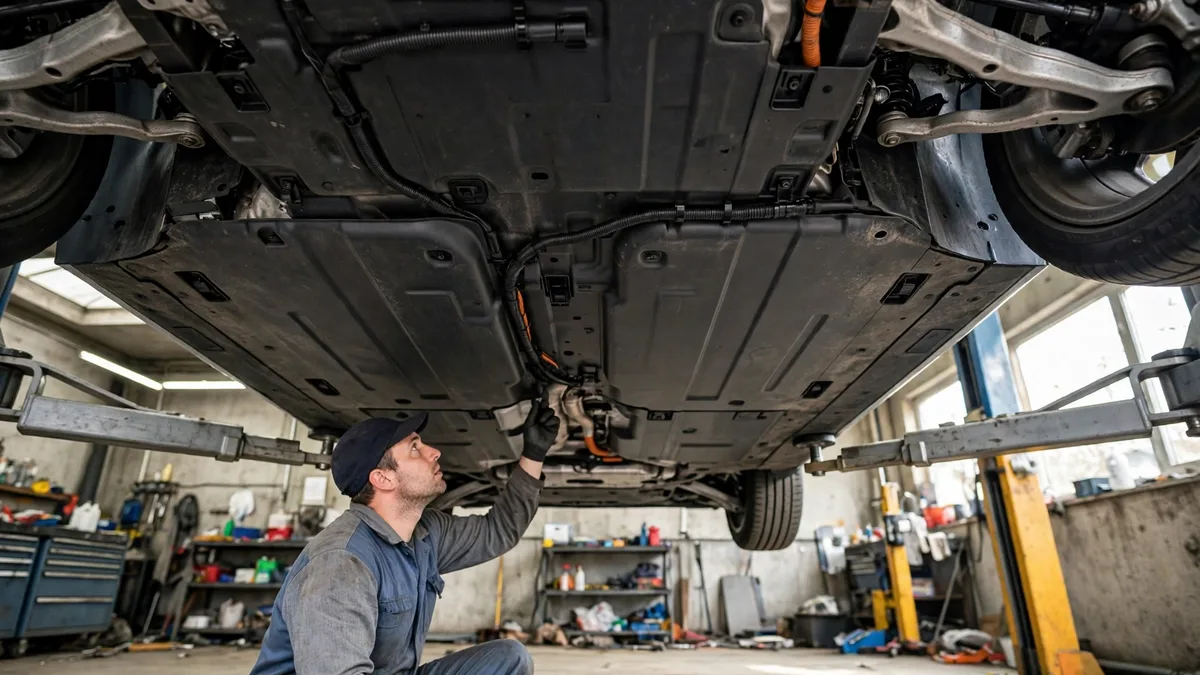
Stand underneath a modern electric car on a lift and you will see something that looks almost boring: a flat, smooth floor stretching from bumper to bumper, broken only by a few seams and fasteners. Yet that flat floor is one of the hardest-working parts of the whole car. At motorway speed it decides how far the battery will take you and how planted the car feels in a crosswind. A rough underside wastes energy, and in an electric car every wasted watt comes straight off the range.
The panel is called the aerodynamic underbody. It is not a single sheet of plastic bolted on as an afterthought, but a carefully shaped system of covers, diffusers, air channels and deflectors, designed in wind tunnels and built to survive stones, water, salt and heat for the life of the car. This is how it is made.
How It’s Made
Step 1: Shaping the air in the wind tunnel
The build begins months before any panel is pressed, in a wind tunnel with a full-size clay model of the car. Engineers blow smoke and coloured air beneath the model and watch where it tumbles, swirls and stalls. A rough underside with dangling cables and a lumpy battery case creates drag, so the team maps every bump and decides what must be covered and where the air should escape at the rear. The goal is a smooth floor that lets air slide underneath, then releases it cleanly through a rear diffuser. The same wind-tunnel discipline shapes the bodywork above, where the lessons are close cousins of those used in hypercar aerodynamic bodywork.
Step 2: Choosing the materials
With the shape settled, the materials are chosen panel by panel. Most underbody covers are moulded from glass-fibre-reinforced polypropylene: light, cheap to form, resistant to water and road salt, and flexible enough to take a stone strike without shattering. Areas close to hot battery and motor components use heat-resistant composites or thin aluminium sheet. Every material is tested for weight, stiffness and heat resistance.
Step 3: Moulding the panels
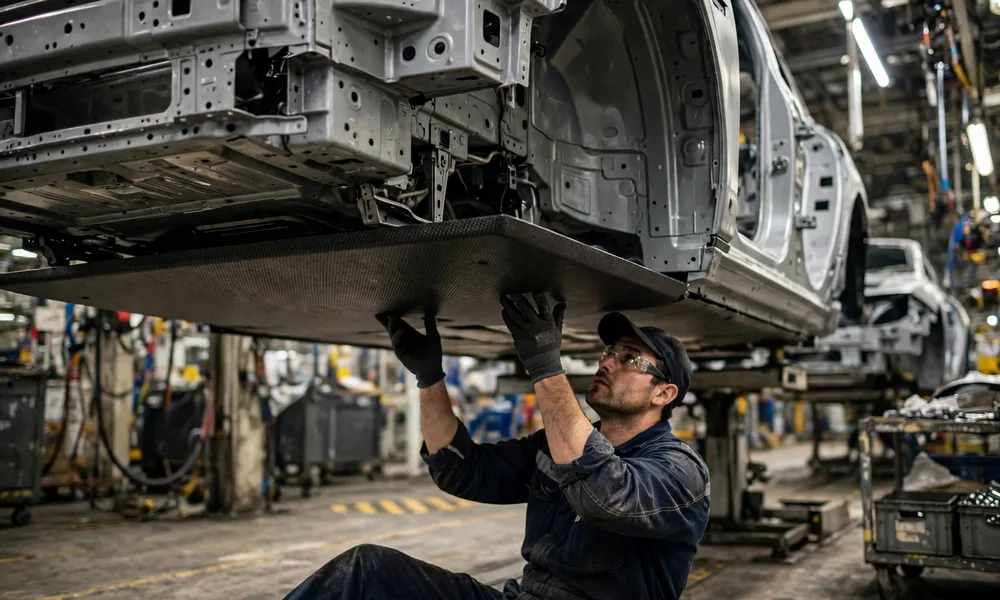
The panels are made by pressing or injection-moulding the chosen material into shape. Large flat covers are compression-moulded: a heated sheet of composite is laid into a steel mould, pressed shut under tonnes of force, and cooled until it holds the exact curve the wind tunnel demanded, complete with ribs and air channels formed in the same single step. Smaller parts are injection-moulded instead. Each panel is trimmed by a robot and checked; warped panels are rejected. A single underbody set can be made up of eight to fifteen separate panels.
Step 4: Fitting the battery case into the floor
On most electric cars the battery pack is itself part of the floor, and the underbody is designed around it. The battery case, a sealed steel or aluminium tray holding the cells, is bolted to the body structure first, and its flat steel underside becomes the centre of the aerodynamic floor. The underbody panels are then fitted around it, bridging the gaps to the suspension and the wheel arches so the air sees one continuous surface. Foam seals in the panel edges keep spray and grit out of the battery and wiring. The pack’s own construction is a study in sealed engineering, as shown in how an EV battery pack is made, and the underbody is its first line of defence against the road.
Step 5: Adding the air channels, deflectors and diffuser
With the main floor in place, the details that actually manage the air are added. Small deflectors ahead of the front wheels push air around the tyres instead of letting it slam into them. At the rear, the diffuser is fitted: a shaped panel with vertical fins that expands the fast-moving air from under the car, slowing it down and creating a gentle suction that pulls the car towards the road. Each part is bolted or clipped to the floor with fasteners designed to be removed by a mechanic without breaking. The rear axle and its drive unit sit just ahead of the diffuser, and their housings are shaped with the same care as the electric axle they carry.

Step 6: Testing the finished car in the wind tunnel
Once the panels are fitted to a complete car, the whole vehicle goes back into the wind tunnel. Engineers measure the drag coefficient and the lift at the front and rear axles, then compare the numbers with the targets set at the start. If the drag is too high, they hunt for the culprit: a lifting panel edge or a diffuser angle a degree off. Small changes follow — a deflector moved by a few millimetres, a seal added — and the car is tested again. On a good electric car the underbody work can cut the drag coefficient by several hundredths, which is worth real kilometres of range on every charge.
Step 7: Proving it on the road
The last test is the road itself. Prototype cars run for thousands of kilometres over gravel, through deep water and on salted winter roads, while engineers inspect the underbody after every run. Panels must not crack, sag, rattle or come loose, and fasteners must still undo cleanly after a winter of salt. Only when the underbody survives all of it is the design signed off for production.
Specs
| Specification | Typical figure |
|---|---|
| Main materials | Glass-fibre-reinforced polypropylene, aluminium sheet, heat-resistant composite |
| Number of panels | About 8–15 separate covers per car |
| Panel thickness | About 2–4 mm for plastic covers |
| Weight of the set | About 10–20 kg for a family electric car |
| Drag coefficient contribution | Underbody work can cut Cd by roughly 0.02–0.05 |
| Operating temperatures | About −30°C to 80°C |
| Design life | The life of the car, typically 15 years or more |
| Service access | Panels remove with standard fasteners for battery and drivetrain work |
Price
An aerodynamic underbody is never sold as a single spare part, and car makers do not publish a price for the set. As an estimate, the full set of underbody panels for a family electric car typically costs roughly $400 to $1,200 in parts, with a single large centre panel roughly $150 to $400 — these are estimates, and the final figure depends on the model and the materials. The value is in the range it protects: several kilometres on every charge, for the whole life of the car.
A Rare Fact
Some of the smoothest underbodies on the road were shaped by studying a fish. Engineers working on early low-drag electric cars found that the underside of a trout, smooth and gently tapered towards the tail, keeps water flowing cleanly past it with almost no turbulence. The rear diffuser of a modern electric car copies the same idea: it widens gradually, slowing the air down gently instead of letting it break away in a swirl.
From a clay model in a wind tunnel to a flat floor that survives a decade of winter roads, the aerodynamic underbody is the quiet part of the electric car. You never see it, you never think about it, and yet every kilometre you drive is a little longer because it is there. Plastic, steel and patience — that is what keeps the air on your side.


