Loading an electric ferry looks calm from the shore: cars roll on in an orderly line, passengers walk up a separate gangway, and the ship leaves on time. The piece of machinery that makes that calm possible is the ramp, a huge hinged steel bridge that connects the quay to the ship’s vehicle deck. It has to carry fully loaded lorries, rise and fall with the tide, seal against the weather while the ferry is at sea, and lock safely in place before a single wheel rolls onto it.
Most electric ferries use a bow or stern ramp, a wide steel platform hinged at the ship end and free at the shore end, which lowers onto the quay like a drawbridge. Some have side ramps for smaller harbours, and some have two levels, but the idea is the same in every case: the ramp is a bridge that the ship carries with it, and it is also a door. When it is raised, it closes the opening in the hull and becomes part of the ship’s watertight shell.

The ramp itself
The ramp is a steel structure, often twenty metres wide and just as long, built from a stiff frame with a flat driving surface on top. The surface is usually coated with a non-slip finish and fitted with raised ribs or a textured plate, because a wet steel ramp with oil on it is treacherous for tyres and for pedestrians. The edges carry kerbs or guide rails that keep vehicles centred, and the whole platform is designed to flex slightly under a lorry’s weight without bending permanently.
The hydraulics that lift it
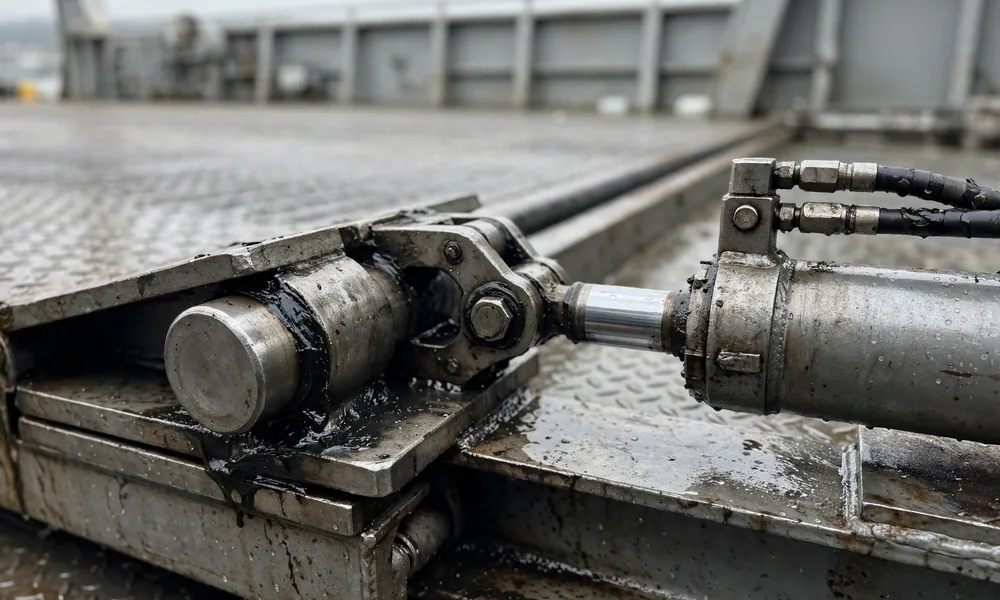
A ramp that size weighs many tonnes, so it is moved by hydraulics. Two or more large hydraulic cylinders, mounted between the hull and the ramp, extend to lower it and retract to raise it, driven by pumps in the engine room. The cylinders are sized so that the ramp can be raised even if one of them fails, and they are fitted with valves that lock the oil in place, so the ramp stays exactly where it is if the power is lost.
Hinges, pins and the seal
The hinge is the most heavily loaded part of the whole system. Every vehicle that crosses the ramp pushes down on the hinge, and every wave the ship meets while the ramp is raised pushes against it from the other side. The pins are made of high-strength steel, run in greased bushings, and are inspected regularly for wear, because a worn hinge pin is the one failure that could let the ramp drop.
When the ramp is raised for sea, it has to seal. The edges of the ramp meet a rubber gasket around the hull opening, and hydraulic pressure pulls the ramp tight against it, squeezing the gasket into a watertight joint. Cleats or locking hooks then hold it there, so the seal does not depend on hydraulic pressure alone. If the seal fails in heavy weather, water comes onto the vehicle deck, which is why the crew checks the gasket and the locking hooks before every departure. How electric ferry docking works shows the other half of the arrival, the thrusters and lines that hold the ship still while the ramp is down.
The safety interlocks
A ramp that moves while a car is on it would be a disaster, so the system is built around interlocks, devices that make the dangerous sequence impossible. The most important one links the ramp to the ship’s propulsion: the ferry cannot take power, or cannot leave the berth, while the ramp is down. The interlock is wired into the control system, and it is backed up by a physical lock that the crew engages by hand.
Other interlocks protect the loading itself. Sensors on the ramp report its angle and whether it is resting properly on the quay, and the crew will not start loading until the readings are right. Lights and barriers at the shore end stop traffic while the ramp is moving, and a second set of sensors watches for anything trapped under the ramp as it lowers. If any sensor disagrees, the hydraulics stop, and the crew investigates before anything moves again. The whole point is that no single mistake, and no single failed part, can put a vehicle on a moving ramp.
Loading, and the order of the deck
With the ramp down and locked, loading is a matter of order. Cars and lorries are directed onto the deck in lanes, heavy vehicles low and central, so the ship stays stable as its weight changes. The crew marshals each vehicle into its space with hand signals, and the driver switches off and applies the handbrake. On a two-deck ferry, the ramp may lead to a hoistable car deck, a second platform that can be raised or lowered inside the ship to fit more vehicles.
The crew directs traffic with hand signals and a loudhailer, because the deck is noisy and the drivers cannot see the whole picture. Each lane fills in turn, and the marshaller watches the mirrors and the gaps, waving each vehicle forward until its wheels are exactly where they should be.
What goes wrong, and how the crew handles it
Most ramp problems are small. A hydraulic leak leaves a sheen on the deck and a slow ramp, a sensor fails and the interlock refuses to clear, or the gasket wears and the seal weeps in a seaway. The crew carries spares for the common failures, and the ramp can usually be worked by hand with a backup pump if the main system fails. A ferry with a ramp that will not rise does not sail, and a ferry with a ramp that will not lock does not load, which is why the checks are done before passengers are allowed near it. How electric ferry propulsion works covers the electric motors that hold the ferry against the quay while the ramp is down and loading.

Why the ramp is the ferry
An electric ferry is defined by its batteries and its motors, but the ramp is what makes it a ferry at all. Without a ramp, the ship would need cranes, or a linkspan ashore, or a port built around it, and the quick turnaround that makes a ferry useful would be gone. The ramp lets the same ship serve a dozen different harbours, each with its own tide and its own quay height, and load and unload in minutes.
It is a simple idea carried out at a large scale: a hinged bridge, two hydraulic cylinders, a seal, and a set of locks that refuse to let it move at the wrong time. The engineering is in the details, in pins that never wear loose, in hydraulics that hold their place without power, and in interlocks that make the dangerous move impossible rather than merely unlikely. The best electric ferries, ranked shows the ships that put this system to work every day, from short harbour crossings to longer coastal routes.


