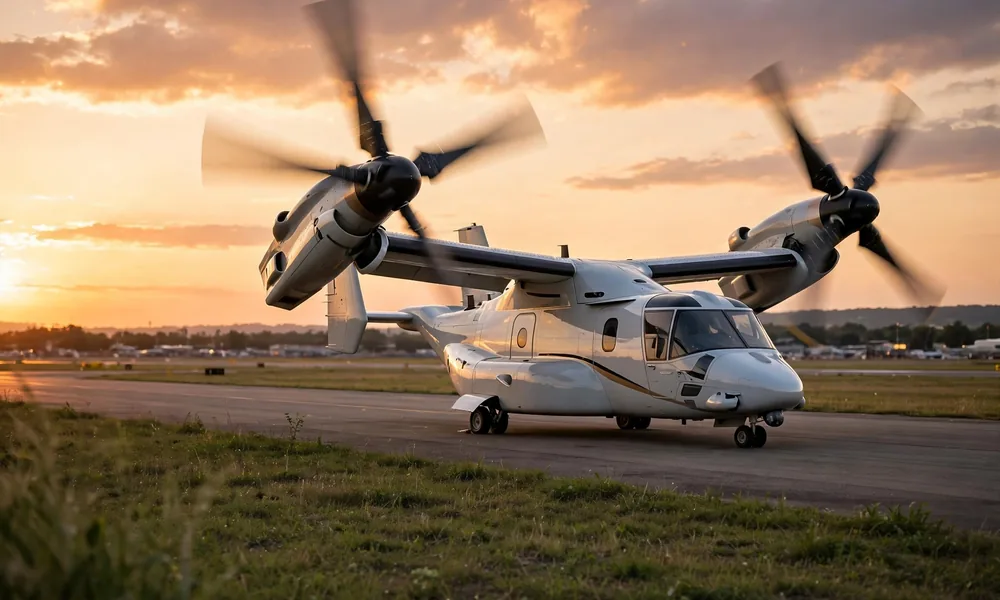
At first light the hangar doors roll open and a half-built aircraft sits in the middle of the floor, looking like a helicopter that changed its mind. It has a sleek fuselage, a straight wing, and two engine pods at the wingtips, each one pointing straight up. The pods will tilt forward in flight, turning the rotors from helicopter blades into aeroplane propellers. Nobody walking past would guess that this machine is about to become one of the most complicated luxury aircraft ever built.
A luxury tiltrotor is not assembled the way an ordinary aeroplane is. Every part has to do two jobs: hover like a helicopter and cruise like a turboprop. Building one takes a small army of specialists, months of careful work, and testing that never really stops. This is how it is made, from the first sheet of carbon fibre to the first flight.
Step 1: The fuselage takes shape
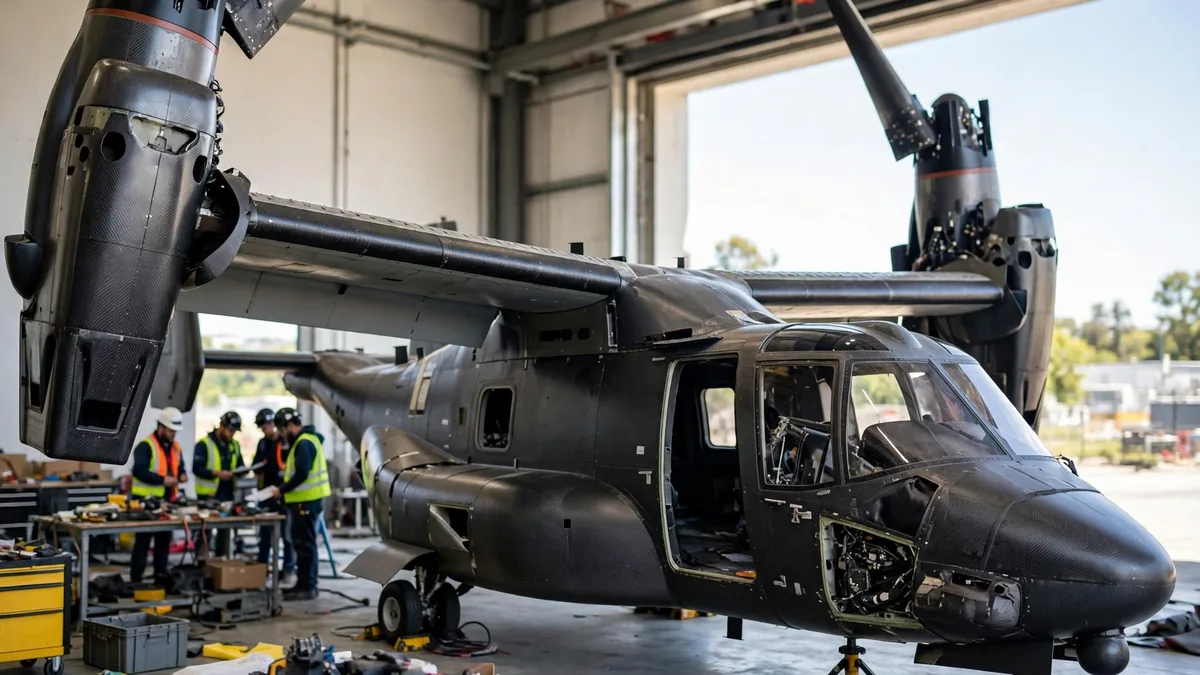
The build starts with the fuselage, and it starts as cloth. Sheets of carbon fibre are cut to pattern, laid into moulds by hand, and brushed with resin. Layer follows layer, each one turned a few degrees from the last, so the finished skin is strong in every direction. Vacuum bags press the layers tight, and the whole shell is cured in a giant oven called an autoclave, where heat and pressure harden the resin into a single rigid piece.
Once cured, the shell is trimmed, drilled, and fitted with frames and longerons, the ribs and spines that give it stiffness. The cabin floor goes in next, then the wiring looms, the hydraulic lines, and the fuel pipes. By the end of this step the fuselage looks like an aircraft, even though it still has no wing and no engines.
Step 2: The wing is built to twist
The wing of a tiltrotor is not like the wing of a normal aeroplane. It must hold two heavy engine pods at its tips, and when the rotors are spinning vertically, the downwash hammers the wing from above. The wing is therefore built around a single massive spar, a torque box of carbon and metal that runs from tip to tip and carries the twisting load into the fuselage.
Technicians build the wing in two halves, skinning each one over its spar and ribs, then join them through the centre section that bolts to the top of the fuselage. When the wing is mated to the fuselage, the aircraft finally gets its silhouette.
Step 3: The tilting nacelles
The nacelles are the heart of the machine. Each one holds an engine, a gearbox, and a rotor hub, and each one must rotate from vertical to horizontal and back again, smoothly, under full power.
Inside the nacelle, the engine drives a gearbox that turns the rotor shaft, and a second gearbox links the two sides together with a cross-shaft running through the wing. That shaft is the safety net: if one engine fails, the other can drive both rotors. How a luxury tiltrotor works explains what these pods do once the aircraft is flying, and why the tilt has to be so precise.
Step 4: The rotors are fitted
The rotors, sometimes called proprotors, are enormous, each one spanning several metres, and each blade is a work of engineering on its own. The blades are built from carbon fibre over a metal spar, with a shaped tip that keeps them quiet in the cruise and efficient in the hover.
Each blade bolts to a hub with bearings that let it change pitch, twisting to bite more or less air as the pilot demands power. The hubs are fitted to the nacelles, the blades are attached one by one, and the whole rotor is spun slowly by hand to check that nothing touches and everything turns true. At this point the aircraft looks complete, but it has never moved under its own power, and the hardest part of the build is still ahead.
Step 5: Systems, cabin, and finishing
With the structure complete, the fitters turn to the systems. The flight controls are connected, with triple-redundant hydraulics and a fly-by-wire system that blends helicopter and aeroplane controls as the nacelles tilt.
The luxury cabin is finished in parallel. Soundproofing goes into the walls, thick carpets onto the floor, and hand-stitched seats are bolted to rails that let the layout change. A small galley, a quiet cabin, and large windows are the point of the whole exercise, and the fitters treat them with the same care as the rotors. Luxury tiltrotor specs, explained breaks down the numbers behind this cabin and the performance it buys, from speed to range.
Step 6: Ground tests, then first flight
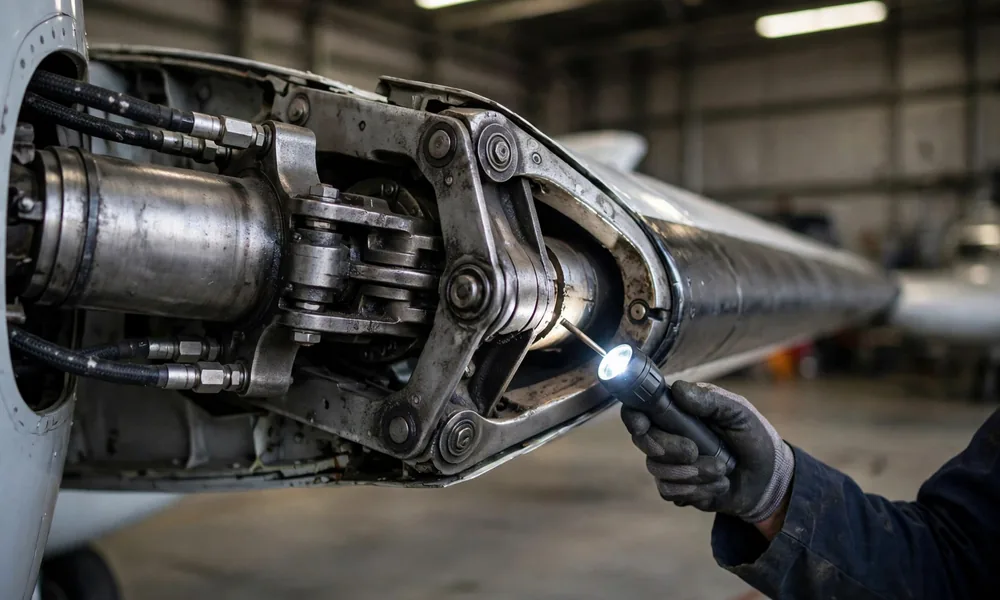
Before it ever leaves the ground, the tiltrotor is tested to destruction in slow motion. Engines are run on the ground, rotors are spun up, and the nacelles are tilted through their full range again and again while engineers watch every sensor.
Then comes the first hover, a few feet off the ground, with the nacelles upright and the aircraft tethered by nothing but the pilot’s hands. If that goes well, the nacelles are tilted a few degrees at a time over successive flights, until one day the rotors are fully forward and the machine is flying like an aeroplane. Why a luxury tiltrotor is so expensive shows what all of this testing costs, and why so few of these aircraft ever get built.
Specifications
| Detail | Specification |
|---|---|
| Engines | Two turboshaft engines |
| Rotors | Two three-blade proprotors |
| Top speed | Around 500 kilometres per hour |
| Range | Around 1,500 kilometres |
| Passengers | Eight to ten in luxury layout |
| Hover ceiling | Around 3,000 metres |
| Structure | Carbon fibre fuselage and wing |
| Controls | Fly-by-wire, triple-redundant hydraulics |
Price
The estimated price of a new luxury tiltrotor is around 70 million dollars, and that figure is an estimate only, because so few are built and each one is fitted to order. The airframe, the engines, the tilting nacelles, and the luxury cabin each account for a large share, and the testing and certification add millions more. A buyer is paying for an aircraft that can land on a rooftop and then cruise at aeroplane speed, and there is almost nothing else that can do both.
A rare fact
Few people know that the cross-shaft running through the wing is one of the most heavily guarded parts of the design. It lets a single engine drive both rotors if the other fails, which means the aircraft can keep flying on one engine in a way no ordinary twin-engine helicopter can match. The shaft spins at thousands of revolutions per minute inside the wing, and it is checked with ultrasound after every major service, because a flaw in that single component could ground the whole fleet.
When the tests are done and the paperwork is signed, the tiltrotor rolls out of the hangar as a machine that is two aircraft at once. That is why it is built the way it is, and why it costs what it does.