He rode past the traffic jam on a bike that looked like it had been drawn by someone who loved bicycles, and the other cyclists turned to look. There was no rattling chain, no bulky battery box bolted to the frame, and no motor humming like a washing machine. The bike was silent, the frame was slim, and the leather grips were the colour of a good pair of boots. It looked like a bicycle that happened to be electric, and the price tag said it cost as much as a used car.
That is the puzzle of the luxury electric bike. A good ordinary e-bike costs a couple of thousand, and it will carry you to work in the rain without complaint. A luxury one can cost five times as much, and the differences are easy to miss if you only look at the top speed. The money hides in the frame, the motor, the battery and the parts you touch every day, and each of them is expensive for a reason.
This guide takes the price apart, piece by piece, so you can see where the money goes and whether any of it is worth it for the way you ride.

1. A frame built like an aircraft part
The frame is the biggest single cost on a luxury electric bike, and it is where the money is easiest to see. A mass-market e-bike uses an aluminium frame welded from tubes, which is strong and cheap. A luxury one often uses carbon fibre, laid up by hand in a mould, layer by layer, with the fibres pointed in different directions to make the frame stiff where it needs to be and forgiving where it does not. Some makers use titanium, which is light, strong and almost impossible to rust, but slow and expensive to work with.
2. A motor you cannot hear
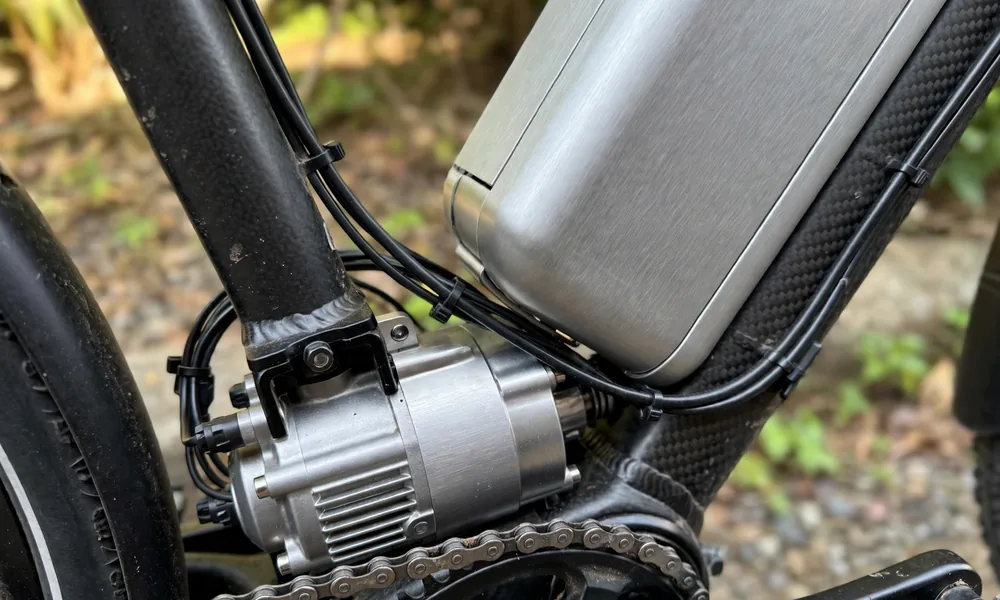
The motor is the second big cost, and the difference between a cheap one and a luxury one is mostly about refinement. A cheap hub motor buzzes, jerks when it starts, and gives the same push whether you are pedalling gently or hard. A luxury mid-drive motor, usually made by a specialist firm, measures how hard you are pedalling a thousand times a second and adds power in exact proportion, so the bike feels like your legs have suddenly become stronger rather than like you are being pushed.
That smoothness needs a torque sensor, a precise gearbox and software that has been tuned over years, and it needs to be quiet. The best motors are almost silent, which means careful machining, high-quality bearings and a housing that does not resonate. The motor is also expected to last for tens of thousands of kilometres, in rain and dust, with almost no maintenance. The numbers behind these motors are set out in the guide to electric bike motor specs explained, where torque, voltage and sensors are decoded.
3. A battery that is small, safe and long-lived
The battery is the most expensive single component on many e-bikes, and on a luxury one it is also the most carefully made. It uses high-density cells from a top maker, a management system that watches every cell individually, and a casing that is sealed against rain and built into the frame so it cannot be stolen easily. The cells are matched and tested, so the pack delivers its full range for years instead of fading after a few hundred charges.
4. Parts that belong on a much more expensive machine
Look closely at a luxury electric bike and the parts tell the story. The brakes may be hydraulic discs with four pistons, the kind of stopping power you would expect on a motorcycle. The gears may be an internal hub or a belt drive, both of which run silently and need almost no maintenance, unlike a chain that needs cleaning and oiling. The tyres may be handmade, the saddle may be leather, and the grips may be stitched by hand.
Each of these parts costs more than the ordinary version, and together they change how the bike feels. A belt drive does not rust, a hub gear does not jump, and hydraulic brakes stop the same way in the rain as they do in the dry. The bike becomes something you maintain once a year instead of once a month, and for a rider who uses it every day, that reliability is worth real money. A clever folding version of the same idea is covered in the guide to how a foldable electric bike is made, where the hinge and the motor share the same small frame.
5. Small numbers and hand finishing
That hand finishing also means the bike can be made to fit. Some makers will build the frame to your measurements, choose the gearing for the hills you ride, and set the motor’s assistance to match your strength. It is a bicycle made for one rider, not for a warehouse shelf, and that is a different kind of product. The market is full of choices, and the guide to the best electric bike brands ranked shows where the luxury makers sit among the big names.
The numbers behind the price
| Figure | Typical luxury electric bike | What it tells you |
|---|---|---|
| Frame | Hand-laid carbon fibre or titanium | Weight, ride feel and cost |
| Frame weight | Under 2 kg for carbon | How light the bike can be |
| Motor | Mid-drive, 250 W, 85 Nm torque | How smoothly it helps you pedal |
| Battery | 500 to 700 Wh, frame-integrated | Range and how clean the bike looks |
| Range | 80 to 150 km per charge | How far a charge takes you |
| Drivetrain | Belt drive or internal hub gears | Silence and low maintenance |
| Brakes | Hydraulic disc, four piston | Stopping power in all weather |
| Total weight | 16 to 20 kg | How easily it lifts and carries |
What a luxury electric bike costs
A luxury electric bike typically costs an estimated $6,000 to $15,000, with some custom-built machines going higher still, while a good ordinary e-bike costs an estimated $1,500 to $3,000. That is an estimate, and it varies by brand, market and specification. The extra money buys the carbon or titanium frame, the silent motor, the carefully made battery and the hand finishing, but it also buys a bike that feels like a bicycle first and an electric machine second, and that is the whole point of the luxury version.
A rare fact
Some luxury electric bikes are built with a gearbox sealed inside the frame, so the chain or belt never sees the weather at all, and the gears are changed by an electronic shifter that works even when the bike is standing still. A few makers will also hide the motor so well that even an experienced cyclist has to look twice to tell the bike is electric, and that invisibility is the most expensive trick of all.

A luxury electric bike is expensive because almost everything about it is made the slow way: the frame is laid up by hand, the motor is machined to be silent, and the battery is tested cell by cell. Whether that is worth five times the price of an ordinary e-bike depends on how you ride, but the money is not disappearing. It is in the frame, the motor and the silence.