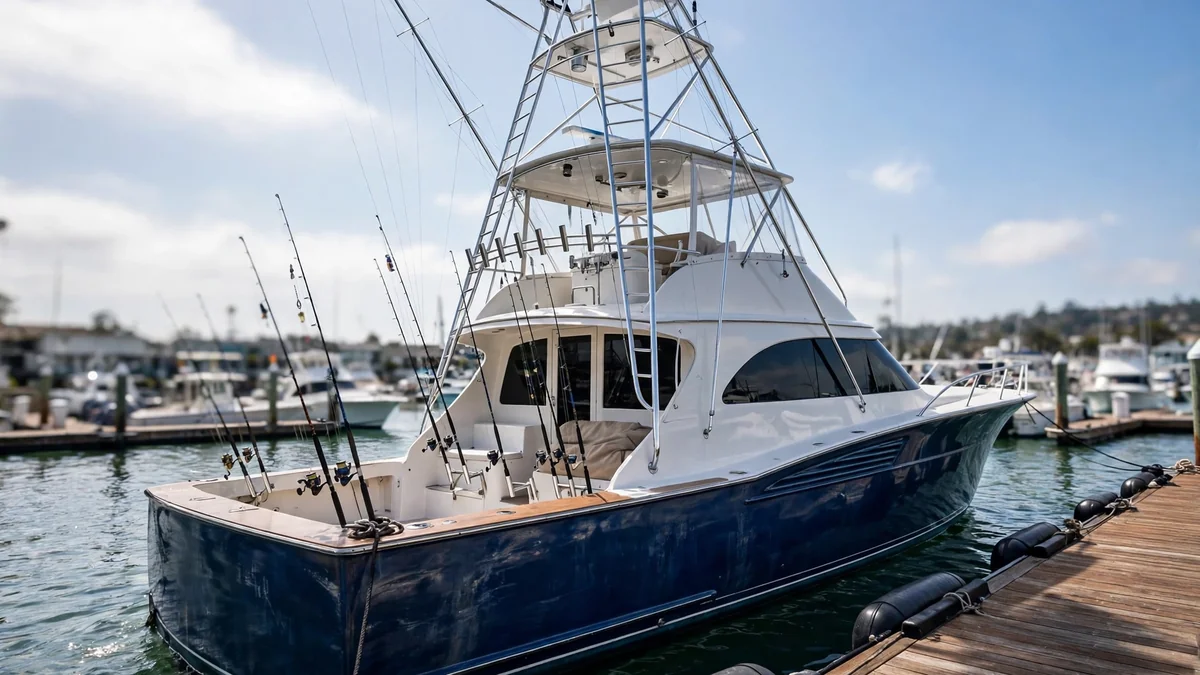
The first time I stood on the dock beside a luxury fishing yacht, the boat looked less like a machine and more like a promise. The hull was a deep, polished blue, the cockpit was wide enough for a small party, and the tower above the bridge rose like a lookout post. A crew member was washing the deck with the care of someone polishing a car, and the smell of salt and diesel hung in the warm air. The broker handed me a specification sheet, and for a moment the numbers meant nothing at all.
A luxury fishing yacht is a working boat dressed in comfort. It must chase fish across open water, hold its position in a swell, keep the catch cold, and then bring everyone home in air-conditioned calm. The specification sheet is the honest record of how it does those jobs, and the figures that matter are rarely the biggest ones.
Length and Hull: The Foundation of the Ride
The headline number is length, usually 50 to 90 feet for a luxury fishing yacht, and it decides almost everything else. A longer hull rides more softly through a chop, carries more fuel, and gives the cockpit more room, but it also costs more to berth, to insure, and to maintain.
The deadrise, the angle of the V at the transom, tells you how the boat will behave in rough water. A steep angle, around 20 degrees, cuts through a swell, while a flatter hull planes faster on calm water but pounds harder when the sea turns. There is no perfect number, only a trade between comfort and speed, and a good builder chooses the angle for the waters the boat will actually fish.
Power and Speed: How Fast It Gets There
Power comes next, and a luxury fishing yacht usually carries two large diesel engines, each making 1,000 to 2,000 horsepower, driving propellers through shafts or pods. A boat that can hold its cruising speed in a head sea is worth more than one that only reaches its top speed on a flat calm day.
The engines also decide the noise and the vibration in the saloon. Modern diesels are mounted on soft mounts and wrapped in sound insulation, and the exhaust runs through the hull so the cockpit stays quiet enough for conversation. Fuel burn is quoted in gallons per hour at cruising speed, and it is a sobering number, often 80 to 150 gallons an hour for a pair of big engines. That is why range, not speed, is the number experienced owners study first. The same thinking about hulls and speed appears in larger expedition boats, and the expedition yacht specifications explained shows how a heavier hull trades speed for the ability to cross an ocean.
Range and Fuel: How Far It Can Fish
Range is the distance a boat can travel on a full tank, and for a fishing yacht it is usually 400 to 800 nautical miles at cruising speed. The fuel tank is the reason, often holding 1,500 to 3,000 gallons of diesel, and it sits low in the hull, where its weight steadies the boat.
The number to watch is the reserve. A careful captain plans to return with at least a fifth of the tank still full, so the useful range is shorter than the brochure figure. The builder balances all of this, and the specification sheet is where the balance becomes visible, in gallons, miles, and feet of draft.
The Fishing Cockpit: Where the Work Happens
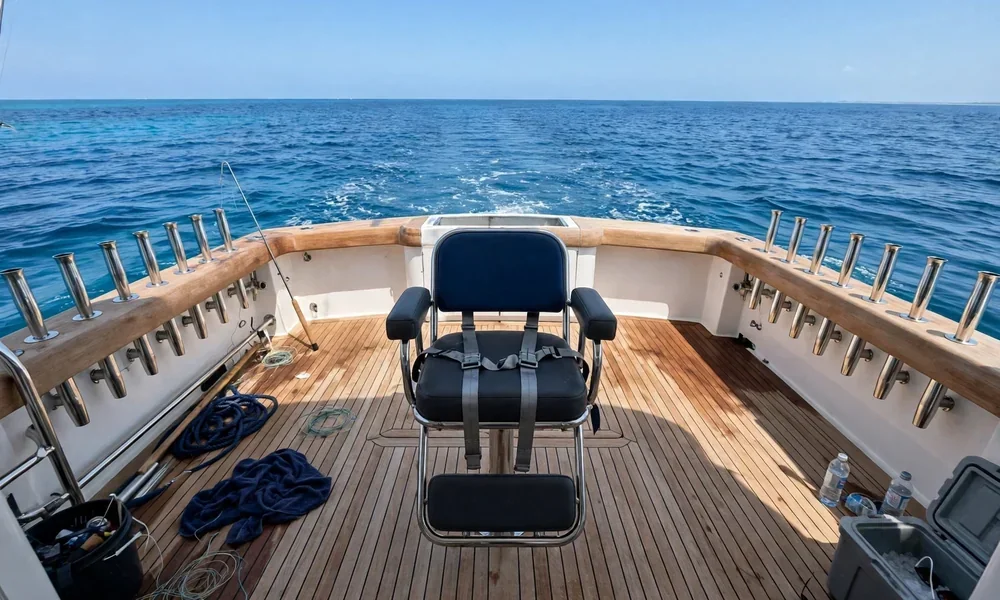
The fighting chair is bolted to the deck and built to hold an angler through a long battle with a marlin, while the bait well keeps live bait swimming with pumped seawater. The rod holders are set into the gunwales and the tower, and the outriggers spread the lines wide so they do not tangle.
Below the deck, the fish boxes are insulated and drained, and a good boat carries a freezer that can hold the catch at the temperature a restaurant would demand. The cockpit is also where the boat shows its build quality, because it is washed down after every trip, and the drains, the hatches, and the non-slip deck must survive salt water and fish blood without staining or corroding. A cockpit that is easy to clean is a cockpit that will still look new in ten years. The craft of building such a boat is shown in how a luxury catamaran yacht is made, which follows the hull, the deck, and the interior from the yard to the water.
The Tower and the Electronics: Eyes Above the Water
Above the bridge, the tower is the second helm, a high perch where the captain can spot fish, birds, and floating debris from far away. The tower carries its own controls, so the boat can be steered from up there, and it is reached by a ladder from the bridge.
The electronics are the boat’s senses. A modern fishing yacht carries radar, sonar, a chart plotter, and a fish finder, all linked on screens at both helms, and the sonar alone can cost as much as a car. The fish finder reads the water below and shows the depth, the temperature, and the shape of the bottom, and an experienced captain reads it the way a doctor reads a scan. The screens are daylight readable, which is a specification worth checking, because a screen that washes out in sunlight is useless at noon. The same attention to the working deck appears on smaller fishing boats, and how a luxury center console boat is made explains how an open cockpit is built for the same job on a smaller scale.
The Numbers That Matter
| Specification | Typical luxury fishing yacht |
|---|---|
| Length | 50 to 90 feet |
| Beam | 16 to 22 feet |
| Engines | Twin diesels, 1,000 to 2,000 hp each |
| Cruising speed | 25 to 30 knots |
| Top speed | 30 to 40 knots |
| Fuel capacity | 1,500 to 3,000 gallons |
| Range | 400 to 800 nautical miles |
| Cockpit | 150 to 300 square feet, fighting chair |
| Cabins | Two to four, sleeping six to eight |
Read the sheet the way a captain would: start with the range and the cruising speed, then the cockpit and the fuel, and only then the length and the top speed. A boat that can reach the fish, hold its position, and bring everyone home comfortably is a better fishing yacht than a faster boat that cannot.
Price, and What You Are Really Paying For
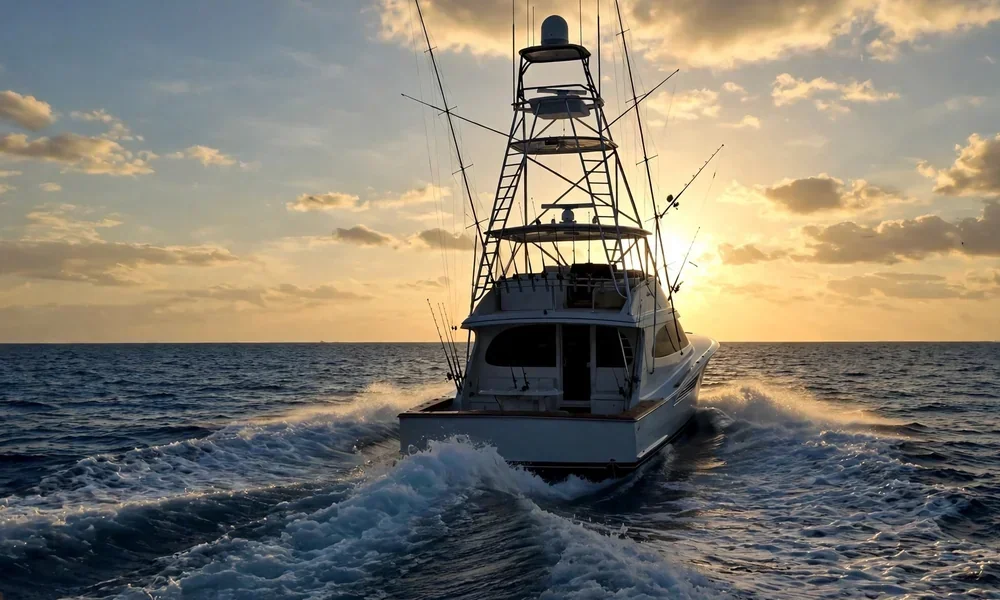
The difference from a normal fishing boat is not one part but all of them at once: the deep-V hull, the twin diesels, the tower, the electronics, and the interior below. The hull and the engines are the two most expensive parts, and the electronics, with radar and sonar, are not far behind.
A Rare Fact Worth Knowing
Here is the detail that surprises almost everyone who steps aboard for the first time. The live bait well, a tank that looks like a simple box of seawater, is one of the most carefully engineered parts of the boat. The well is round for exactly that reason, and the pump, the filter, and the overflow are tuned like a small aquarium. The yacht is, in effect, a floating fish tank with an engine, and the specification sheet is the only place the builder tells you exactly how far they went.