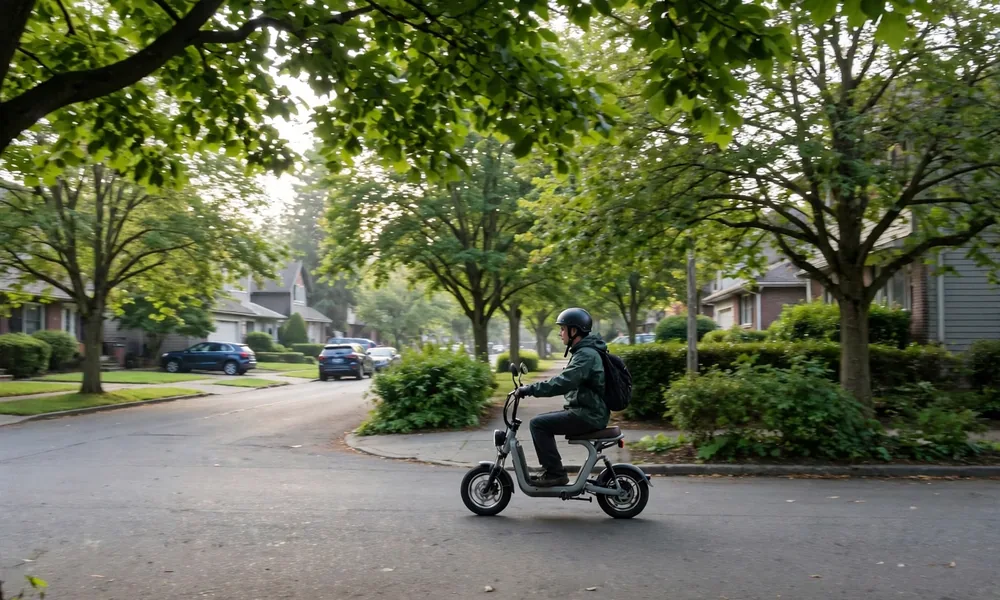
The morning commute has a rhythm, and a luxury electric moped fits it perfectly. No kick-start, no clutch, no smell of petrol on your clothes. You press a button, twist the throttle, and the little machine pulls away in silence, weaving through traffic while the cars around you are still waiting for their engines to warm up. By the time you reach the office, the moped has used less electricity than a kettle uses to boil.
That simplicity hides a careful machine. A moped must be light enough to park anywhere, strong enough to carry two people, and smart enough to make its small battery last all day. Here is how it works, from the twist of the throttle to the spin of the rear wheel, and why the best ones feel effortless rather than cheap.

How It Works
Step 1: The throttle asks for power
It starts with your right hand. The throttle grip contains a sensor that measures exactly how far you have twisted it, and it sends that reading to the controller hundreds of times a second. There is no cable and no carburettor, just a clean electrical signal. The sensor is designed with a spring that returns the grip to zero the moment you let go, so the moped never keeps accelerating on its own. On luxury models the throttle is tuned to feel progressive, gentle at first for crowded streets and stronger as you twist further for open roads.
Step 2: The controller decides how much current to send
The controller is the moped’s brain, a small box of electronics hidden under the seat. It takes the throttle signal, checks the battery’s charge and temperature, reads the motor’s speed, and works out how much current the motor should get. If the battery is low, it limits the power to protect the cells. If the motor is already spinning fast, it sends less. All of this happens in milliseconds, and the result is a smooth pull instead of a sudden jerk. A good controller also talks to the brakes, cutting power the instant you touch a lever.
Step 3: The motor turns electricity into motion
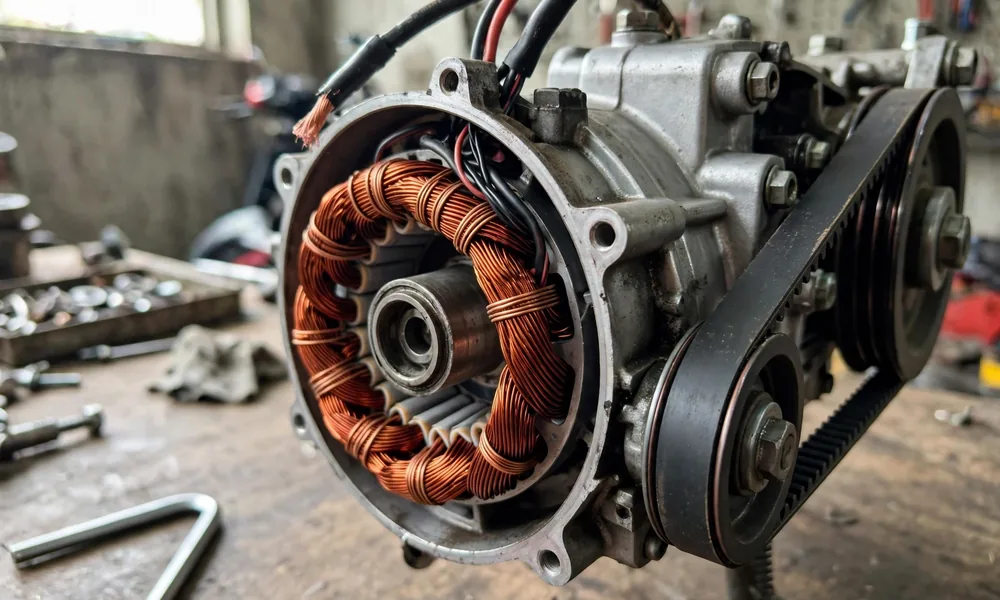
Most luxury electric mopeds use a hub motor built into the rear wheel. Inside it, coils of copper wire sit in a stator, and magnets are fixed to the rim around them. When the controller sends current through the coils in sequence, the magnetic field chases the magnets around, and the whole wheel turns. There are no gears and no chain, which is why the moped is so quiet and why there is so little to wear out. The motor also doubles as a generator when you brake, sending a little energy back to the battery.
Step 4: The battery delivers the energy
The battery lives under the floor or under the seat, a pack of lithium cells wired together and watched over by a management board. The board balances the cells, so no single cell is overworked, and it cuts the power if the pack gets too hot or too cold. Many luxury mopeds use a removable battery, so the rider can lift it out and charge it indoors like a laptop. A full charge takes a few hours from a normal socket, and the pack is sealed against rain, because a moped’s battery spends its life outside in all weather.
Step 5: The belt or chain carries the power
Some mopeds drive the wheel directly through the hub motor, but others use a mid-mounted motor with a belt or chain to the rear wheel. A belt is quieter and cleaner, needing no oil and lasting tens of thousands of kilometres, while a chain is cheaper and easier to replace. Either way, the drive is enclosed or guarded so road grit cannot wear it out. The final drive ratio is chosen carefully: too tall and the moped is slow off the line, too short and it runs out of speed on a main road. Luxury models get this balance right, quick in town and calm at cruising speed.
Step 6: Brakes and regeneration slow you down
Slowing down is a team effort. Hydraulic disc brakes at the front and rear do the heavy work, with a combined braking system that applies both brakes when you pull either lever, so a panicked rider still stops straight. At the same time, the controller switches the motor into generator mode, turning the wheel’s momentum back into electricity and feeding it to the battery. The effect is gentle, a slight drag as you roll up to a junction, and it extends the range a little on every ride. On a long downhill, regeneration can add a useful few kilometres back.
Step 7: The display and rider aids tie it together
The last part of the system is the one the rider sees: a small display showing speed, battery level and range, and sometimes a phone connection for navigation and locking. Luxury mopeds add rider aids like traction control, which stops the rear wheel spinning on wet cobbles, and a reverse gear for parking, which is surprisingly useful on a heavy machine. A keyless start, an alarm and a tracker complete the package. Together they turn a simple two-wheeler into a machine that feels considered, not just assembled.
Key Specifications
The figures below describe a typical luxury electric moped; individual builds vary.
| Specification | Typical figure |
|---|---|
| Motor power | 3 to 6 kW |
| Top speed | 45 to 90 km/h by class |
| Battery capacity | 2 to 4 kWh, often removable |
| Range | 80 to 150 km per charge |
| Weight | 90 to 130 kg |
| Charging time | 3 to 5 hours from a home socket |
| Brakes | Hydraulic disc, combined braking, regenerative |
How Much Does It Cost?
A luxury electric moped typically costs from around $4,500 to $9,000, depending on the battery size, the motor and the finish. That is an estimate based on current premium models, and a spare removable battery can cost over $1,000. Most of the price sits in the battery, the motor and the quality of the bodywork. To see how the machine is put together, read how a luxury electric moped is made for the factory side. Its stylish cousin is covered in how a luxury electric Vespa works, and how an electric bike motor works explains the same motor ideas on two thinner wheels.
A Rare Fact
Here is something few riders know: the first electric mopeds were built more than a century ago, and one of them, made in the 1910s, could travel about fifty kilometres on a charge, which was respectable even by modern standards. It failed not because the technology was bad, but because petrol was cheap and batteries were heavy and expensive. The design was forgotten for decades, and when engineers revived it, they found the old patents described almost exactly the hub motor layout that luxury mopeds use today.
A luxury electric moped is a small machine that does a big job quietly. From the throttle sensor to the controller, from the hub motor to the regenerative brakes, every part exists to make the city feel smaller and the commute feel easier. Twist the grip, and the whole system answers in silence, which is exactly how a morning should start.