A hypercar hits a bump at 250 kilometres an hour, and the body barely moves. The wheel rises, the spring compresses, the damper absorbs the energy, and the tyre stays pressed to the road, all in a fraction of a second. Then the wheel drops back down, the body stays level, and the driver never feels the bump at all. That is the suspension doing its job, and on a hypercar it is doing it with materials that belong in a spacecraft as much as in a car.
The suspension of a hypercar is a system of levers, springs, and dampers, and every part is fighting the same enemy: weight. Unsprung weight, the mass of everything that moves with the wheel, is the enemy of grip, because a heavy wheel cannot follow the road quickly enough.
The result is a set of parts that look delicate and cost a fortune, and that fail catastrophically if the wrong material is used in the wrong place. Here is what those materials are, and why each one earned its place.

The Materials Behind Hypercar Suspension
1. Carbon fibre wishbones, the arms that hold the wheel
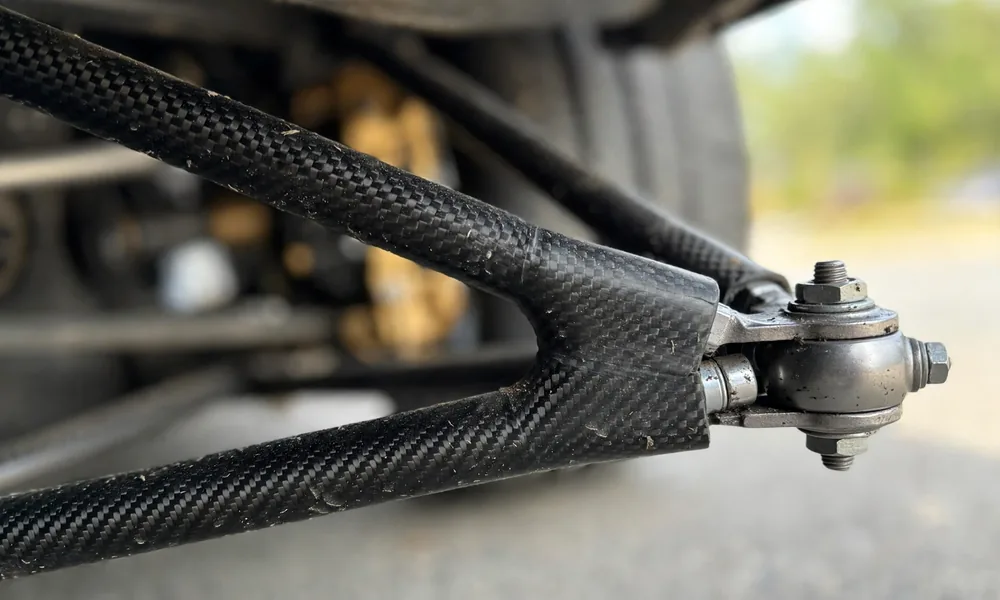
The wishbones, the A-shaped arms that connect the wheel to the chassis, are made from carbon fibre on a hypercar, and they are the most visible material in the suspension. The result is a part that is lighter than aluminium and stiffer than steel, and that can be shaped so the fibres run exactly along the direction of the load. The full process of shaping that carbon into a working part is described in how a hypercar suspension is made, from laying up the fibres to curing the finished arm.
2. Titanium fasteners and joints, the metal that holds it together
Where the wishbones meet the chassis and the wheel, the joints are made from titanium. Titanium is roughly as strong as steel but about forty per cent lighter, and it resists corrosion, which matters on a part that lives close to the road and gets sprayed with water and grit. The ball joints and the bolts that hold the suspension together are usually made from a titanium alloy, most commonly Ti-6Al-4V, which is machined to a precise fit and then given a surface treatment to resist wear.
3. Spring steel, the coil that carries the car
The springs on a hypercar are coil springs, wound from a high-strength steel, usually a silicon-chromium steel, that is heat-treated after winding to give it the right balance of strength and flexibility. The wire is thinner than on an ordinary car, because the spring has to be light, but it is made from a stronger steel, so it can carry the same load. The spring rate, the force needed to compress the spring by a given amount, is chosen to suit the car’s weight and its aerodynamics, and on a hypercar the spring has to cope with downforce that can exceed the weight of the car itself at high speed. The way the spring and the damper share that work is set out in how a hypercar suspension works, including how the suspension keeps the tyre in contact with the road at speed.
4. Damper materials, the oil and the valves inside
The damper, the shock absorber, is where the energy of a bump is turned into heat, and its materials are chosen for how they behave under pressure. The damper body is usually made from aluminium or steel, machined to hold a piston that slides inside it with almost no clearance. The oil itself is a synthetic fluid, chosen for its stable viscosity, because a damper that gets thinner as it heats up will go soft after a few hard laps.
5. Pushrods and rockers, the levers that move the work inboard
On many hypercars the springs and dampers are not mounted at the wheel. They are mounted inside the body, and connected to the wheel by a pushrod and a rocker, a lever that transfers the movement inboard. The pushrod is usually a carbon fibre tube, because it has to be light and stiff, and it carries the load in compression, which carbon fibre handles well. The rocker is machined from aluminium or titanium, and it pivots on bearings that have to survive high loads with almost no play. The active systems that adjust those dampers on the move are explained in the hypercar active suspension specifications, where the numbers show how quickly the system has to react.
6. Bushings and bearings, the small parts that decide the feel
The smallest parts of the suspension are the bushings and bearings, and they decide how the car feels more than any other material. A bushing is a flexible joint, usually made from rubber or polyurethane, that lets a suspension arm move slightly while absorbing vibration. On a hypercar, many of the bushings are replaced with solid metal bearings, because a rubber bushing flexes under load and changes the geometry of the suspension at exactly the moment it matters most. The trade-off is comfort: a car with solid bearings transmits every bump to the chassis, and the driver feels it.
Hypercar Suspension Materials
| Material | Where it is used | Why it is chosen |
|---|---|---|
| Carbon fibre composite | Wishbones and pushrods | Lighter than aluminium, stiffer than steel |
| Titanium alloy Ti-6Al-4V | Fasteners and joints | Strong as steel, forty per cent lighter |
| Silicon-chromium spring steel | Coil springs | Strong, flexible, resists sagging |
| Synthetic damper oil, sometimes magnetorheological | Dampers | Stable viscosity, changes stiffness fast |
| Aluminium or titanium rockers | Pushrod levers | Light, stiff, moves dampers inboard |
| PTFE composite bearings | Joints and bushings | Self-lubricating, no flex under load |
What Does a Hypercar Suspension Cost?
A hypercar suspension is estimated to cost roughly $30,000 to $80,000 for a full set of corners, including the wishbones, springs, dampers, and pushrods, and that is before the active control system. A single carbon fibre wishbone is estimated at roughly $3,000 to $8,000, and a single damper with magnetorheological fluid is estimated at roughly $5,000 to $10,000. The cost is why these materials stay on hypercars and racing cars, and why an ordinary sports car uses aluminium wishbones and steel springs instead.
A Rare Fact
The pushrod suspension on a hypercar comes directly from Formula 1. In the 1980s, Formula 1 teams moved their springs and dampers inside the bodywork to improve the aerodynamics, and they connected them to the wheels with pushrods, exactly as hypercars do today. The layout is now so closely associated with hypercars that it is a badge of honour, and a car without it is assumed to be a lesser machine, even though a conventional suspension can be just as fast on the road.

A hypercar suspension looks like a piece of sculpture, all carbon fibre and titanium and blue springs, but every material in it is there for a reason, and the reason is always the same: make it lighter, make it stiffer, and make it survive.


