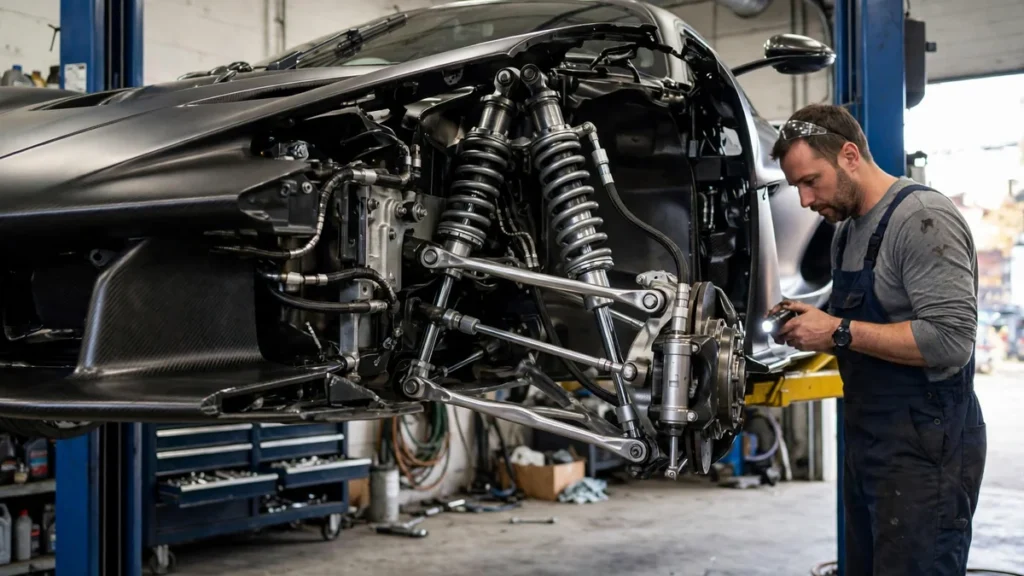
You are driving a fast car through a series of bends, and the gears arrive one after another with a small kick each time, so quick that the engine never seems to pause. There is no clutch pedal under your left foot, and no torque converter softening the shifts the way an old automatic did. The car simply changes gear, again and again, while the power keeps flowing.
That is a dual-clutch gearbox at work, and the reason it can shift that fast is not electronics. It is materials. Two clutches, two input shafts, and a set of gears that have to survive hundreds of newton-metres of torque, thousands of shifts a day, and oil temperatures that would cook an ordinary gearbox, all inside a casing not much bigger than a suitcase.
Here is what those materials are, and why each one earned its place.

The Materials Behind the Dual-Clutch Gearbox
1. Friction material, the lining that grips and lets go
The heart of the gearbox is the friction material on the clutch plates, and it is the most specialised material in the whole car. In a wet-clutch gearbox the plates are lined with a paper-based friction material, made from cellulose fibres mixed with resins and friction modifiers, running in oil. The material has to do two contradictory things: grip hard enough to transmit full engine torque without slipping, and then release cleanly hundreds of times a minute without shuddering. The way those plates are machined and assembled is described in how a dual-clutch gearbox is made, from the clutch packs to the finished unit.
2. Steel clutch plates, the backbone of the clutch pack
Behind every friction lining sits a steel plate, and the steel is not ordinary. The plates are made from high-carbon steel, heat-treated to a precise hardness, and ground flat to within a few micrometres, because a plate that is even slightly warped will not engage evenly and will wear out in patches. The steel has to stay flat at temperatures above 200 degrees Celsius, which is why the plates are often given a surface treatment, such as nitriding, that hardens the outer layer without making the core brittle. The grooves are shallow, usually less than a millimetre deep, but without them the clutch would overheat in stop-start traffic.
3. Gear steel, the teeth that never rest
The gears in a dual-clutch gearbox are made from alloy steels, usually a chromium-molybdenum steel such as 20MnCr5, chosen because it can be case-hardened. Case hardening means the surface of the gear is made very hard, to resist wear on the teeth, while the core stays tough and flexible, so the gear can absorb shock loads without cracking.
4. The aluminium casing, the housing that holds it all straight
The casing that holds the clutches, gears, and shafts is usually cast from aluminium alloy, often a silicon-aluminium alloy that flows well in a mould and machines cleanly. Aluminium is chosen because it is light, it conducts heat away from the oil, and it can be cast into the complex shapes the gearbox needs, with ribs and bosses in exactly the right places. The casing has to be stiff, because if it flexes under load the shafts move out of alignment and the gears wear unevenly, so the ribs are placed where the loads are highest. The two clutches inside that casing hand over to each other without dropping power, and the way that handover works is set out in how a dual-clutch gearbox works, including how the gearbox preselects the next gear before the driver asks for it.
5. Transmission oil, the liquid that is also a material
The oil in a wet-clutch gearbox is not just a lubricant. It is a working material, and it has to do three jobs at once: cool the clutches, lubricate the gears, and operate the hydraulics that move the shift forks. Dual-clutch transmission fluid is a synthetic oil, usually based on polyalphaolefin, with a carefully balanced additive package that controls friction. Too much friction modifier and the clutches slip; too little and they shudder.
6. Seals and the mechatronic unit, the parts that must not leak
The gearbox is controlled by a mechatronic unit, a block that combines hydraulic valves, solenoids, and electronics in a single housing, usually mounted on top of or inside the casing. The solenoids are wound from copper wire and sealed against the oil, and the valve body is machined from aluminium to tolerances that would shame a watchmaker. The same trade between shift speed, cooling, and torque capacity that shapes this gearbox also shapes its bigger cousin, and the hypercar gearbox materials show how far that trade can be pushed when cost is no object. In an ordinary dual-clutch gearbox the materials are a compromise, but they are a compromise that has to last a hundred thousand kilometres, and that is what makes them remarkable.
Dual-Clutch Gearbox Materials
| Material | Where it is used | Why it is chosen |
|---|---|---|
| Paper-based or organic friction lining | Clutch plates | Grips hard, releases smoothly, resists heat |
| Heat-treated high-carbon steel | Clutch plates and shafts | Stays flat and hard at high temperatures |
| Case-hardened chromium-molybdenum steel | Gears | Hard wearing surface, tough flexible core |
| Silicon-aluminium alloy | Casing | Light, stiff, conducts heat away |
| Synthetic dual-clutch transmission fluid | Clutches, gears and hydraulics | Cools, lubricates, controls friction |
| Fluorocarbon rubber seals | Seals and mechatronic unit | Survives hot oil and pressure without leaking |
What Does a Dual-Clutch Gearbox Cost?
A dual-clutch gearbox is estimated to cost roughly $2,000 to $5,000 more than a manual gearbox in the same car, depending on the number of gears and the torque capacity, and most of that difference is in the materials and the machining. A replacement clutch pack for a wet-clutch gearbox is estimated at roughly $1,500 to $3,000 before labour, and a full replacement gearbox is estimated at roughly $8,000 to $15,000. That figure is why a used car with a dual-clutch gearbox deserves a careful test drive in traffic, where a worn clutch shows up as hesitation or shuddering long before it fails outright.
A Rare Fact
The dual-clutch gearbox was invented for racing in the 1980s, not for road cars. Porsche developed the first working dual-clutch gearbox, called PDK, for its 956 and 962 racing cars, because it let the drivers shift without lifting off the throttle. The technology sat on the shelf for twenty years before it became cheap enough for road cars, and the first modern road-going dual-clutch gearbox arrived in a Volkswagen Golf in 2003.


A dual-clutch gearbox never gets the attention the engine gets, yet it is the part that decides how the engine’s power reaches the road. The friction material grips, the steel carries, the aluminium holds it straight, and the oil keeps it cool, and together they shift gears faster than a human ever could.