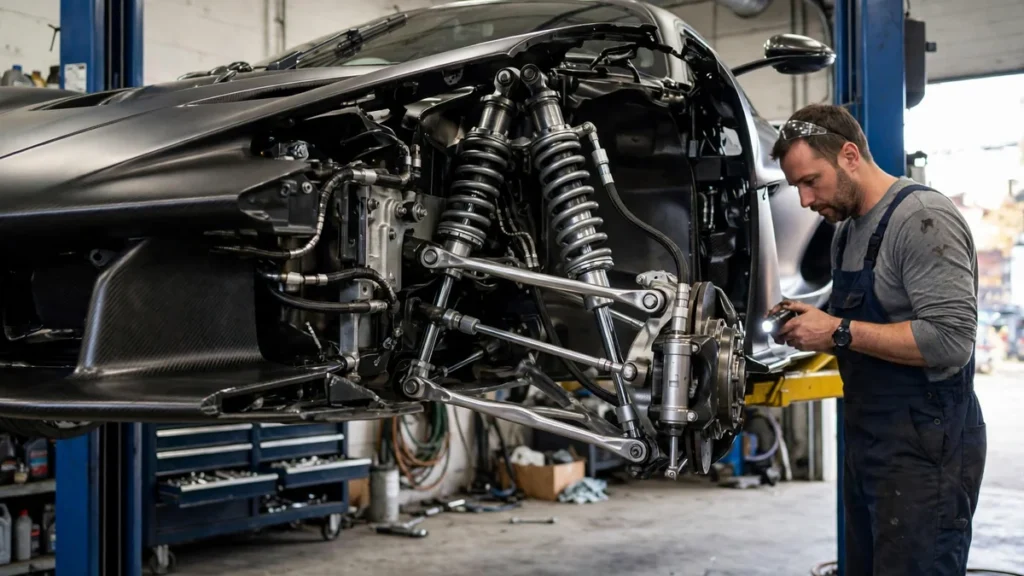
A wheel is the last thing most drivers think about, until it is the only thing between a car and the road. On a hypercar, the wheel has to be lighter than aluminium, stronger than steel, and able to survive potholes at 200 miles per hour The answer is carbon fibre, and a single carbon wheel takes days of hand work, a giant pressurised oven, and testing that would destroy an ordinary wheel in seconds.
Carbon wheels were once a racing curiosity, too fragile and too expensive for the road. Then the weaving, the resins, and the curing got better, and the weight saving became impossible to ignore: a set of four carbon wheels can save as much as 20 kilograms of unsprung weight, which is weight the suspension does not have to control. That changes how the car steers, brakes, and rides. Here is how a hypercar carbon wheel is made.
How It’s Made
Step 1: Designing the wheel
Before any fibre is cut, the wheel is designed on a computer and tested in simulation. Engineers decide where the loads go — the spokes carry the braking and cornering forces, the rim barrel holds the tyre, and the hub face bolts to the car — and then they map the fibre direction for each area. Carbon fibre is only strong along the direction of its threads, so a spoke might need layers running at several different angles. The design also has to pass strict road-wheel standards, which means the virtual wheel is crashed, kerbed, and fatigued thousands of times in software before a single real layer is laid down.
Step 2: Cutting the cloth
The raw material is carbon fibre cloth, woven from threads thinner than a human hair and pre-impregnated with resin — so-called prepreg. It arrives in rolls kept in a freezer, because the resin starts to cure slowly at room temperature. Workers cut the cloth into hundreds of shaped pieces using computer-guided cutters, following patterns like a tailor’s. Cut pieces are kept cold until they are needed. A single wheel can use several hundred individual plies, and getting one piece in the wrong place would weaken the finished wheel.

Step 3: Laying up the wheel
Layup is the slow, skilled heart of the job. Workers place the cut pieces one by one into a mould, smoothing each layer down by hand and rolling out any trapped air. The rim barrel is built up first, then the spokes, then the hub face, with extra layers added where the simulation showed the highest stress. The work is done in a clean, temperature-controlled room, and the workers wear gloves so skin oils never touch the fibre. This is the same careful hand work that goes into the cloth itself, as how carbon fibre weave is made explains, and a single wheel’s layup can take a full working day. When the last ply is down, the mould is closed and sealed in a vacuum bag.
Step 4: Curing in the autoclave
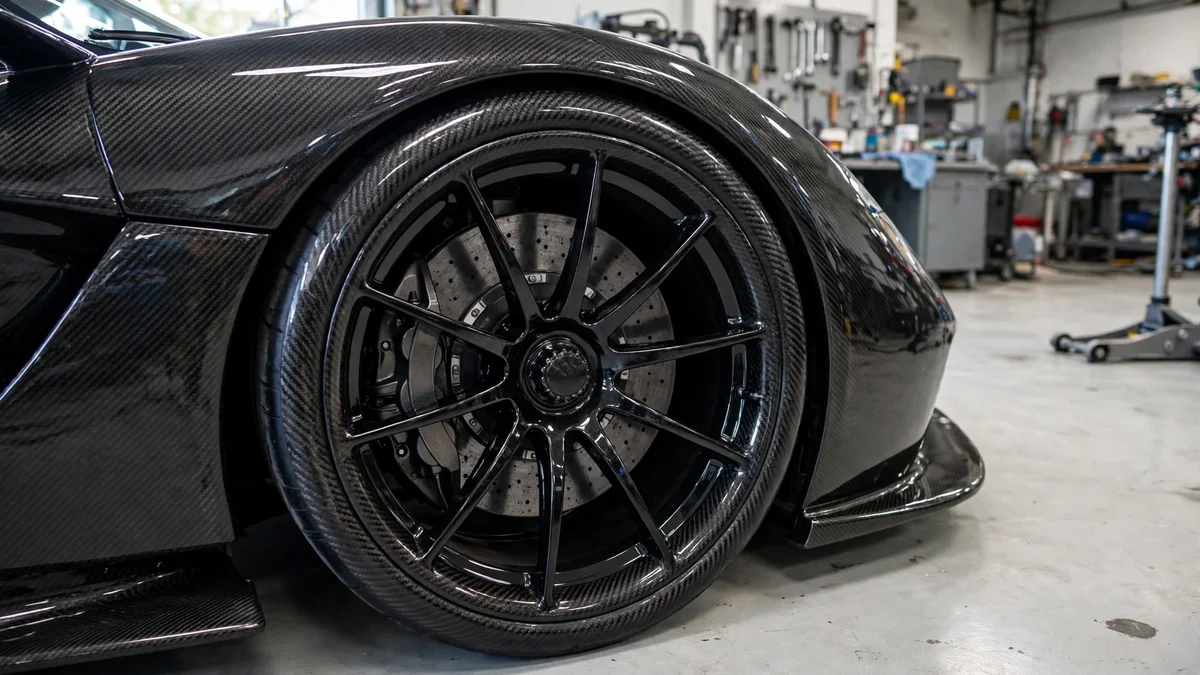
The sealed mould goes into an autoclave, a giant pressurised oven that bakes the resin hard. Inside, the temperature climbs to around 120 to 180 degrees Celsius while the pressure squeezes the layers together, forcing out any remaining air bubbles. The cure cycle lasts several hours and follows a precise recipe of heating and cooling, because a resin that cures too fast becomes brittle and one that cures too slowly never reaches full strength. When the autoclave door opens, the wheel comes out as a single rigid piece, dark and glossy, with the woven pattern visible under the surface. It is then trimmed and machined.
Step 5: Finishing and balancing
The cured wheel is sanded, inspected, and finished. Workers check the surface for pinholes and dry spots, then apply a clear coat that protects the carbon from sunlight and stone chips. The wheel is weighed — a finished hypercar carbon wheel typically weighs around 6 to 8 kilograms, roughly half an aluminium wheel of the same size — and then it is balanced on a machine with a tyre fitted. Any wheel that is out of balance or shows a defect is rejected. The finish must look as good as the wheel performs.

Step 6: Testing to destruction
Before a wheel design is allowed on the road, sample wheels are tested to destruction. They are spun at high speed under load, hit with impact rigs that simulate a kerb strike, and fatigued through millions of load cycles. Some wheels are deliberately broken to find out exactly where and how they fail, so the design can be strengthened. Every production wheel also gets a non-destructive check — ultrasound or X-ray — to make sure there are no hidden voids inside the laminate. The wheel shares the car with brakes that face the same brutal testing, as how carbon-ceramic brakes are made shows, and nothing is allowed on a hypercar until it has proved it can survive the worst day it will ever see.
Specs
| Specification | Typical figure |
|---|---|
| Weight per wheel | About 6–8 kilograms for a 20-inch wheel |
| Weight saving vs aluminium | Roughly 40–50 percent lighter |
| Material | Carbon fibre prepreg with epoxy resin |
| Cure temperature | About 120–180 degrees Celsius |
| Plies per wheel | Several hundred individual layers |
| Production time | Several days per wheel, mostly hand work |
| Standards | Road-wheel impact and fatigue testing |
| Finish | Clear-coated woven carbon fibre |
Price
Carbon wheels are among the most expensive parts on a hypercar. A single wheel is often estimated at $4,000 to $8,000, and a set of four can cost $15,000 to $30,000 or more as an estimate, depending on the size and the maker. That price reflects days of skilled hand work, expensive prepreg, and autoclave time. These are estimates, and the real price is usually buried inside the car’s options list. Even so, buyers keep ordering them, because the weight saving is real and no other wheel looks quite like woven carbon.
A Rare Fact
The first carbon fibre wheels were not made for cars at all — they were made for racing motorcycles in the 1990s, where the weight saving mattered even more and the wheels were small enough to build by hand. Road cars had to wait, because early carbon wheels could be damaged by a hard kerb strike in a way that was difficult to see, and regulators wanted proof that a damaged wheel would fail safely rather than shatter. Modern wheels are designed so that damage shows up in inspection, and some makers now build in a sacrificial outer layer that takes the scrape while the structure underneath stays intact.
A carbon wheel is the lightest way to connect a hypercar to the road, and it is only one part of a machine where every gram is argued over. The car it bolts to is engineered with the same obsession, as how the Aston Martin Valkyrie is made shows, and the wheel has to earn its place on it. The next time you see a hypercar with a woven black wheel, remember the freezer, the hand layup, and the oven — and the wheel that was deliberately broken so yours would never be.