Squeeze the brake lever on an electric bike and something remarkable happens in a fraction of a second. A small steel disc on the wheel, spinning at hundreds of revolutions a minute, is gripped by a pair of pads, and a bike that weighs as much as a person stops in a few metres. There is no screech, no shudder, and no smell of burning rubber. The bike simply slows, smoothly and firmly, as if an invisible hand had reached out and held the wheel.
That invisible hand is a disc brake, and on an e-bike it works harder than on any ordinary bicycle. An e-bike is heavier, it travels faster, and it is often ridden by people carrying shopping, children, or a heavy lock. Its brakes have to stop more weight, more often, and in all weather. The numbers on a disc brake specification sheet — rotor size, piston count, pad material — decide whether stopping feels calm and controlled or vague and frightening.
Here is what those numbers mean, in plain English.

How It Works
Step 1: The rotor
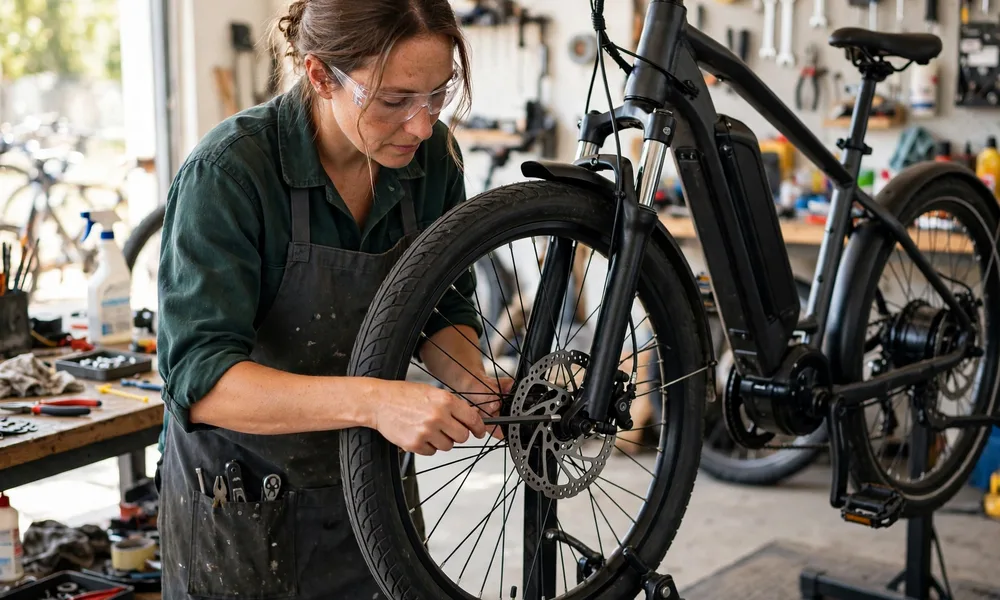
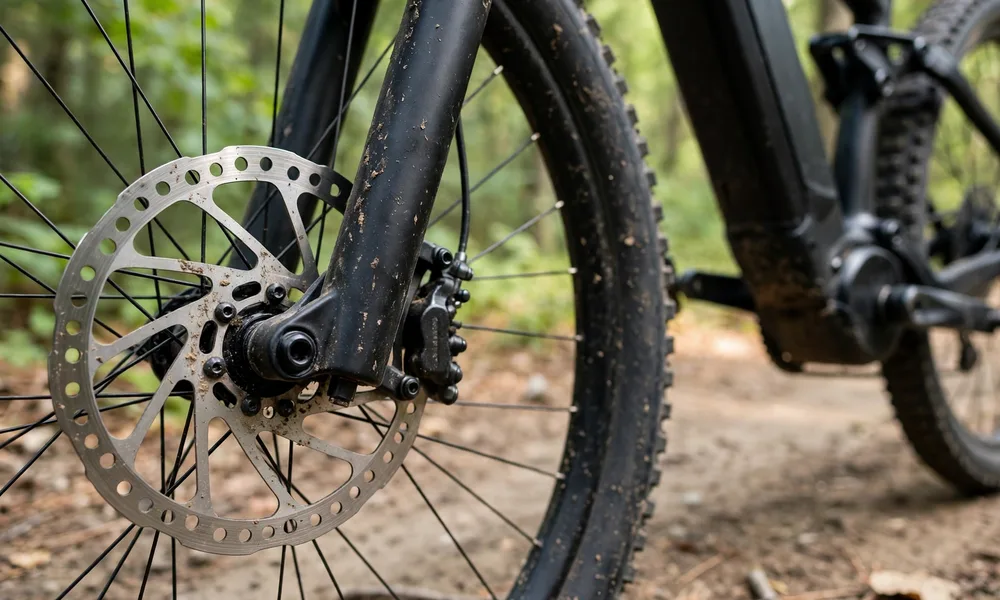
The most visible part of a disc brake is the rotor, a round steel disc bolted to the centre of the wheel. When the wheel spins, the rotor spins with it, and the brake works by gripping the rotor to slow it down. Rotor size is the first number that matters: most e-bikes use rotors of 160, 180, or 203 millimetres across. A bigger rotor gives the brake more leverage, so it stops the bike with less effort at the lever, and it also has more metal to absorb heat. Heavy e-bikes and mountain bikes usually get the biggest rotors, because they have the most weight to stop.
Step 2: The caliper and the pads
The rotor runs through the caliper, a small housing fixed to the frame or the fork, which holds the brake pads on either side of the disc. When you squeeze the lever, the pads are pushed against the rotor, and the friction between pad and steel turns the bike’s speed into heat. The pads are small — about the size of a postage stamp — but they do all the work. They are made from different compounds: resin pads are quiet and gentle on the rotor, while metallic pads last longer and cope better with heat, but they can be noisier in the wet.
Step 3: Hydraulic or mechanical
There are two ways to push the pads against the rotor. A mechanical disc brake uses a steel cable, like the brakes on an old bicycle: pull the lever, the cable pulls, the pads move. It is simple and easy to fix, but the cable stretches and needs adjusting. A hydraulic disc brake uses fluid in a sealed hose instead: pull the lever, a piston pushes fluid down the hose, and the fluid pushes the pads. Hydraulic brakes feel smoother, need less hand strength, and adjust themselves as the pads wear down, which is why most good e-bikes use them. Their cost is covered in our guide to why e-bike disc brakes are so expensive.
Step 4: Pistons and power
Inside the caliper, the pads are pushed by pistons, and the number of pistons is a good guide to how strong the brake is. A basic e-bike brake has two pistons, one on each side of the rotor. A stronger brake has four pistons, two per side, which spread the force more evenly across the pad and give more stopping power with the same squeeze at the lever. Four-piston brakes are common on heavy cargo bikes and mountain e-bikes, where the extra power matters on long, steep descents. The same idea appears on a much bigger scale in supercars, as explained in our guide to hypercar brake disc specs explained.
Step 5: Heat and fade
Every stop turns motion into heat, and on a long downhill that heat builds up fast. A brake rotor can reach several hundred degrees, and if it gets too hot the pads lose their grip — a problem called fade — and the lever can feel soft and useless. Big rotors, metallic pads, and rotors with cooling fins all help shed heat, and so does the rider: braking in short, firm bursts, rather than dragging the brake all the way down a hill, gives the rotor time to cool between stops. If your brakes ever feel weak after a long descent, stop and let them cool before you need them again.
Step 6: Modulation, bedding in, and care
A good brake is not just strong; it is controllable. Modulation is the word for how finely you can adjust the braking force, from a gentle slowing to a full stop, without the wheel locking up. Hydraulic brakes usually modulate better than mechanical ones. New pads and rotors also need bedding in: a dozen firm stops from speed, which transfers a thin layer of pad material onto the rotor and makes the brake grip properly. After that, the main jobs are keeping oil off the pads, replacing them when they wear thin, and bleeding the hydraulic fluid every year or two. The frame that carries all of this braking force is covered in our guide to how an e-bike carbon frame works.
E-Bike Disc Brake Specs
| Specification | Typical range |
|---|---|
| Rotor diameter | About 160, 180, or 203 millimetres |
| Pistons per caliper | Two on basic brakes, four on stronger brakes |
| Pad material | Resin for quiet braking, metallic for heat and life |
| Brake type | Mechanical cable or hydraulic fluid |
| Rotor thickness | About 1.8 to 2.3 millimetres |
| Weight per wheel | About 300 to 600 grams for caliper, rotor, and lever |
| Stopping distance | About 4 to 7 metres from 25 kilometres per hour |
| Pad life | About 500 to 2,000 kilometres, depending on use |
What Do E-Bike Disc Brakes Cost?
Disc brakes are a small part of an e-bike’s price, but they matter out of proportion to their cost. A mechanical disc brake set for one wheel is estimated to cost roughly $30 to $60 (estimate), while a hydraulic set is estimated to cost roughly $80 to $200 (estimate) per wheel, and a four-piston hydraulic set for a heavy cargo or mountain e-bike is estimated to cost roughly $150 to $400 (estimate) per wheel. A replacement rotor is estimated to cost roughly $20 to $60 (estimate). Prices are estimates only and vary by brand and specification.
A Rare Fact
On a long mountain descent, an e-bike brake rotor can get hot enough to burn skin on contact — several hundred degrees — and riders have measured rotors glowing faintly in the dark after a hard run down a steep pass. That heat is the bike’s speed turned into warmth: every stop pours energy into a disc of steel no bigger than a side plate.
A disc brake looks like a simple steel circle, but it is a careful argument between friction, heat, and control. When you understand its rotor size, its pistons, and its pads, you are reading the answer to the only question that matters when it counts: will this bike stop, quickly and calmly, when you need it to. On an e-bike, that question is worth asking before every ride.


