A rider is descending a mountain pass at sixty kilometres an hour when a car pulls out of a side road. There is no time to think, only to squeeze the brake levers, and in less than two seconds the e-bike sheds half its speed without a skid, a squeal or a wobble. The rider survives the moment and forgets it by the next bend. The brake that made it possible is a small disc of steel, a calliper the size of a matchbox and a handful of pads — and on a good e-bike, that little assembly costs more than some whole bicycles.
An e-bike disc brake looks simple, but it is asked to do a job no bicycle brake was ever designed for: stop a machine that weighs thirty kilograms or more, carries a rider and a motor, and regularly travels at speeds a racing cyclist only reaches downhill. It must do it in rain and mud, after thousands of stops, without fading, and it must do it with one finger. The price is the cost of materials, sealing and precision that make that possible.
Why It Costs So Much
A bicycle brake and an e-bike brake look alike, but the forces are different in kind. An e-bike is heavier, faster and ridden further than a pedal bike, and its brakes work harder on every single ride. Every part of the system has been upgraded to cope, and each upgrade adds cost.
Reason 1: The rotor is a heat sink, not a dinner plate
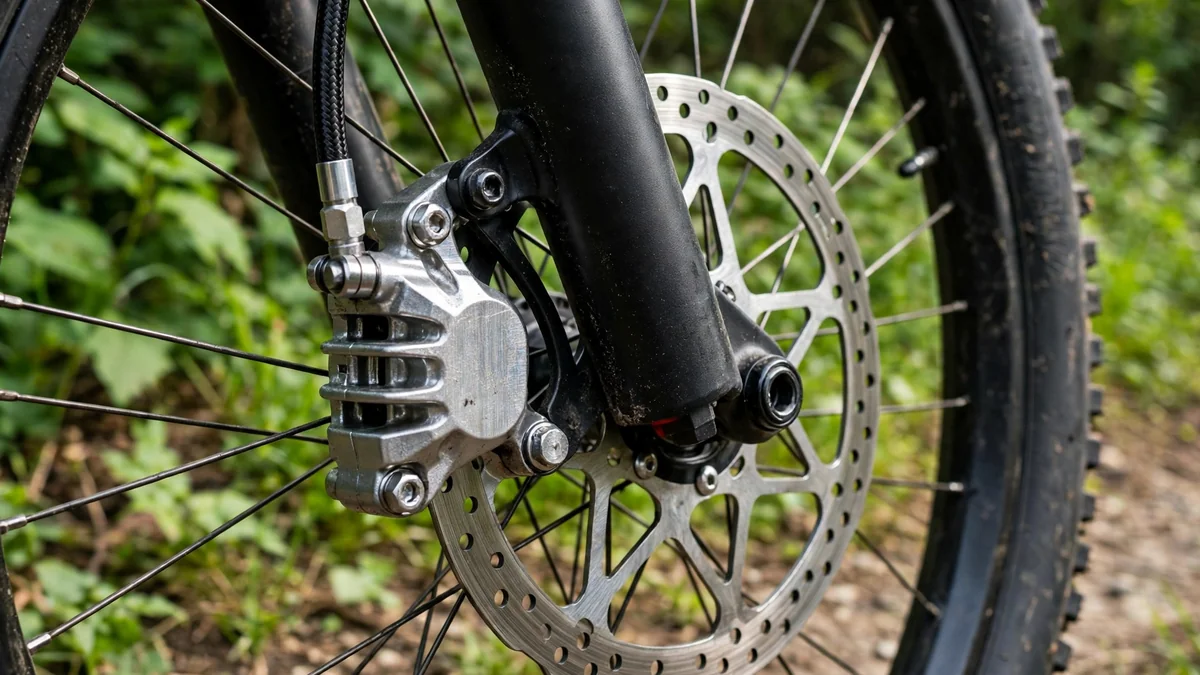
The steel disc, or rotor, is where speed becomes heat. A heavy e-bike descending a long hill can push a rotor past two hundred degrees Celsius, and a cheap rotor warps, glazes or fades when that happens. Good e-bike rotors are made from heat-treated stainless steel, often in two pieces — a steel braking surface riveted to an aluminium spider that sheds heat and stays true. The same heat problem shapes the most powerful brakes on the road, as carbon-ceramic brakes show.
Reason 2: The calliper is a tiny hydraulic machine
The calliper squeezes the pads against the rotor, and on a good e-bike it does so hydraulically: brake fluid pushes pistons that press the pads with even, enormous force. The calliper body is forged or machined from aluminium, its bores honed smooth, its pistons often made from ceramic or phenolic resin so they do not transfer heat into the fluid. Four pistons are common on heavier e-bikes, two on each side, so the pads wear evenly and the braking stays smooth.
Reason 3: The pads are a chemistry problem
Brake pads look like small blocks of friction material, but their compound decides everything: how hard the brake bites, how it behaves when wet, how long it lasts and how much noise it makes. E-bike pads use sintered metal compounds — copper, iron and other metals fused under heat and pressure — that keep working when they are hot and wet, where organic pads would fade. A set of pads is a consumable, but a good one is engineered like a component.
Reason 4: Hydraulic lines must never fail
The hose between lever and calliper carries brake fluid at high pressure, and it must survive years of steering, vibration, mud and crashes without leaking or swelling. Good hoses are reinforced, routed internally through the frame on many e-bikes, and fitted with sealed connectors that are bled of air at the factory. Air in a hydraulic brake makes the lever feel spongy and the braking unpredictable, so the system is filled and bled with the same care as a car’s brakes, then tested before the bike leaves the factory.
Reason 5: One finger must control it all
An e-bike brake lever is designed to be operated with a single finger, because the rider’s other fingers are holding the handlebar. That means the lever, the master cylinder and the calliper must multiply a small force into a large one, smoothly and predictably. The lever blade is forged aluminium with a reach adjustment, the pivot runs on bearings rather than a plain bush, and the bite point — the place where the pads first touch the rotor — is adjustable on better systems.
Reason 6: E-bikes are heavy, and weight punishes brakes
A typical e-bike weighs twice as much as a comparable pedal bike, and its motor adds speed on the flat and on climbs, so the brakes are used harder and more often. The motor that makes the bike heavy is itself a precision machine, as the e-bike mid-drive motor shows, and the brakes are sized to stop everything it can do.
Reason 7: Weather, mud and neglect are part of the job
An e-bike is ridden in rain, through mud and along salted winter roads, and its brakes must work the first time after a week parked outside. Seals keep water and grit out of the calliper, stainless hardware resists corrosion, and the whole system is designed to be serviced — pads changed, fluid replaced, rotors trued — by a mechanic with ordinary tools. The battery that powers the bike needs the same weatherproof thinking, as e-bike battery specifications show.

Specifications
| Specification | Detail |
|---|---|
| Rotor size | 180 to 203 millimetres on most e-bikes |
| Rotor material | Heat-treated stainless steel, often two-piece with aluminium spider |
| Calliper | Forged aluminium, two or four pistons, ceramic or phenolic |
| Pads | Sintered metal compound on steel or aluminium backing |
| Actuation | Hydraulic, mineral oil or DOT fluid, sealed lines |
| Lever | Forged aluminium, one-finger, reach and bite-point adjustment |
| Operating temperature | Rotors can exceed 200 degrees Celsius on long descents |
| Service | Pads, fluid and rotors replaceable with standard tools |
Price
A quality hydraulic e-bike disc brake set — lever, hose, calliper, rotor and pads for one wheel — is estimated to cost roughly $150 to $400 (estimate), with premium four-piston systems at the top of that range and a full pair for both wheels roughly double. That is several times the price of a basic mechanical bicycle brake, and it reflects the forged calliper, the two-piece rotor, the sintered pads and the hydraulic system built to stop a heavy, fast machine in the wet. Riders pay it because the alternative is a brake that fades on the one descent where fading matters.

Rare Fact
Some high-end e-bike rotors carry small cooling fins or a sandwich of steel and aluminium layers, borrowed directly from motorcycle and car brake design. The disc on a bicycle is quietly becoming a piece of motorsport engineering, because the speeds and weights it must handle are now closer to a motorbike’s than to a bicycle’s.
That is why e-bike disc brakes cost so much: they are hydraulic machines built to stop a heavy, fast vehicle in any weather, with materials and tolerances a pedal bike never needed. The next time a single finger brings thirty kilograms to a calm stop in the rain, remember the forged calliper, the sintered pads and the rotor glowing quietly with heat — they are the reason the stop was boring instead of terrifying.