Floor the throttle in a hypercar and the world tilts. The engine note hardens, the horizon rushes at you, and behind your shoulders a turbine the size of a grapefruit spins faster than a dentist’s drill, forcing twice as much air into the engine as it could breathe alone. That turbine lives in exhaust gas hotter than a kiln, spinning at speeds that would tear ordinary metal apart, lap after lap, year after year.
The turbocharger is the most abused component in a hypercar. One side sits in exhaust gas at nearly a thousand degrees, while the other gulps cold air at motorway speed. Its shaft spins fast enough to make a full rotation in the time a camera flash takes to fire, and if a single blade fails, the debris goes straight into an engine worth more than a house.
The Materials Behind the Turbocharger
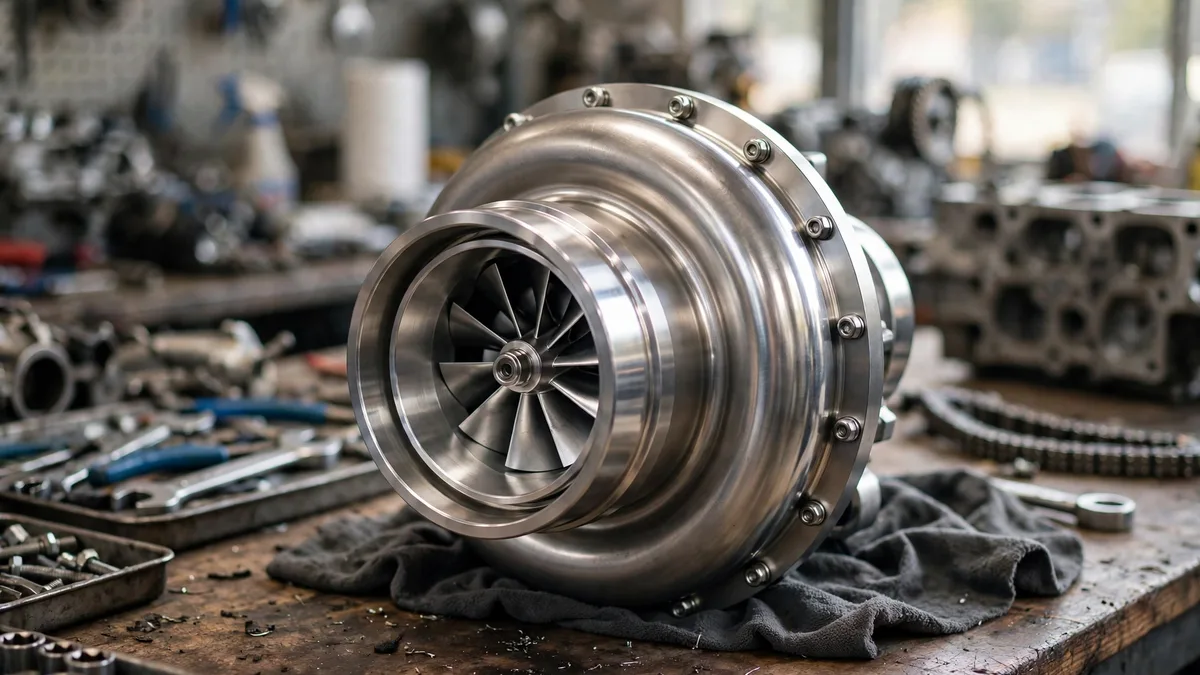
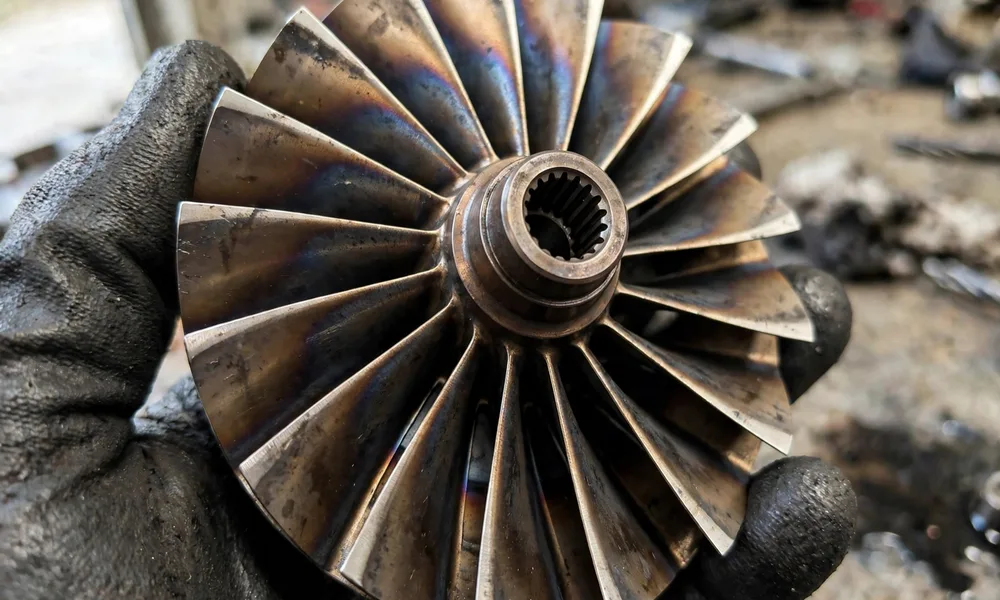
At the heart of the turbocharger sits the turbine wheel, made from Inconel, a nickel-based superalloy that keeps its strength at temperatures where steel would sag like warm toffee. Inconel is cast in a single piece, with blades thin enough to slice air yet tough enough to survive a constant blast of exhaust gas, and it resists the oxidation that would eat an ordinary alloy alive in weeks. Some hypercar turbines go further with titanium-aluminide, an alloy half the weight of Inconel that lets the turbine spool up faster, shaving precious milliseconds off the wait between throttle and surge.
The shaft linking turbine to compressor spins on bearings that never touch metal: a film of engine oil, or in exotic designs a ball bearing of ceramic silicon nitride, carries a shaft turning at up to 200,000 revolutions per minute. The compressor wheel is usually forged aluminium alloy, light enough to spin up instantly and strong enough to fling air at twice the speed of sound, while the housings are cast from iron or aluminium alloys chosen to contain the heat without cracking. The assembly is balanced to within a fraction of a gram, because at those speeds even a speck of imbalance would shake the turbo to pieces. The same obsession with spinning metal at impossible speeds shapes the rest of the drivetrain, from the gears inside a dual-clutch hypercar gearbox to the discs that stop it all, carbon-ceramic brakes.
How It Is Made
Building a hypercar turbocharger is foundry work at aerospace tolerances: molten superalloy, machined to microns, balanced to fractions of a gram. The process runs roughly like this.
- Cast the turbine. Molten Inconel is poured into a ceramic mould in a vacuum furnace, forming the turbine wheel and its blades in one piece, then cooled slowly to avoid internal stress.
- Forge the compressor. A billet of aluminium alloy is forged under huge pressure into a blank, then machined on a five-axis mill into curved compressor blades.
- Machine the shaft. A steel shaft is ground to a mirror finish and heat-treated, because any roughness would destroy the oil film keeping it afloat at full speed.
- Fit the bearings. Ceramic ball bearings or journal bearings are pressed into the centre housing, fed by oil passages drilled to a fraction of a millimetre.
- Balance the rotor. The turbine, shaft and compressor are assembled as one rotor and spun in a balancing machine, with tiny amounts of metal removed until vibration all but disappears.
- Test at full speed. Each finished turbo is spun to maximum speed on a test rig while hot gas is blown through it, and any unit that vibrates, leaks or smokes is rejected.
Why These Materials Win
Inconel wins because nothing else survives the exhaust stream: at 950 degrees, ordinary steel loses most of its strength and stainless steel scales and flakes, while Inconel barely notices. Titanium-aluminide wins where response matters, because a lighter turbine spins up faster and kills the lag that once made turbocharged cars feel lazy. Ceramic bearings win because they are harder and lighter than steel, surviving speeds and temperatures that would cook a steel bearing in minutes, and forged aluminium wins for the compressor because it is the lightest way to make a wheel that flings air at supersonic speed.
The failures are instructive, too. A turbine blade that cracks from thermal fatigue sheds fragments into the exhaust and can destroy the engine. A bearing starved of oil seizes in seconds, and a shaft spinning at 200,000 revolutions per minute stops with a violence that wrecks the unit. A compressor wheel that ingests a stone is ruined instantly. Engineers fight all three with better alloys, oiling and air filters, and the result can outlast the car around it. It is the same materials logic that shapes the rest of the engine: the turbo must be light yet indestructible, which is why the engine of a Bugatti W16 is built around turbos made the way these are, with every material chosen to survive heat no other part of the car ever sees.
Specifications
| Specification | Detail |
|---|---|
| Turbine wheel | Inconel nickel superalloy, investment cast |
| Compressor wheel | Forged aluminium alloy, five-axis machined |
| Shaft | Heat-treated steel, mirror ground |
| Bearings | Ceramic ball or oil-film journal bearings |
| Housings | Cast iron turbine housing, aluminium compressor housing |
| Maximum speed | 150,000 to 200,000 revolutions per minute |
| Exhaust temperature | Up to 950 degrees Celsius |
| Boost pressure | 1.5 to 2.5 bar in a hypercar |
Price
A hypercar turbocharger is one of the most expensive components bolted to the engine, and it is priced like an aerospace part. A replacement turbocharger for a high-performance car typically sells for around $2,000 to $8,000 (estimate), while a bespoke hypercar unit with a titanium-aluminide turbine is estimated to cost several times more at low volume (estimate). The real expense is not the raw alloy but the machining and balancing: every rotor is individually spun and balanced to a fraction of a gram, because one unbalanced turbo would destroy itself the first time the driver floored the throttle. That testing is why a hypercar can be driven hard for years without its turbos missing a beat.

Rare Fact
The turbine inside a hypercar turbocharger spins so fast that its blade tips travel faster than sound, and the whole rotor makes a revolution in about a third of a millisecond. At that speed the centrifugal force on each blade is equivalent to hanging a small car off its tip, and the metal holds together only because superalloys like Inconel get their strength from tiny ordered particles inside the metal that block the defects that would let it creep apart. Engineers even cool the turbine by letting a little air leak past it, because a blade running a few dozen degrees cooler can last ten times longer.
That is the hidden craft of the hypercar turbocharger: a wheel of metal that laughs at a thousand degrees, spinning faster than anything else in the car, on bearings that never touch. You never see it, you only feel it as a shove in the back, yet it is the part that turns a good engine into an unforgettable one.