Watch a hypercar cross a speed bump and nothing happens. The body stays flat, the wheels rise and fall beneath it, and the driver feels almost nothing. It looks like magic, but it is engineering: a suspension system that reads the road hundreds of times a second and pushes back against every bump, dive and roll before the driver notices. Ordinary suspension reacts. Active suspension predicts.
That prediction is why it costs so much. A normal damper is a sealed tube of oil with a few valves. An active system is a network of sensors, a computer, hydraulic pumps and actuators, all working together in real time, built to survive heat, vibration and forces that would destroy ordinary parts. It is closer to aircraft flight controls than to a car shock absorber, and it is priced that way.
Why Hypercar Active Suspension Costs So Much
An active suspension system looks like a set of springs and dampers, but most of the cost hides in the parts you cannot see. Here are the seven reasons the bill is so high.
Reason 1: The sensors never stop watching
An active system starts with sensors: accelerometers on the body and wheels, ride-height sensors at each corner, steering and brake inputs, and sometimes cameras that scan the road ahead. Each sensor must be accurate to a fraction of a millimetre, fast enough to report hundreds of times a second, and tough enough to live next to a hot brake disc in rain and grit. A single failed sensor can confuse the whole system, so they are built to aerospace standards and priced accordingly. The way the parts fit together is explained in how a hypercar active suspension works, and the sensors are where that story begins.
Reason 2: The computer decides in milliseconds
All that sensor data flows into a control unit that must decide, in a few thousandths of a second, how hard each wheel should push. The software behind it is the result of years of testing: engineers drive the car over every kind of road, record what the suspension should have done, and tune the code until the car feels calm at any speed. Writing that software costs millions of dollars (estimate) before a single car is sold, and it must be updated and tested again for every new model. The code is the most expensive invisible part of the car.
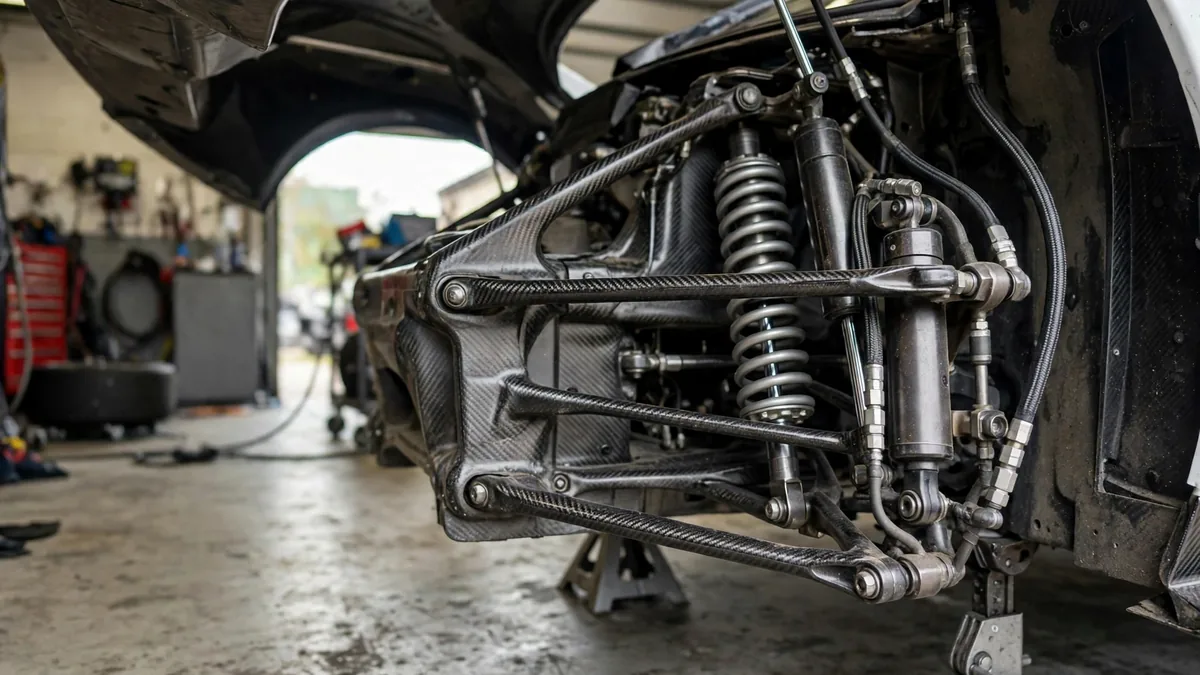
Reason 3: Hydraulic actuators are precision machines
The computer’s decisions are carried out by hydraulic actuators — small, immensely strong rams that can push a wheel up or down with thousands of newtons of force in a blink. Each one is machined to tolerances of a few microns, sealed against leaks at pressures of several hundred bar, and tested until it can cycle millions of times without wearing out. A single actuator can cost thousands of dollars (estimate), and a car needs four. They are built in clean rooms by specialists, not on a normal production line.
Reason 4: The pump and plumbing cost a fortune
Hydraulics need power, and that means a high-pressure pump, a reservoir, cooling and metres of braided hose routed through a crowded chassis. The pump must deliver full pressure the instant the system asks for it, even at low engine speeds, and the fluid must stay clean and cool under constant use. Every fitting is a potential leak, so the plumbing is assembled and pressure-tested by hand. The whole hydraulic circuit adds weight, complexity and cost, and it needs servicing by trained technicians for the life of the car.
Reason 5: The structure must be stronger everywhere
Active suspension can push a wheel down with far more force than a passive spring, and that force has to go somewhere. The wishbones, uprights and chassis mounting points are all made stronger to carry it, usually from carbon fibre or machined aluminium, and each part is designed and tested for loads a normal car never sees. The extra strength adds cost twice: once in the parts themselves, and once in the testing that proves they will not fail. Building those parts is a craft of its own, as shown in how a hypercar suspension is made.
Reason 6: It must be tuned for every car, by hand
No two hypercars behave the same, so an active system cannot be bolted on and forgotten. Engineers spend weeks on test tracks and rigs, tuning the software corner by corner until the car feels right — flat in corners, calm over bumps, stable under braking. The tuning is done by a small team of specialists whose time is billed by the day, and the work is repeated for every variant of the car. A suspension that feels effortless to the driver is the result of hundreds of hours of invisible labour.
Reason 7: Few suppliers can build it at all
The final reason is scarcity. The companies that can design and supply active suspension for a hypercar can be counted on one hand, and each system is built in tiny numbers. There is no mass-market version to copy, and no cheap way to make a hydraulic actuator or a control unit that must survive a decade of heat and vibration. The buyer pays for a supply chain the size of a workshop, and for the knowledge of the few engineers who understand it. Even a conventional setup is a serious piece of engineering, as how a hypercar suspension works shows — and the active version adds a computer on top.

Hypercar Active Suspension at a Glance
| Specification | Detail |
|---|---|
| System type | Hydraulic active, four corners |
| Sensor updates | Hundreds of times per second (estimate) |
| Control decision time | A few milliseconds (estimate) |
| Hydraulic pressure | Several hundred bar (estimate) |
| Actuator force | Thousands of newtons per corner (estimate) |
| Main materials | Carbon fibre, machined aluminium, steel |
| Typical system cost | $20,000 to $50,000 (estimate) |
| Main benefit | Flat body, grip and comfort at once |

What Does It Cost?
A full active suspension system for a hypercar typically costs between $20,000 and $50,000 (estimate), and that is before the cost of fitting, tuning and servicing it over the life of the car. What the money buys is a car that can be soft over a bump and stiff in a corner at the same time — two things a passive suspension cannot do together. It buys grip on rough roads, stability under braking, and a ride that feels calm at speeds where an ordinary car would be nervous. For a hypercar, that is not a luxury. It is part of what makes the car drivable at the speeds it was built for.
A Rare Fact
Some active suspension systems can read the road ahead and prepare for a bump before the wheel reaches it. Using cameras or sensors that scan the surface in front of the car, the system lifts or firms up each wheel in advance, so the bump is absorbed before the body ever feels it. The car is, in effect, reacting to a pothole it has not hit yet — a trick that would have sounded like science fiction a generation ago, and that only works because the computer, the sensors and the actuators are fast enough to stay ahead of the road itself.