Electric outboards have a simple problem: the battery is the boat’s fuel tank, and refilling it takes hours. A petrol outboard can be refuelled in minutes at any marina, but an electric outboard plugged into a charger sits idle while the battery slowly fills. Battery swapping is the workaround. Instead of charging the battery in the boat, you lift the flat pack out, slot in a fresh one, and carry on. The idea is borrowed from electric scooters, where it already works at scale, and it is now moving into boats in two very different forms: small swappable packs for outboards and tenders, and container-sized batteries for ferries and workboats.
The logic is the same in both cases. Charging is slow, swapping is fast, and the expensive part, the battery, can be owned and maintained by someone else. A boat owner who swaps batteries never waits for a charge, never worries about a battery ageing in their boat, and never has to find a fast charger at a remote marina. The cost is standardisation: swapping only works if the battery, the connector, and the station all agree on a common design, and that agreement is the hard part.

How Swapping Works on a Small Outboard
The clearest example is Mercury’s Avator 7.5e, the first electric outboard in the company’s range to use a swappable battery. The motor delivers 750 watts at the prop shaft, roughly a 3-horsepower equivalent, and its battery is a 1-kilowatt-hour lithium-ion pack built with Mastervolt. The pack is IP67 rated, weighs about 16 pounds, and slides into the top of the motor under a hinged lid. When it runs flat, the owner lifts it out by the handle and drops in a spare. A second pack doubles the range in seconds, and both packs can be taken home and charged from a household outlet overnight.
The rest of the system is built around the same idea of portability. The whole motor weighs about 59 pounds including the battery, and it can be steered with a ratcheting tiller that locks into a carry handle. A display above the tiller shows battery state and estimated range, and a companion app maps the remaining range on the water. The battery is the only part the owner ever has to handle, and it is designed to be handled: sealed against spray, light enough to carry with one hand, and fitted with a quick-connect mounting system that needs no tools.
Honda has shown the same concept from the other direction, with a prototype electric outboard designed around its Mobile Power Pack e:, the Gogoro-style portable battery the company already uses in its electric scooters. The motor itself was shown without specifications, but the battery is the point: a standardised pack that works across scooters, micro-EVs, and now boats. If the same pack can power a scooter in the morning and an outboard in the afternoon, the economics change completely, because the battery is no longer a boat part but a shared piece of infrastructure.
The Big Version: Containerised Marine Batteries
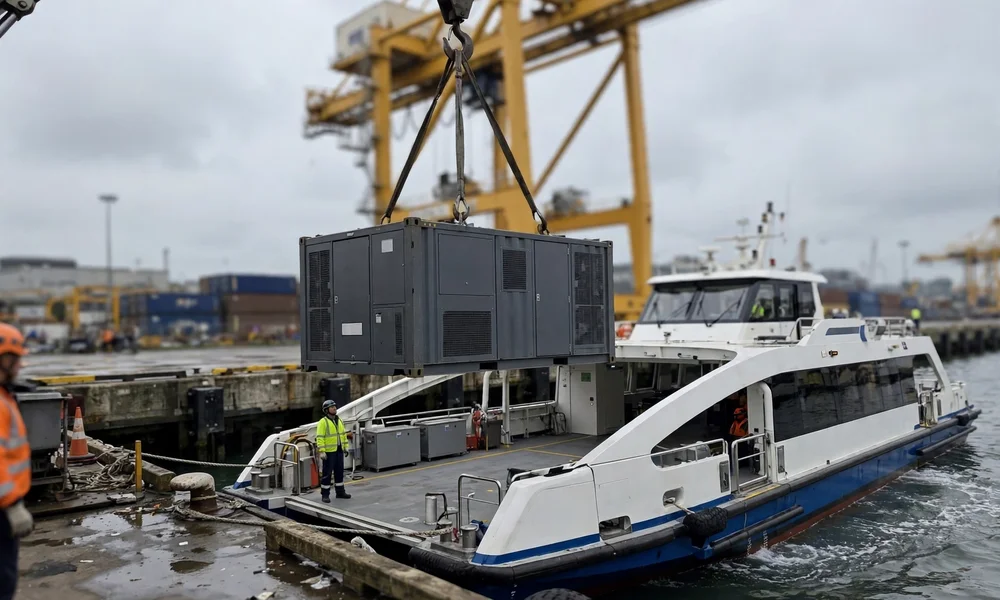
At the other end of the scale, swapping looks completely different. Marine battery maker AYK Energy has unveiled Cosmos, a containerised battery system designed for ferries, RoPax vessels, and workboats. The batteries are loaded onto the vessel in standard containers and exchanged between voyages, rather than being permanently installed in a dedicated battery room. They are charged off-site, transported to port, and loaded according to the energy a particular voyage needs. Multiple units can be loaded for a fully electric crossing, or removed and replaced between trips.
The advantage for a ferry operator is turnaround time. A ferry that charges at the dock is tied up for the duration of the charge, and a fast charge stresses the battery and demands a powerful grid connection at the port. A ferry that swaps containers can be turned around as fast as the crane can work, while the discharged containers charge slowly ashore, where power is cheaper and the grid load is easier to manage. The same containers can also provide temporary hotel-load power while the vessel is alongside, and they can be permanently installed if the owner prefers a conventional fixed system.
Cosmos is built to marine standards, with eight independent levels of safety, IP67 protection, and an A60 fire rating, and AYK says it has completed its new-technology qualification stage and is receiving orders ahead of class approval. The company previously secured DNV certification for its LFP batteries, and its founder worked on the hybrid ferry Prinsesse Benedikte and the fully electric ferry Ampere. The target is clear: make electric propulsion practical for vessels that cannot afford to sit at a charger.

Why Swapping Beats Charging on the Water
The case for swapping is strongest where charging is weakest, and boats are almost the worst case for charging. Marinas often have limited electrical capacity, and a fast charger for a boat battery needs a grid connection that many small harbours simply do not have. A boat that charges overnight at a marina is fine until the owner wants to go further than one charge allows, and then the trip is over. A swappable battery removes the wait entirely: the boat is ready as soon as the pack is changed, and the charging happens somewhere else, at whatever pace the grid allows.
The Problems That Still Need Solving
The biggest problem is standardisation. Swapping only works if the battery fits the boat, the connector matches, and the station stocks the right pack. Gogoro solved this by building the network and the scooters together, and by getting ten brands and 47 models onto the same pack in Taiwan. Honda is trying the same with its four-maker Gachaco venture. In boats, there is no equivalent agreement yet: Mercury’s Avator pack fits Mercury’s motor, Honda’s pack fits Honda’s products, and nobody’s pack fits anyone else’s. Until a standard emerges, swapping will stay locked inside single-brand ecosystems.
The other problem is the marine environment itself. Salt water, vibration, and impact are harder on connectors than anything a scooter faces, and a battery that is swapped dozens of times needs a connector that survives every mating without corrosion or wear. The packs are sealed to IP67, but the connector is the weak point, and it has to be both waterproof and easy to use with wet hands. The economics are also unproven: a swap network needs enough stations and enough users to pay for itself, and the boating market is far smaller and more seasonal than the scooter market.
Where It Goes From Here
Our ranking of the best electric outboard motors shows where the swappable Avator sits against its rivals, and our guide to how electric boat charging works covers the alternative the swap is trying to beat. The wider picture is in the best electric boat propulsion systems, where swapping is one option among several. Battery swapping will not replace charging, but for boaters who want to keep moving, it is the most practical way to make an electric boat behave like a petrol one.