An electric car slips down the motorway at a steady hundred kilometres an hour, and the air flowing beneath it is doing more work than most drivers ever imagine. It is not just passing underneath. It is being shaped, smoothed and hurried along by a flat panel most owners never see, a panel that decides how much of the battery’s energy is spent fighting the wind and how much is spent moving the car forward.
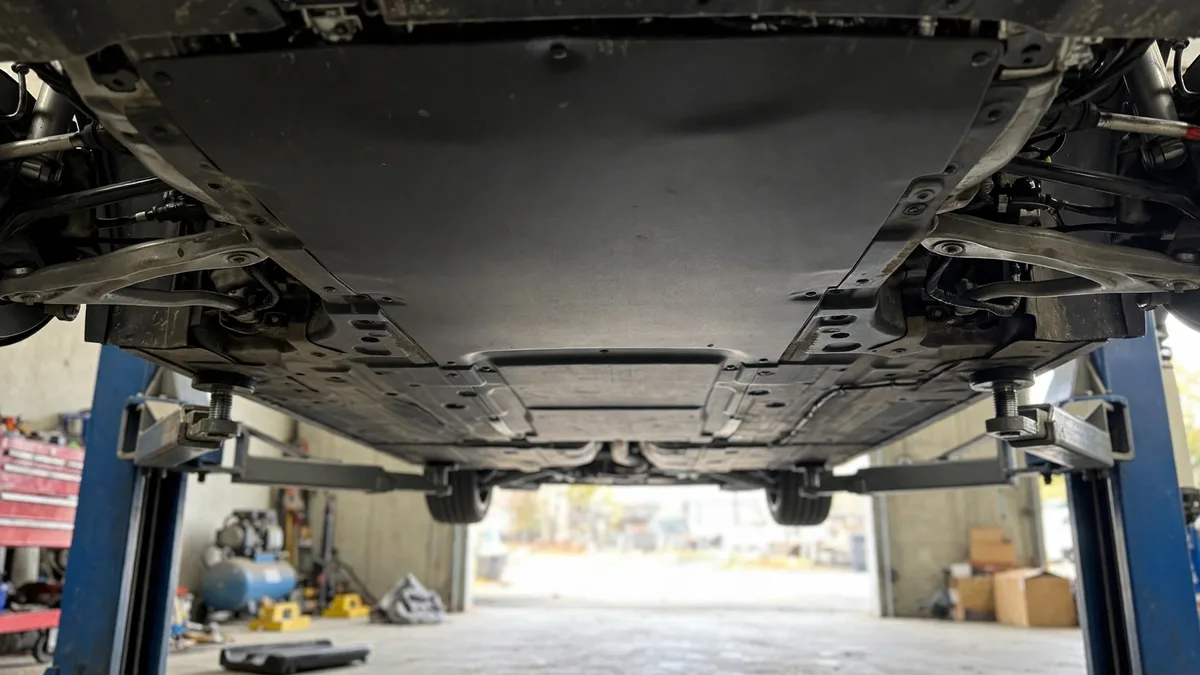
That panel is the aerodynamic underbody, a full-length shield that turns the messy underside of a car, with its cables, cooling pipes and suspension arms, into one smooth surface. Engineers obsess over it because the underside of a car is where a surprising amount of drag is born. Get it right and the car goes further on every charge, stays quieter at speed, and feels more planted on the road.
The panel must be light, stiff, cheap to make in huge numbers, and tough enough to survive kerbs, stones and standing water. Here is what it is made from, why each material earned its place, and what happens when it fails.
The Materials Behind the EV Aerodynamic Underbody
1. Glass-fibre composite, the workhorse of the flat floor
Most underbody panels are moulded from glass-fibre reinforced plastic, often a polypropylene or polyester resin loaded with chopped or woven glass fibres. Engineers choose it because it is light, stiff for its weight, and can be pressed into a large flat panel with ribs, vents and mounting holes in a single moulding step. It is compression moulded: fibre and resin are heated and pressed into shape in a steel mould. When glass-fibre composite fails, it usually cracks rather than bends. A stone strike or a hard scrape on a kerb can start a crack that spreads along the fibres, and a cracked panel flutters at speed, making noise and letting drag creep back.
2. Carbon fibre, the stiff skin where it matters most
On high-performance electric cars, the most stressed sections of the underbody are made from carbon fibre composite. Carbon fibre is chosen because it is far stiffer and lighter than glass fibre, so a thin panel can span a wide gap without sagging or vibrating. The fibres are laid in woven sheets, soaked in epoxy resin, and cured under heat and pressure in an autoclave. When carbon fibre fails, it fails suddenly and without warning. Unlike metal, it does not dent and deform first; a hard impact can delaminate the layers inside while the surface looks almost untouched.
3. Aluminium, the shield for the battery beneath
Directly beneath the battery pack, the underbody is often a sheet of aluminium alloy. Aluminium is chosen because it is light, conducts heat away from the battery, and can be stamped or extruded into strong, thin panels that shield the cells from stones thrown up by the tyres. The sheet is rolled, stamped into shape, and coated against road salt. When aluminium fails, it dents and tears rather than shattering. A sharp stone can puncture a thin sheet, and a dented panel can press against the battery casing or trap water against it, starting corrosion.
4. Thermoplastic polyurethane, the flexible edge that takes the scrapes
The front lip and the flexible skirts around the wheels are often made from thermoplastic polyurethane, known as TPU. Engineers choose it because it is tough and springy: it bends when it scrapes a speed bump instead of snapping, then returns to shape. TPU is moulded or extruded into flexible strips and bolted along the panel edges. When TPU fails, it does so slowly, becoming stiff and brittle after years of heat, road salt and ultraviolet light.
5. Acoustic felt, the quiet layer inside
Between the hard outer panel and the car body sits a layer of dense acoustic felt, made from recycled textile fibres bonded with resin. It is chosen because it absorbs the drumming of rain and the roar of the tyres, making the cabin quieter without adding much weight. The felt is pressed into shape, treated to repel water, and clipped inside the panel. When acoustic felt fails, it usually soaks up water. A torn panel lets in spray, the felt becomes heavy and soggy, and it sags onto the panel below, where it can trap moisture against metal parts and speed up corrosion.
6. Steel fasteners, the small parts that hold everything together
The whole underbody is held to the car with dozens of steel bolts, clips and rivets, usually stainless or zinc-coated steel. Steel is chosen because the fasteners must clamp hard, resist corrosion, and survive constant vibration without loosening. They are cold-formed, threaded, and coated against salt spray. When steel fasteners fail, they usually seize or corrode in place. A rusted bolt snaps when a mechanic tries to remove it, and a loose clip lets a panel corner droop at speed, where the wind catches it. That is why underbody work always starts with a check of the fasteners.
EV Aerodynamic Underbody Materials
| Material | Where it is used | Why it is chosen |
|---|---|---|
| Glass-fibre composite | Main flat panels | Light, stiff, moulded in one step |
| Carbon fibre composite | High-stress sections | Very stiff and light, thin panels span wide gaps |
| Aluminium alloy | Battery shield | Light, conducts heat, shields cells from stones |
| Thermoplastic polyurethane | Front lip and skirts | Flexible, bends instead of snapping |
| Acoustic felt | Inner sound layer | Absorbs tyre and rain noise, low weight |
| Coated steel | Bolts, clips and rivets | Strong clamping, resists vibration and corrosion |
EV Aerodynamic Underbody Specifications
| Specification | Typical value |
|---|---|
| Coverage | Full length, front bumper to rear axle |
| Main panel material | Glass-fibre reinforced plastic |
| Panel thickness | About 2 to 4 millimetres |
| Weight | About 8 to 15 kilograms for a full set |
| Battery shield | Aluminium alloy sheet, about 1.5 millimetres |
| Drag benefit | Can cut drag coefficient by roughly 0.02 to 0.04 |
| Fasteners | About 20 to 40 steel bolts and clips |
| Service life | Life of the vehicle, unless damaged by impact |
The full process of shaping these panels is described in how an EV aerodynamic underbody is made, and the same obsession with smooth air shapes the fastest cars in the materials behind the hypercar aerodynamic body. The heat that the smooth floor helps to manage is covered in the materials behind EV thermal management.
A Rare Fact
The smooth underbody is older than the electric car itself. Racing engineers in the 1970s discovered that a flat floor with a shaped rear diffuser could pull a car down onto the track, and the idea, known as ground effect, was so powerful that it was banned from Formula 1 in 1983. Everyday electric cars inherited the same trick in a gentler form: instead of generating downforce, their flat floors simply let the air pass cleanly, which is why a family electric car today can be more aerodynamically slippery than many of the supercars of the past.


Nobody buys an electric car for its underbody, and most owners will never see it. Yet every kilometre of extra range and every decibel of quiet at speed owes something to this flat sheet. Glass fibre gives it span, carbon fibre stiffness, aluminium armour, flexible plastic forgiveness, felt silence, and steel grip.


