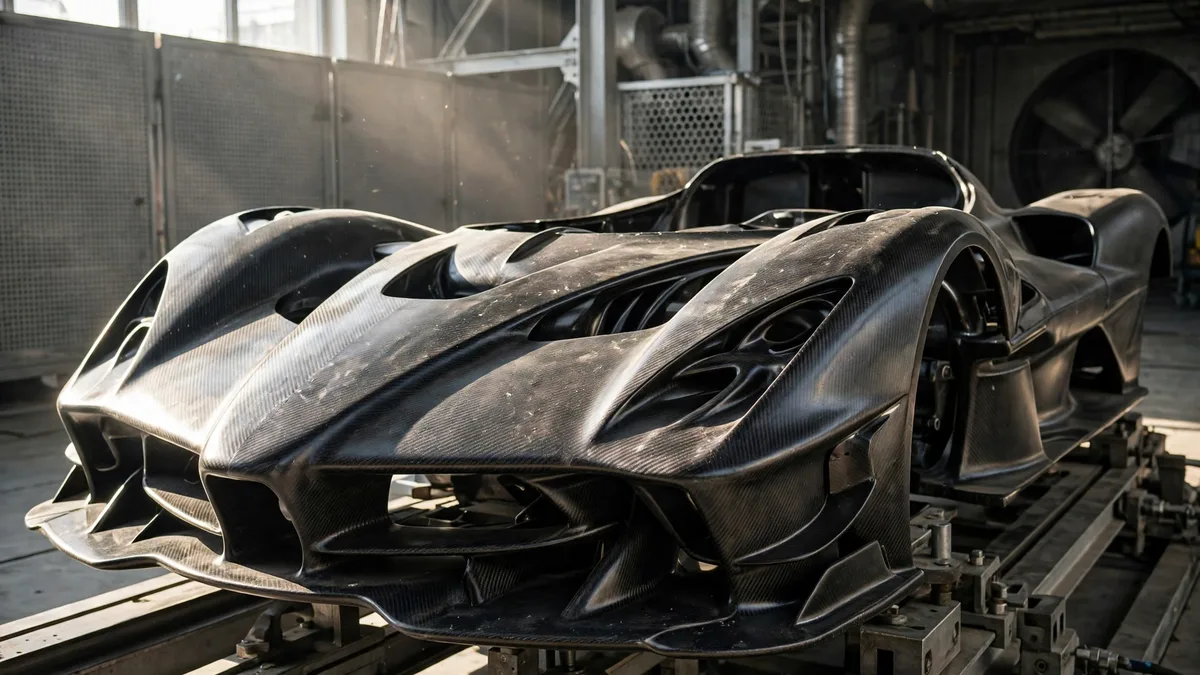
Stand in front of a hypercar and the bodywork looks like it was poured rather than built. There are no flat panels, no straight edges, only curves that dive and rise as if the air itself had sculpted them. That is not far from the truth. Every scoop, vent and wing on a hypercar body is there because the air demanded it, and the materials underneath — carbon fibre, honeycomb and resin — exist to hold those shapes while weighing almost nothing. The body is not decoration over the engineering. It is the engineering, wearing its working clothes.
A hypercar body has two jobs that fight each other. It must slice through the air with as little drag as possible, and it must also push the car down onto the road with tonnes of aerodynamic force. The faster the car goes, the harder the air pushes back, and at 300 kilometres per hour the body is carrying loads that would crush a normal car panel. The only materials that can hold those shapes, survive those loads and stay light enough to matter are composites — and making them is closer to tailoring than to metalwork.
The Materials Behind the Hypercar Aerodynamic Body
The heart of a hypercar body is carbon fibre composite: woven carbon cloth soaked in epoxy resin, laid into moulds and baked hard under pressure. Around it are supporting players — aluminium honeycomb cores that stiffen panels without adding weight, titanium fasteners that hold wings on at speed, and clear coats that protect the weave from sunlight and stone chips. Building it takes weeks of hand work, and every layer is placed by someone who knows exactly which direction the loads will run. A body panel may be only a few millimetres thick, yet it can carry the full aerodynamic load of the car at top speed.
Step 1: Carbon fibre cloth, woven for the load
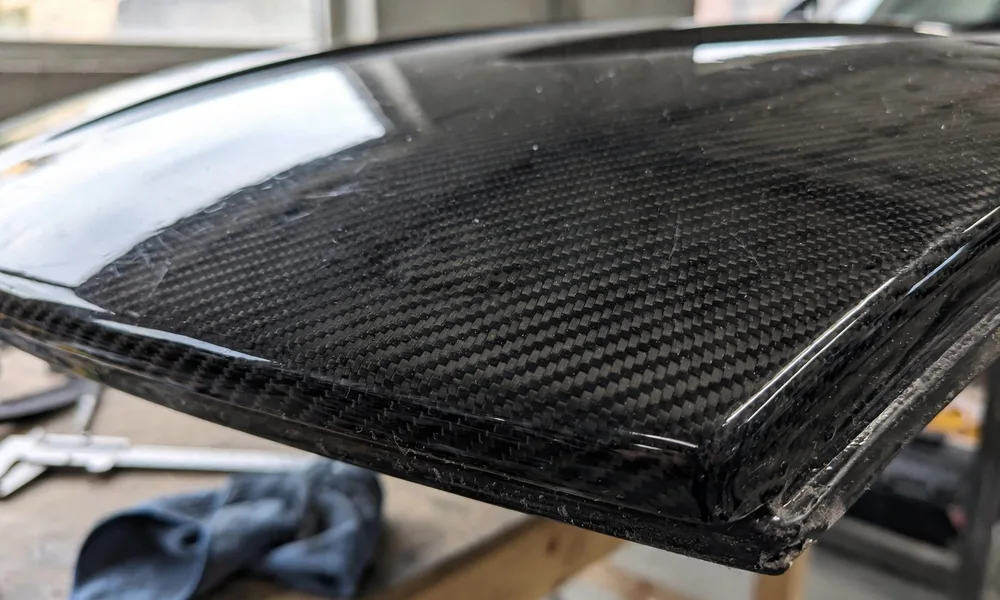
It starts with carbon fibre cloth, made from filaments thinner than a human hair and woven in patterns — plain, twill or satin — that trade strength, flexibility and looks. The cloth arrives as prepreg, already impregnated with epoxy resin and kept in a freezer until it is needed, so the resin stays soft enough to shape. The same fibre-and-resin partnership builds the carbon fibre weave used across motorsport, from monocoques to wings.
Step 2: Layup — building the body one ply at a time
Layup is the slow heart of the job. Technicians in gloves lay the cut plies into a polished mould, one layer at a time, smoothing each one down and rolling out any trapped air. Where a panel needs stiffness without weight, a core of aluminium honeycomb is sandwiched between the plies: a sheet of tiny hexagonal cells that weighs almost nothing yet makes the panel enormously rigid, like the cardboard in a corrugated box.
Step 3: The autoclave — heat, pressure and patience
Once laid up, the mould goes into an autoclave, a giant oven that is also a pressure vessel. Inside, the temperature climbs to around 120 to 180 degrees Celsius while the pressure rises to several times atmospheric, squeezing the plies together and curing the epoxy into a hard, glassy matrix. When the mould opens, the panel that comes out is rigid, feather-light and already close to its final shape. It is a long way from a steel panel stamped in seconds, and that is why a hypercar body costs what it does.
Step 4: Wings, splitters and the active aero
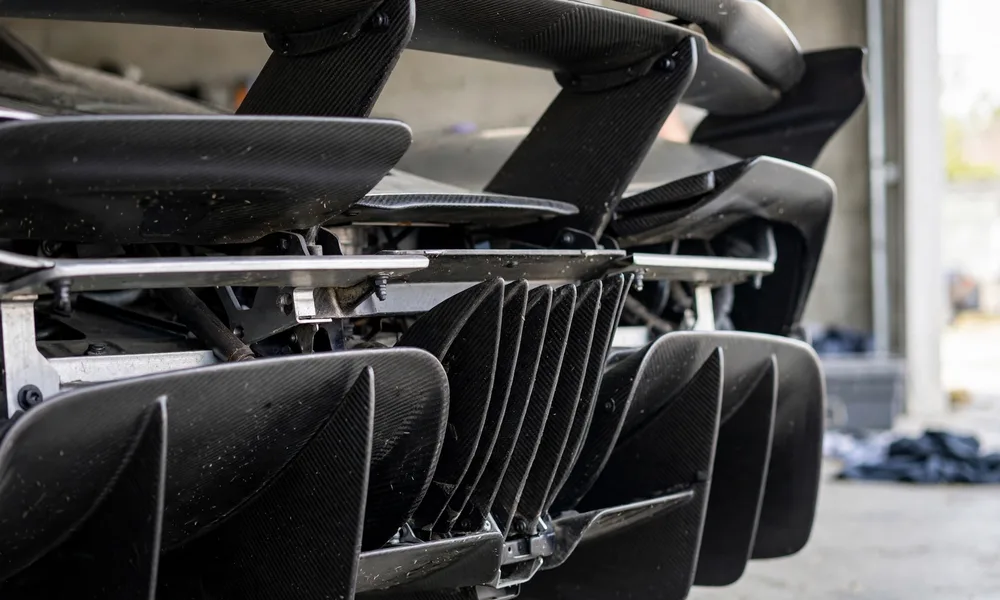
The most dramatic parts of the body are the ones that move. A rear wing on a modern hypercar is not fixed: it rises, tilts and flattens itself as the car accelerates, brakes and corners, acting as an airbrake one moment and a downforce generator the next. The whole car is a study in managed air, in the same spirit as the Formula 1 monocoque, where the body is the structure and the aerodynamics are the point.
Step 5: The underbody — where the real downforce lives
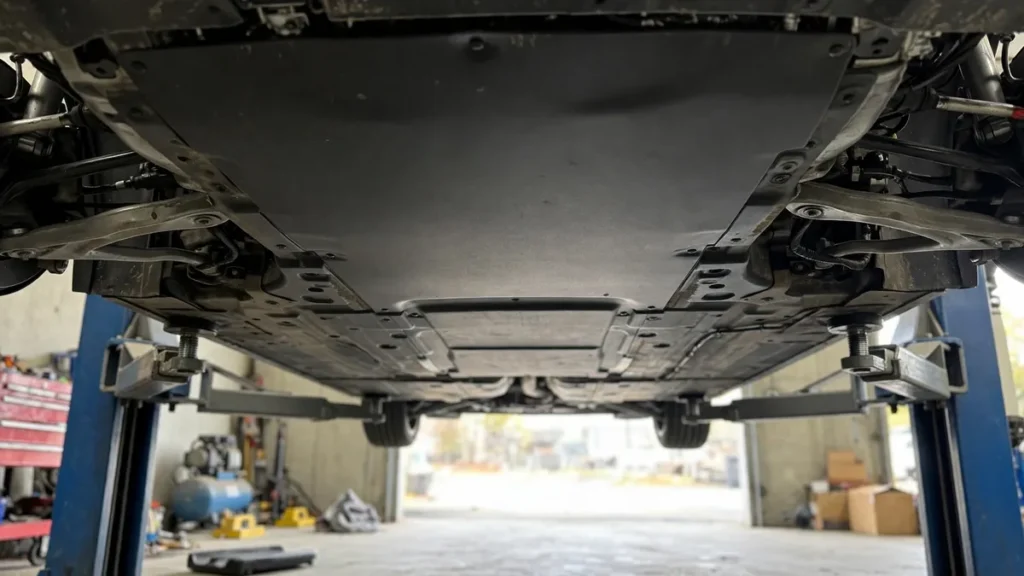
Most people look at the wings, but the cleverest aerodynamics are underneath, where nobody sees them. The floor of a hypercar is a sculpted Venturi tunnel: air speeds up as it passes under the car, its pressure drops, and the car is sucked down onto the road. The floor is made from carbon fibre over honeycomb, stiff enough to hold its shape at speed and smooth enough not to disturb the airflow.
Step 6: Paint, clear coat and the weight of looking good
A hypercar body is usually painted, but the paint is part of the engineering too. The clear coat that protects the carbon weave is applied in thin, even layers and polished by hand, because a thick coat adds weight and a rough one disturbs the airflow. The paint must also survive stone chips at 300 kilometres per hour and the heat of the engine bay, so it is baked on and often protected with a transparent film on the most exposed areas.
Step 7: Wind tunnel, track testing and failure
No computer model, however good, replaces the wind tunnel. The finished body is tested at scale and full size, with smoke and sensors showing where the air separates, stalls or swirls. That is why panels are inspected with ultrasound after hard use, and why a car like the Aston Martin Valkyrie, whose body generates more downforce than its own weight, is checked as carefully as an aircraft.
Hypercar Aerodynamic Body at a Glance
| Specification | Detail |
|---|---|
| Main material | Carbon fibre prepreg in epoxy resin, twill or plain weave |
| Core material | Aluminium honeycomb in stiff, flat panels |
| Curing method | Autoclave, roughly 120–180°C under several atmospheres of pressure |
| Panel thickness | Often only a few millimetres, including the core |
| Downforce at top speed | Top hypercars generate over 1,000 kg — more than their own weight |
| Active aero | Moving rear wing, front flaps and airbrake, driven by hydraulics or motors |
| Weak point | Delamination from stone strikes; front splitter and diffuser fins |
What Does It Cost?
A hypercar body is priced like the hand-built object it is. A single replacement front splitter can cost roughly $10,000 to $30,000 (estimate), a rear wing assembly several times that (estimate), and a full body repair after a serious crash can run into six figures (estimate). It is expensive because there is no shortcut — every panel is made the slow way, by hand, one ply at a time.
A Rare Fact
At top speed, some hypercars press themselves into the road with more force than their own weight — in theory, they could drive upside down on the ceiling of a tunnel, held up by nothing but air. The Valkyrie, for example, is said to generate around 1,100 kilograms of downforce at speed, more than the car weighs. The most extreme bodywork on the road is also one of the thinnest, and it works because the air, the shape and the material were designed as one thing.