On a quiet stretch of motorway, an electric car feels different from anything with an engine under the bonnet. There is no rumble rising through the floor, no vibration in the pedals, and at speed the loudest sound is often the faint rush of air moving around the body. Most drivers credit the motor for that silence. The real hero is underneath them, out of sight: a flat, carefully sculpted floor that guides the air instead of fighting it.
For decades, the underside of a car was an afterthought, a jumble of exhaust pipes, fuel tanks and suspension arms left exposed to the wind. Electric cars changed that. With no exhaust to route and a flat battery pack filling the floor, engineers suddenly had a clean sheet. They covered it with smooth panels, shaped the airflow with small fins and channels, and turned the whole underside into a working aerodynamic surface. Those numbers decide how far the car goes on a charge and how calm it feels at speed.
This guide explains the key specifications of an EV aerodynamic underbody in plain English: what each number means, why it matters, and how to compare one car with another. Every figure here is a typical estimate for modern family and premium electric cars, not the specification of any single model.

The Key Specifications, Explained
An underbody has no dials or screens, so its specification sheet reads like a physics lesson. The six numbers below are the ones engineers argue about most, and together they describe how cleanly a car slips through the air.
1. Drag coefficient: how slippery the whole car is
The drag coefficient, written Cd, is a single number that sums up how much resistance the air puts up as the car moves through it. A typical family EV sits around 0.24 to 0.28, while the slipperiest production cars dip to about 0.19. Lower is better, and the underbody does a surprising share of the work: a fully panelled floor can cut the total drag by roughly a tenth compared with an open, cluttered underside.
2. Frontal area: the size of the hole the car punches in the air
Drag coefficient alone does not tell the whole story, because a big car still has to push more air out of the way than a small one. Frontal area is the size of the car’s silhouette as seen from the front, usually around 2.2 to 2.6 square metres for a family EV. Multiply it by the drag coefficient and you get the effective drag area, CdA, which is the fairest way to compare cars of different sizes. A tall SUV with a good Cd can still have a worse CdA than a low saloon with a mediocre one.
3. Underbody panel coverage: how much of the floor is sealed
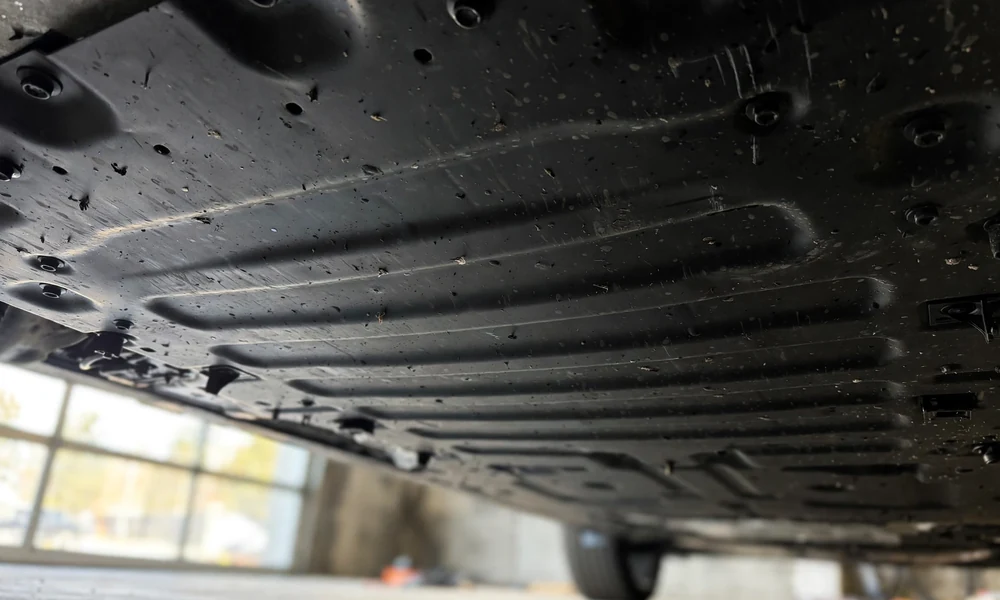
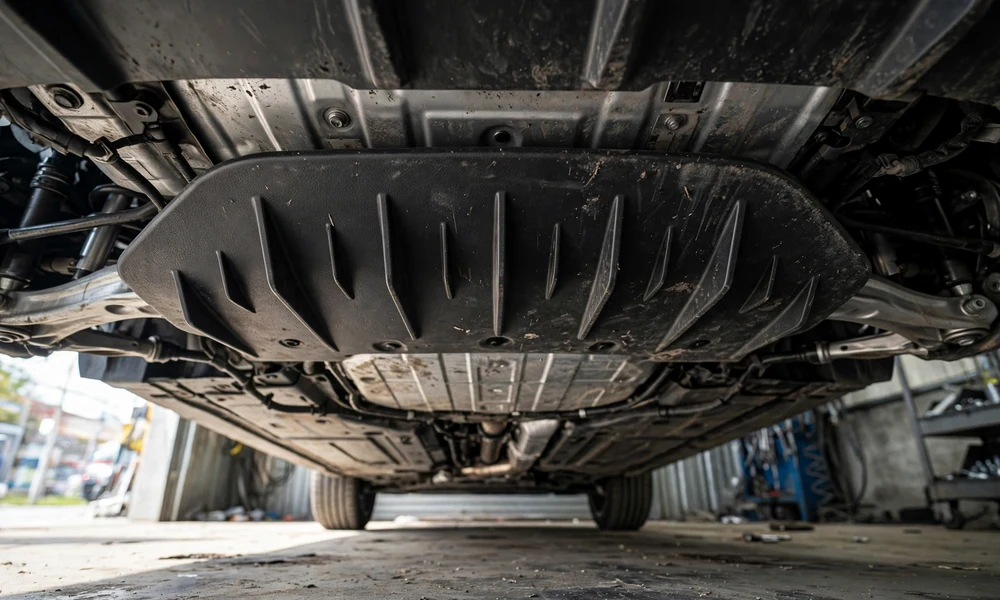
Panel coverage is the share of the underside hidden behind smooth covers, often 70 to 95 percent on a modern EV. The battery pack itself forms a large flat section in the middle, and composite or aluminium panels close off the areas ahead of and behind it. Full coverage is not just about smoothness: the panels also protect the battery and wiring from stones, water and road salt.
4. Ground clearance: the gap between floor and road
Ground clearance on a typical EV is roughly 120 to 180 millimetres, and every millimetre matters to the airflow. A lower car squeezes the air beneath it, speeding it up and reducing lift, but it also risks scraping on speed bumps and steep driveways. Many premium EVs solve this with air suspension that drops the car by 10 to 20 millimetres at motorway speed and raises it again in town.
5. Rear diffuser angle: the ramp that calms the air behind
At the back of the car, the underbody rises in a shaped ramp called a diffuser, usually angled at about 7 to 15 degrees. Its job is to let the fast-moving air underneath the car slow down gently and rejoin the air behind, instead of tumbling into a turbulent wake that drags the car backwards. Too steep and the airflow separates from the surface, which makes things worse; too shallow and the diffuser does almost nothing.
6. Lift and downforce: whether the air pushes the car up or down
Air moving quickly under a flat floor can create lift, the same force that holds an aircraft up, and lift makes a car feel light and nervous at speed. Engineers measure it as a lift coefficient, and a well-shaped underbody aims to keep it close to zero or slightly negative, meaning a gentle push downwards. Small spoilers and strakes ahead of the wheels fine-tune where the air goes.
| Specification | Typical value (estimate) | What it tells you |
|---|---|---|
| Drag coefficient (Cd) | 0.19–0.28 | How slippery the whole car is |
| Frontal area | 2.2–2.6 m² | How much air the car must push aside |
| Drag area (CdA) | 0.45–0.70 m² | The fairest drag comparison between cars |
| Underbody panel coverage | 70–95% | How much of the floor is sealed smooth |
| Ground clearance | 120–180 mm | The gap that shapes underfloor airflow |
| Rear diffuser angle | 7–15° | How gently air rejoins the flow behind |
| Panel material | Composite or aluminium | Light, stiff and resistant to stone damage |
How the Specs Matter in Use
On the road, these numbers show up as range and refinement. A car with a low drag area can hold motorway speed with less energy, which is why two EVs with the same size battery can differ by 50 kilometres or more on a long trip. The effect grows with speed: around town, aerodynamics barely matter, but at 120 kilometres per hour they dominate everything else the car is doing.
The trade-offs appear in everyday life. A fully sealed underbody is brilliant on a smooth road and a nuisance in a workshop, adding time to jobs that need access from below. Very low cars scrape on ramps and tall speed bumps, and lightweight composite panels can crack on a hard stone strike where a steel floor would only dent. The battery pack itself is a big part of the story, and the way its size and voltage shape the car is explained in the EV battery pack specs. The motor it feeds is covered in the EV electric axle specs, and the electronics that manage the power are explained in the EV inverter specs.
A Rare Fact
Some of the smoothest underbodies on the road were shaped in part by studying how air flows under a penguin. Engineers testing body shapes in wind tunnels noticed that the bird’s streamlined belly and tapered tail produce remarkably little drag for their size, and the same gentle taper now appears in the rear diffusers of several production EVs. It is a small reminder that the flat floor beneath an electric car is not just a cover: it is one of the most carefully designed surfaces on the whole vehicle, and the numbers on its spec sheet are the reason a quiet car can travel so far on a single charge.


