Open the bonnet of an electric car and the first surprise is how empty it looks. There is no engine block, no exhaust, no gearbox the size of a suitcase — just a tidy box of electronics and, down low between the wheels, a compact unit about the size of a large rucksack. That unit is the electric axle, or e-axle, and it is doing the work that once needed an engine, a gearbox, and a differential spread across the whole car. Motor, gears, and power electronics, all bolted together into one piece.
The numbers on its specification sheet decide how the car feels: how hard it pulls away from a standstill, how far it goes on a charge, and how quietly it does both. Power and torque are the headlines, but efficiency, gear ratio, and cooling decide whether the car is genuinely good.
This guide reads those numbers in plain English. Peak power, torque, gear ratio, efficiency, motor speed, weight, and cooling — each one tells you something different about what the axle can do and how long it can keep doing it.
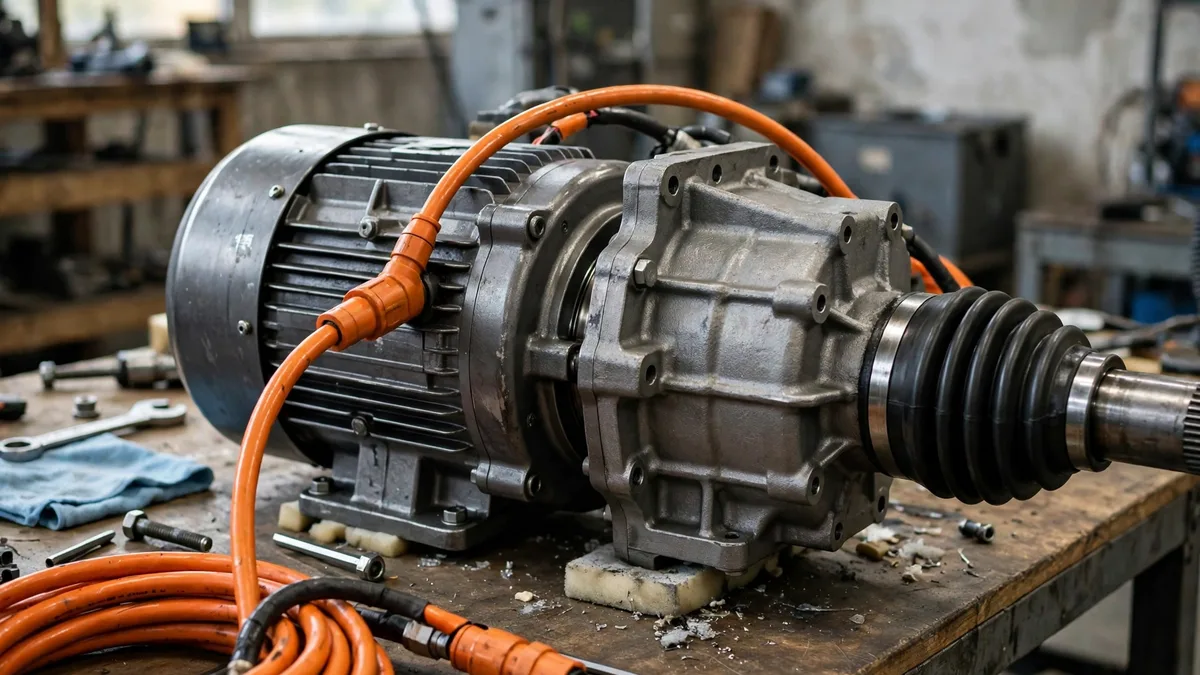
The Specs That Matter
1. Peak power
Peak power is the most power the axle can deliver, quoted in kilowatts, and a typical family electric car runs at about 100 to 200 kilowatts, while a performance model can reach 300 to 500 kilowatts or more. That headline figure is only half the story, because peak power is often available for a few seconds at a time — long enough for an overtaking manoeuvre, but not for a full lap of a circuit. The axle that delivers those numbers is built in stages, as explained in how an EV electric axle is made, from casting to final test.
2. Torque
Torque is the twisting force that actually turns the wheels, measured in newton-metres, and a typical e-axle delivers about 250 to 500 newton-metres at the wheels, with performance models passing 1,000. Unlike a petrol engine, an electric motor makes its full torque from a standstill, which is why even a modest electric car pulls away with a shove that surprises first-time drivers. The figure to watch is torque at the wheels, because the gear ratio multiplies it.
3. Gear ratio
The gear ratio is how many times the motor turns for each turn of the wheel, and most e-axles use a single fixed ratio of about 8-to-1 to 12-to-1, with no gears to change at all. A higher ratio gives stronger acceleration but a lower top speed, while a lower ratio does the opposite, so engineers pick one number that has to serve everywhere from a car park to a motorway. The single-speed axle is simpler, lighter, and quieter.
4. Efficiency
Efficiency is how much of the battery’s energy reaches the wheels, and a good e-axle converts about 90 to 95 percent of it, against about 30 to 40 percent for a petrol engine. The missing few percent become heat, and that heat is the enemy: it is why the axle needs cooling, and why efficiency matters more than raw power for real-world range. The production line where that efficiency is engineered in is covered in inside EV electric axle production, from winding to assembly.
5. Motor speed
Motor speed is how fast the electric motor spins, measured in revolutions per minute, and modern e-axle motors routinely reach 16,000 to 20,000 rpm, with some racing units passing 25,000. That is far faster than any petrol engine, and it is what lets a small motor make big power: power is torque multiplied by speed, so spinning faster is a way to make more power without making the motor bigger. Bearings, balancing, and cooling all get harder as the speed rises.

6. Weight and packaging
Weight is quoted in kilograms, and a complete e-axle — motor, gearbox, and inverter together — usually weighs about 80 to 150 kilograms, far less than the engine and gearbox it replaces. Just as important is the size: because the whole unit fits between the wheels, it leaves the rest of the car free for batteries and cabin space, and it lowers the centre of gravity, which is why electric cars handle so flatly in corners. A bigger motor and stronger gears weigh more, and every extra kilogram is one the battery must carry.
7. Cooling and thermal limits
Cooling is the number that decides how long the fun lasts. An e-axle is usually liquid-cooled, with coolant flowing through channels in the motor housing and the inverter, and the thermal limit is the temperature — often about 150 to 180 degrees Celsius in the windings — beyond which the motor must cut its power to protect itself. The materials that make that cooling possible are the subject of EV electric axle materials engineering, from copper windings to silicon carbide chips.
EV Electric Axle Specs
| Specification | Typical range |
|---|---|
| Peak power | About 100 to 200 kW family car; 300 to 500 kW performance |
| Torque at the wheels | About 250 to 500 Nm; over 1,000 Nm in performance models |
| Gear ratio | About 8-to-1 to 12-to-1, single speed in most cars |
| Efficiency | About 90 to 95 percent from battery to wheels |
| Motor speed | About 16,000 to 20,000 rpm; over 25,000 in racing units |
| Weight | About 80 to 150 kilograms for the complete unit |
| Cooling | Liquid cooled; winding limit about 150 to 180 degrees Celsius |
| Operating voltage | About 400 volts; 800 volts in newer fast-charging cars |
What Does an EV Electric Axle Cost?
A complete electric axle unit is estimated to cost roughly $2,000 to $6,000 to manufacture, depending on the power output and the materials, with the motor itself estimated at roughly $800 to $2,000 and the inverter estimated at roughly $500 to $1,500. A replacement axle fitted at a dealer is estimated at roughly $4,000 to $10,000 including labour, and the silicon carbide chips in a modern inverter are estimated to cost several times more than the silicon chips they replace — which is why they appear first in expensive cars. All prices are estimates only and vary widely by manufacturer, model, and region.
A Rare Fact
The motor inside a modern e-axle can spin faster than 20,000 revolutions per minute — roughly ten times faster than a petrol engine at full throttle — and it does it while being smaller than a watermelon. The first electric cars, more than a century ago, used motors that turned at a few hundred rpm and needed huge gearboxes to be useful at all; the modern e-axle works because engineers learned to spin a small motor very fast and gear it down, packing the power of a sports car engine into a unit you could lift onto a workbench with a friend.

An electric axle is the whole drivetrain, shrunk into a single box: motor, gears, and brains, all arguing about heat and efficiency in a space smaller than a suitcase. Read the power, the efficiency, and the cooling limit together, and the specification sheet stops being a list of big numbers and starts being a picture of the car itself — how hard it pulls, how far it goes, and how long it can keep its promises before it has to slow down and cool off.


