The jet is sitting on a runway barely longer than a football field, its engines at full power, held back by a single steel bar. On the deck, a sailor in a yellow shirt raises his hand, and the bar releases. In less than three seconds, the jet goes from standing still to flying, launched off the end of a ship that is itself moving at thirty knots. Behind it, the next jet is already taxiing into position.
That launch is the work of the aircraft carrier flight deck, the busiest and most dangerous few acres in the world. A carrier’s deck is a floating airfield, a factory, and a car park at the same time, where jets take off and land within metres of each other, fuel and weapons are moved by hand, and a mistake can be fatal in seconds.
The deck’s job is simple to state and hard to do: launch and recover aircraft from a ship that is pitching and rolling in the open sea. Two systems make it possible, the catapult that throws jets into the air and the arresting gear that catches them when they come back. Here is how the whole deck works.

How It Works
Step 1: The catapult launch
The launch begins with the catapult, a track set into the deck that runs the length of the bow. The jet is attached to the catapult shuttle by a tow bar, and the pilot runs the engines to full power while the jet is held back. When the launch officer gives the signal, the catapult fires: on older carriers, a piston driven by high-pressure steam drags the shuttle forward, and on the newest carriers, an electromagnetic motor does the same job with finer control. The jet accelerates from zero to around 150 knots in under three seconds, covering roughly 90 metres of deck, and leaves the bow already flying. Building a deck that can launch jets this way is enormously costly, as why aircraft carrier flight deck is so expensive explains.
Step 2: The angled deck and the landing
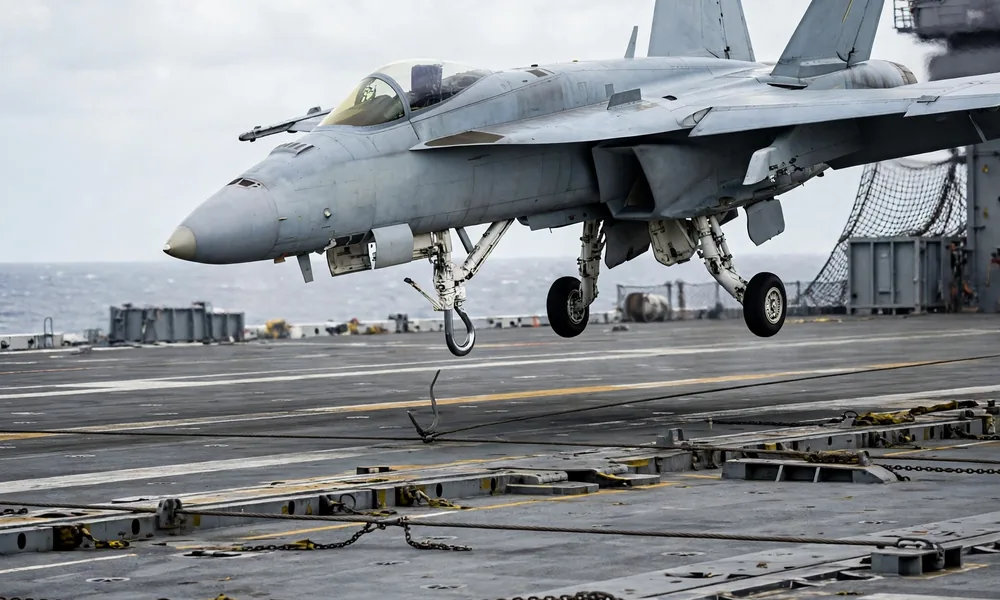
Landing is the harder half of the job. The carrier’s deck is angled, with the landing strip set at about nine degrees to the ship’s centreline, so a jet that misses the wires can power up and fly off again instead of crashing into parked aircraft. The pilot approaches from behind, following a light system that shows whether the aircraft is high, low, or on the glide path, and aims for a target speed that is only just above stalling.
Step 3: The arresting wires
The tailhook’s job is to catch one of four steel cables stretched across the landing area, the arresting wires. When the hook snags a wire, the wire pays out through a hydraulic system below deck, absorbing the jet’s energy and stopping it in about 100 metres, in under two seconds. The deceleration is brutal, several times the force of gravity, and the pilot is thrown forward against the straps. If the hook misses all four wires, the pilot immediately goes to full power and flies off the angled deck for another attempt, a manoeuvre called a bolter.
Step 4: The coloured shirts and the ballet
The deck crew are the system that holds all of this together, and their coloured shirts tell everyone their job at a glance. Yellow shirts direct the aircraft, green shirts handle the catapults and arresting gear, red shirts deal with weapons and firefighting, blue shirts move and chain the aircraft, and purple shirts fuel them.
Step 5: Parking, fuelling, and the hangar below
Between launches, the deck is a car park. Jets are parked in tight rows along the edges, chained to the deck with tie-downs, and moved by hand signals and small tractors. Below the flight deck sits the hangar deck, a vast workshop where aircraft are serviced, repaired, and stored, reached by huge side lifts that carry jets up and down. The hangar is where the deep work happens, while the flight deck above is kept clear for the next launch. Moving heavy machines safely at sea is a skill shared across the navy, as how submarine propeller works shows in a very different vessel.

Step 6: The ship underneath the airfield
None of this works without the ship itself. The carrier steams into the wind at full speed during flight operations, adding its own speed to the wind over the deck so the jets need less catapult power and less runway. The island, the tower on the starboard side, holds the bridge and the flight control centre, from which the air boss watches every aircraft and every crew member on deck. The power plant that drives a great ship through the sea is a marvel of its own, and its materials are laid out in cruise ship engine materials engineering.
| Deck length | Roughly 330 metres on a large modern carrier |
| Catapult | Steam or electromagnetic, launching in under three seconds |
| Launch speed | Around 150 knots at the end of the catapult track |
| Arresting wires | Four steel cables, stopping a jet in about 100 metres |
| Landing angle | Angled deck at about nine degrees to the centreline |
| Crew colours | Yellow, green, red, blue, and purple shirts by role |
| Ship speed | Up to around 30 knots during flight operations |
| Aircraft carried | Typically 60 to 75 aircraft aboard a large carrier |
What Does an Aircraft Carrier Flight Deck Cost?
The flight deck is part of a ship estimated at $13 billion or more for the newest American carriers, and the deck systems alone, catapults, arresting gear, lighting, and lifts, are estimated at hundreds of millions of dollars. Operating the deck costs millions a year in fuel, spares, and crew. The price is repaid in power: a carrier can put dozens of aircraft over a coastline within hours, and no other ship can do that.
A Rare Fact
The first carrier landings were made on wooden platforms built over a ship’s guns, and the first pilots had no arresting wires at all. They landed by catching sandbags, or by being grabbed by ropes held by sailors standing on deck. Every feature of the modern flight deck, the angle, the wires, the coloured shirts, the light system, was written in response to an accident. The deck looks like a design. It is really a history of lessons learned the hard way.
The next time a jet leaves a carrier’s bow, it is worth remembering how many systems fired in those three seconds. A catapult threw it forward, a ship steamed into the wind to help, a crew in coloured shirts cleared the way, and a pilot trusted a strip of steel barely longer than a football field. The flight deck is not a runway. It is a machine for making an airfield out of a moving ship, and it does its job dozens of times a day, in weather that would close any airport on land.


