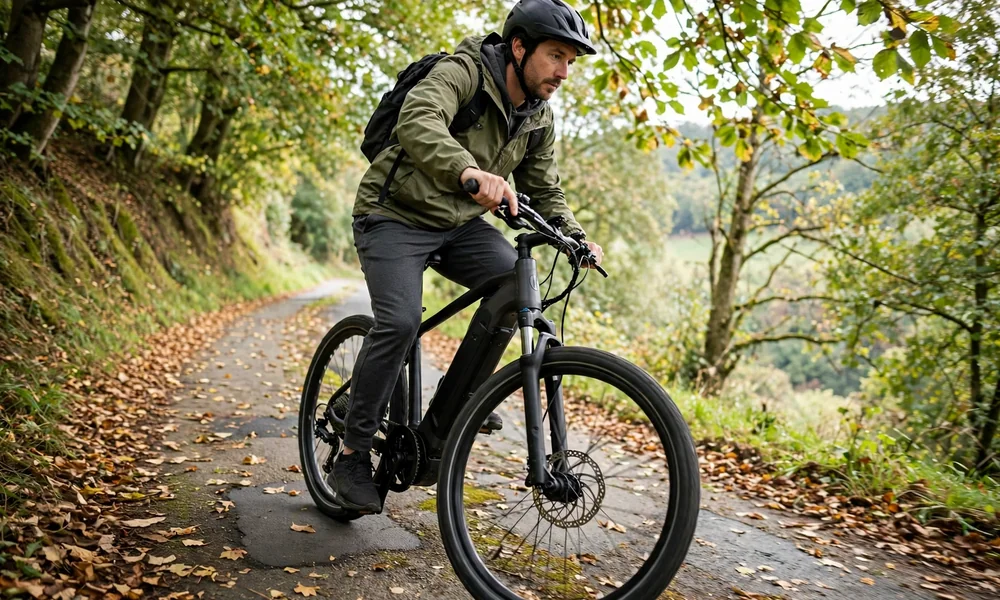
There is a moment every e-bike rider knows. You are rolling downhill, the motor humming, the town blurring past at thirty kilometres an hour, and a car pulls out ahead. Your fingers close on the brake levers, and instead of drama there is simply — stop. No squeal, no judder, no white-knuckle squeeze. The bike sheds its speed in a smooth, confident line and comes to rest exactly where you wanted it to.
That calm is the work of the disc brake, a small steel disc and a pair of pads that turn speed into heat, many times a second, without fading. E-bikes need it more than ordinary bicycles do: they are heavier, they go faster, and their motors add momentum that old-fashioned rim brakes were never designed to handle. The disc brake looks simple from the outside, but inside it is a neat chain of levers, fluid, and friction. This is how it works.

How It Works
Step 1: The lever multiplies your hand
It starts at your fingers. When you squeeze a brake lever, you are pulling on a lever arm that multiplies your force several times over before it does anything else. A gentle two-finger squeeze at the lever becomes a strong push further down the system, which is why modern e-bike brakes feel powerful without demanding a strong grip. The lever is also shaped to give feedback: as the pads approach the disc, the lever firms up, so you can feel exactly how hard you are braking and adjust without thinking. Good brakes talk to your hands.
Step 2: Hydraulic fluid carries the force
On most e-bikes, the lever does not pull a cable. It pushes a small piston inside a master cylinder at the handlebar, squeezing brake fluid — usually mineral oil — down a sealed hose to the wheel. Because fluid cannot be compressed, the push arrives at the other end instantly and undiminished, no matter how the hose bends around the frame. This is the same principle as a car’s brakes, and it is why hydraulic disc brakes feel so consistent: there is no cable to stretch, rust, or go slack, and the braking force is the same on a wet morning as on a dry afternoon.
Step 3: The calliper squeezes the pads
At the wheel, the hose ends at the calliper, a compact block bolted to the fork or frame that straddles the brake disc. Inside it, the fluid pushes one or two small pistons, and those pistons press the brake pads — flat blocks of metal-backed friction material — against both faces of the spinning disc. The pads do not grab and hold; they press with a controlled friction, and the harder you squeeze the lever, the harder they press. When you release, small seals pull the pistons back a fraction of a millimetre, so the pads clear the disc and the wheel spins freely again.

Step 4: Friction turns speed into heat
The actual stopping happens at the meeting of pad and disc. The disc, or rotor, is a steel ring bolted to the wheel hub, and as it spins between the pads, friction converts the bike’s kinetic energy — its speed — into heat. The pads get hot, the disc gets hot, and the bike gets slower, in exact proportion. This is the heart of every brake ever made, and the disc brake does it better than a rim brake because the disc is small, made of steel, and built to take the heat, while the rim of a wheel was designed to hold a tyre, not to be cooked. A hard stop from speed can push a rotor well past a hundred degrees in seconds.
Step 5: The rotor sheds the heat away
Heat is the enemy of braking, so the rotor is designed to get rid of it fast. It is drilled with holes and cut with slots that let air flow through, and its arms act like the fins of a radiator, carrying heat out into the passing air. On long descents, where the brakes are used again and again, this cooling is what stops the brakes from fading — that frightening moment when overheated pads and boiling fluid make the lever go soft. Larger rotors, usually 180 or 203 millimetres on e-bikes, give more surface to cool and more leverage to stop, which is why heavier and faster e-bikes wear bigger discs.
Step 6: The motor cuts out as you brake
E-bikes add one clever step that ordinary bicycles never had. A sensor in the brake lever tells the motor controller the instant you start braking, and the motor cuts its assistance immediately. Without this, the motor would keep pushing the bike forward while the brakes tried to stop it — a tug-of-war that would wear the pads and confuse the rider. Some systems go further, using the braking moment to feed a little energy back, but on most e-bikes the cut-off is the key trick: the moment your fingers move, the motor steps aside and lets the brakes do their job alone.
Specs
| Specification | Typical figure |
|---|---|
| Brake type | Hydraulic disc brake |
| Rotor size | Commonly 160–203 mm; 180–203 mm on heavier e-bikes |
| Rotor material | Stainless steel, drilled and slotted |
| Fluid | Mineral oil in most e-bike systems |
| Calliper | Two-piston, bolted to fork or frame |
| Pad material | Resin (organic) or sintered metal |
| Lever | Two-finger, with reach adjustment |
| Motor cut-off | Sensor in the lever cuts assistance on braking |
| Pad life | Roughly 500–2,000 km depending on riding and terrain |
Price
A pair of hydraulic disc brakes for an e-bike typically costs roughly $80 to $400 as an estimate for the set, depending on the brand, rotor size, and whether they are entry-level or high-end four-piston units — these are estimates, and the final price depends on the retailer and the model. Replacement pads cost a small fraction of that, and a new rotor is usually an affordable wear item. The materials and factory story are covered in how e-bike disc brakes are built from steel, the reason for the price range is explained in why e-bike disc brakes cost so much, and the factory process is told in how e-bike disc brakes are machined in the factory.
A Rare Fact
A disc brake rotor can glow faintly on a long mountain descent, and professional mechanics have measured rotor temperatures above 400 degrees Celsius after sustained braking — hot enough to boil water on contact and to burn skin instantly. Yet the same rotor can be cool to the touch a few minutes later, because its drilled surface and spinning motion dump heat into the air so efficiently. It is one of the hardest-working parts on the bike, and it does its whole job in a space smaller than a dinner plate.
From a two-finger squeeze to a glowing steel disc, the e-bike disc brake is a short chain with no weak links: lever, fluid, calliper, friction, heat, and a motor that knows when to get out of the way.