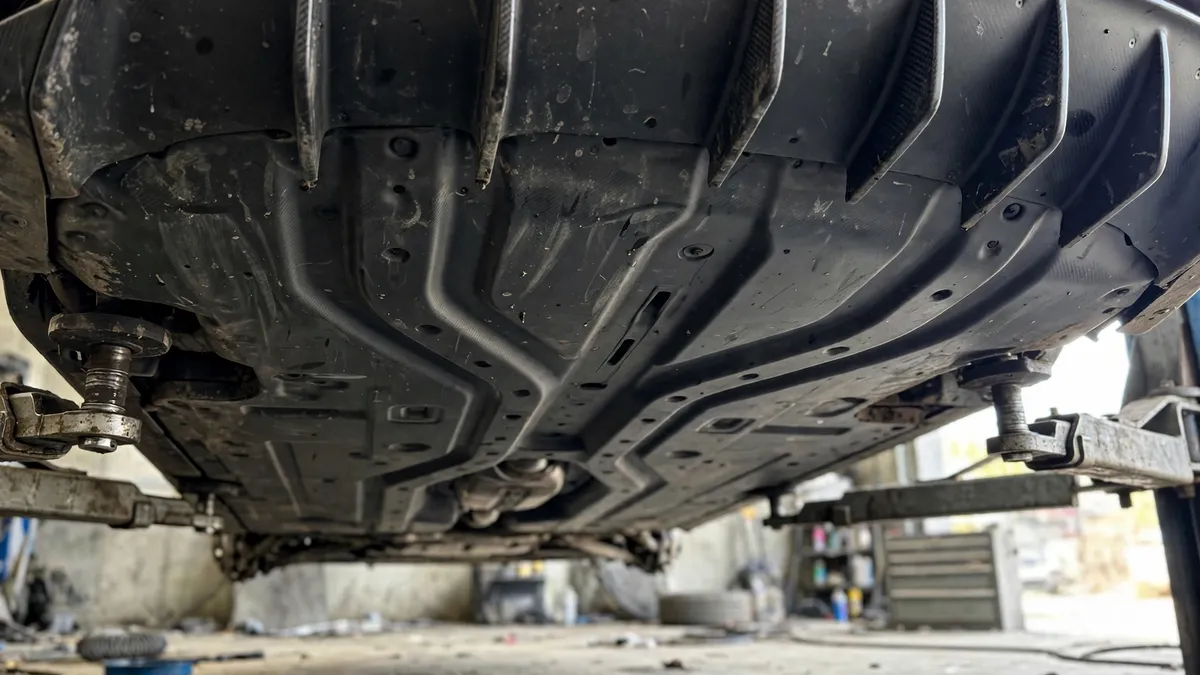
Lie on a creeper and roll under a modern electric car, and the first thing you notice is how little there is to see. No exhaust pipe, no driveshaft, no fuel tank — just a single smooth floor, dark and almost featureless, stretching from bumper to bumper. It looks boring, and that is exactly the point: the flat underside is one of the hardest-working parts of the machine, and the air sliding beneath it at motorway speed is doing a job the driver never notices.
How an EV Aerodynamic Underbody Works
An aerodynamic underbody is a set of shaped panels, channels and fins that covers the underside of the car and manages the air flowing beneath it. At speed, that air can either slide cleanly past or tumble into turbulence, and turbulence is drag — drag the battery pays for with range. The underbody keeps the air attached, fast and orderly, from the front bumper to the rear. It also shields the battery, motors and wiring from water, stones and salt.
Step 1: The flat floor smooths the air
The foundation of the whole system is the flat floor itself. The battery pack sits inside a rigid case that forms the centre of the car’s floor, and the battery pack under the floor gives engineers a naturally smooth surface to build on, something a petrol car could never offer. Panels close the gaps around the suspension and motors, so the air meets one continuous surface. A smooth floor alone cuts drag noticeably, and that saving turns directly into extra kilometres of range.
Step 2: The front air dam sets the flow
Air first meets the car at the front, and the underbody’s work starts there. A low air dam and a shaped front splitter push the oncoming air either over the bonnet or cleanly under the floor, and small deflectors ahead of the front wheels steer air around the tyres, among the dirtiest aerodynamic objects on any car. The openings in the front bumper are kept as small as possible, because air that enters the nose and rattles around the wheel wells creates drag instead of slipping past. On many electric cars the grille is mostly blanked off, with no big radiator demanding air.
Step 3: Channels and strakes keep the air attached
Once the air is under the car, shaped channels and long strakes keep it moving in straight lines. The panels are not simply flat; they carry shallow grooves and ridges that guide the flow toward the rear and stop it wandering sideways into the wheels. Small vertical fins, called strakes, sit ahead of the rear wheels to calm the air. The panels are usually moulded from glass-fibre composites or tough plastics, light enough not to hurt range and stiff enough not to flutter, because a flapping panel creates the turbulence it was fitted to prevent.

Step 4: The rear diffuser speeds the air out
At the back of the car sits the diffuser, the most visible piece of underbody aerodynamics. It is a ramp of angled fins that expands the space under the car, letting the fast-moving air slow down and rejoin the air behind the car without tearing into a turbulent wake. That expansion also creates suction that pulls the car down onto the road, a little downforce without any visible wing. The aerodynamic body of a hypercar uses the same idea at a far more extreme level, but the principle under a family electric car is identical, just quieter.
Step 5: Air curtains calm the wheels
The wheels are the underbody’s biggest problem, because a spinning tyre churns the air around it. To tame that, many electric cars use air curtains: narrow slots in the front bumper that blow a thin sheet of fast air across the face of the front wheels, keeping the turbulent wake of the tyre away from the bodywork. Behind the wheels, small vents let trapped air escape instead of building up pressure. Together they can be worth a meaningful slice of the car’s total drag, which is why designers obsess over details the driver will never see.

Step 6: Cooling inlets open only when needed
An electric car still needs cooling, for the battery, the motors and the power electronics, but cooling and aerodynamics are enemies: an open inlet is a hole in the smooth floor. So modern cars use active shutters, flaps in the nose that stay closed most of the time and open only when the thermal management system asks for more air. When the battery is cool and the car is cruising, the nose stays sealed and the air slides past. When fast charging or a long climb heats things up, the shutters open, trading a little drag for cooling — a compromise managed by software, hundreds of times per journey.
Step 7: Seals and fasteners hold it all together
The final step is the least glamorous and the most important: keeping the panels in place. Undertray panels are held by dozens of clips, bolts and seals, and must survive kerb strikes, speed bumps, water and winter salt without coming loose. A single sagging panel can whistle at speed and add drag, and a missing panel after a careless service can cost several percent of range. That is why the panels are made to be removed quickly yet sit flush and tight when fitted, and why the battery case beneath them is sealed against water even if a panel is damaged.
| Specification | Typical value |
|---|---|
| Drag coefficient | About 0.19 to 0.24 |
| Undertray material | Glass-fibre composite or moulded plastic panels |
| Underbody coverage | Up to 90 percent of the floor |
| Diffuser angle | Roughly 7 to 15 degrees on a road car |
| Active grille shutters | Open only when cooling is needed |
| Panel weight | A few kilograms |
| Drag saving vs open floor | Several percent of total drag |
Price is hard to pin down because the underbody is rarely sold as one part, but estimates put a full set of undertray panels and a diffuser at roughly 500 to 1,500 US dollars in parts for a typical electric car, with fitting on top. A single damaged front undertray panel can cost roughly 150 to 400 dollars to replace, depending on the model, and a rear diffuser panel can cost more. Those are estimates, not list prices, and they vary widely between brands. What matters more is the hidden cost of ignoring them: a missing undertray can quietly trim the car’s range on every journey.
A rare fact: some electric cars use their underbody to make downforce without any visible wing at all. The diffuser and the flat floor together press the car onto the road at motorway speed, adding grip in fast corners while the car still looks like an ordinary family saloon. It is the same physics that holds a racing car to the track, hidden underneath a car that will spend most of its life doing the school run.
The aerodynamic underbody works because it treats the air under the car as carefully as the air over it. A flat floor, guided channels, a diffuser and shutters that open only when needed turn the underside from a jumble of parts into a single smooth surface. The driver never sees it, and benefits from it on every journey — in silence, stability and a few extra kilometres from every charge.