Ride a cheap e-bike up a hill and you will feel the problem at once. The motor kicks in late, surges, then fades, as if it is guessing what your legs are doing. Ride a good one and the experience is entirely different: you press the pedal, and the bike simply feels stronger, as if your own legs had doubled in power overnight. The difference is a small part hidden near the crank, about the size of a matchbox, called a torque sensor. It measures exactly how hard you are pedalling, hundreds of times a second, and tells the motor to match your effort in real time. It is the part that makes an e-bike feel like a bicycle instead of a moped.
A torque sensor does not measure speed, and it does not count pedal turns. It measures force, the actual push of your feet on the cranks, and it does it while the cranks are spinning under load. That is a hard measurement to make, because the sensor has to live inside a spinning, vibrating, rain-soaked bottom bracket and still report tiny changes in force accurately. Engineers have solved it in several clever ways, and the best systems are so seamless that riders never know the sensor is there. They just know the bike feels natural.
How an Electric Bike Torque Sensor Works
Step 1: You press the pedal. Everything starts with your foot. As you push down on the pedal, the crank arm bends by a microscopic amount, and the chain pulls harder on the chainring. The force travels through the bottom bracket spindle, the axle the cranks turn on, and that is where the sensor lives. The harder you push, the more the metal flexes, and the sensor’s job is to measure that flex precisely, even though it is far too small to see.
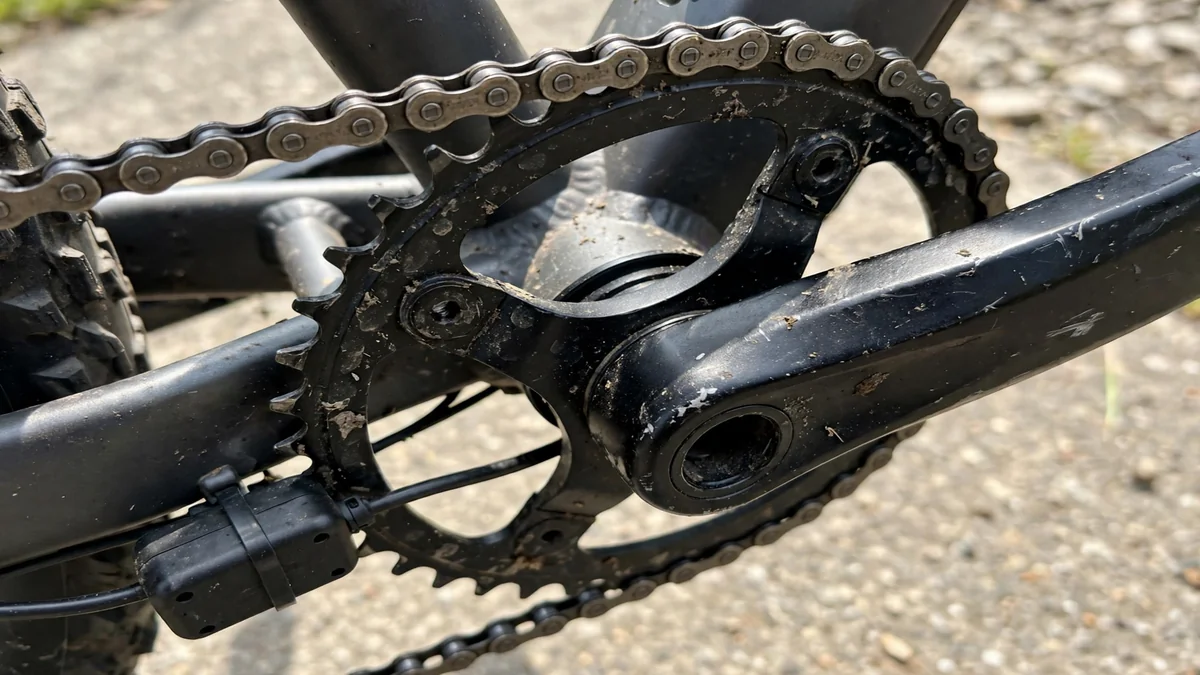
Step 2: Strain gauges detect the flex. Most torque sensors use strain gauges, tiny electrical resistors glued to the spindle or the crank spider. When the metal flexes, the gauge stretches by a fraction of a millimetre, and its electrical resistance changes. That change is tiny, so it is amplified by the sensor’s electronics and converted into a number: this many newton-metres of torque, right now. Some sensors instead use magnetic fields, watching how a magnetised section of the spindle twists under load, which avoids gluing anything to the metal at all.
Step 3: The signal reaches the controller. The torque reading travels to the bike’s controller, the small computer that runs the motor, along with the reading from a cadence sensor that counts how fast you are pedalling. The controller combines the two: torque tells it how hard you are pushing, cadence tells it how fast, and together they tell it how much power you are producing. A good controller updates this calculation many times a second, so the assistance never lags behind your legs.
Step 4: The motor matches your effort. The controller tells the motor how much help to give, based on the assist level you selected. On a low setting it might add half as much power as you produce; on a high setting it might add three times as much. The key is that the help is proportional: push gently and the motor is gentle, push hard on a hill and the motor pushes hard too. That proportionality is what makes the bike feel like an extension of your legs rather than a machine with a mind of its own.
Step 5: The loop repeats, constantly. The whole cycle, measure, calculate, assist, runs again and again, dozens or hundreds of times a second. When you ease off at the top of a hill, the motor eases off with you; when you stand up to sprint, it stands up with you. If you stop pedalling, the torque falls to zero and the motor cuts out, which is also a safety feature. The system never needs to guess, because it is always measuring what you are actually doing.

Step 6: Calibration keeps it honest. A torque sensor only works if it knows what zero feels like. When you switch the bike on, it takes a reading with no load and calls that zero, and it repeats the check whenever you stop pedalling. Temperature changes, wear, and knocks can all shift the reading, so the best sensors recalibrate themselves automatically. A sensor that drifts will make the bike surge or lag, which is why a bike that suddenly feels jerky often just needs its sensor recalibrated or replaced.
Electric Bike Torque Sensor Specs
| Specification | Typical figure |
|---|---|
| Torque range measured | 0 to 100 Nm |
| Sampling rate | 100 to 1,000 times per second |
| Sensor type | Strain gauge or magnetic |
| Location | Bottom bracket or rear dropout |
| Accuracy | Within 2 to 5 percent |
| Assist ratios | 50 to 300 percent of rider power |
| Motor cut-off | Within milliseconds of pedalling stopping |
The sampling rate is the number that matters most to how the bike feels. A sensor that reports once a second would make the motor surge and fade; one that reports hundreds of times a second makes the assistance feel continuous and natural. It is the difference between a bike that helps and a bike that guesses.
How Much Does a Torque Sensor Cost?
A replacement torque sensor for an e-bike typically costs an estimated $50 to $200 for the part, with fitting adding an estimated $50 to $150 at a bike shop. A complete bottom bracket sensor unit on a premium bike can cost an estimated $200 to $400. The sensor is one reason a torque-sensing e-bike costs more than a cadence-only model, which simply detects that the pedals are turning and switches the motor on at a fixed power. That price gap, often an estimated $300 to $800 on the whole bike, buys a ride that feels far more natural. These are estimates, and prices vary by brand and model.
For riders, the value is in the feel. A cadence sensor bike can lurch away from a standstill and keep pushing after you stop pedalling, which is unnerving in traffic. A torque sensor bike starts smoothly, stops when you stop, and gives you exactly the help you ask for with your legs. Most riders who try both never go back.
A Rare Fact About Torque Sensors
Here is a detail that surprises even keen cyclists: the metal in a torque sensor flexes by less than the width of a human hair, and the sensor still measures it accurately enough to control a motor. The strain gauges detect changes in length of a few millionths of a metre, and the electronics amplify that signal thousands of times without drowning it in electrical noise. It is the same technology used to weigh aircraft and test bridges, shrunk down to fit inside a bicycle’s bottom bracket and sold for the price of a good tyre. The next time your e-bike feels like it is reading your mind, it is really reading the bend in a piece of steel.

The torque sensor is the quiet reason good e-bikes feel good, and it works with the rest of the drivetrain, from the motor itself, covered in electric bike motor specs explained, to the hub motor designs described in how an e-bike hub motor works. The same idea of matching motor output to rider input shows up in other small electric vehicles too, including the motors in how an electric scooter motor works. It is a small part, hidden away where nobody sees it, but take it out and the whole bike changes character. That is the mark of a part that matters.


