An electric boat motor makes heat every time it runs, and the water it floats in is the best coolant available. How electric boat motor cooling works comes down to moving that heat from the copper windings and the magnets, through the motor housing, and into the surrounding water or air, before temperatures climb high enough to damage insulation or demagnetise the magnets. Done well, the motor can run at full power for hours. Done badly, it overheats, loses power, and eventually fails.
Heat is the unavoidable by-product of turning electricity into motion. Even a good electric motor wastes roughly 5 to 10 percent of its input power as heat, mostly in the windings where current meets resistance, and in the steel core where the magnetic field cycles. A 50-kilowatt motor at 90 percent efficiency is still producing about 5 kilowatts of heat, which is the output of a large household heater, concentrated in a metal case the size of a watermelon. That heat has to go somewhere, continuously, for as long as the motor runs.
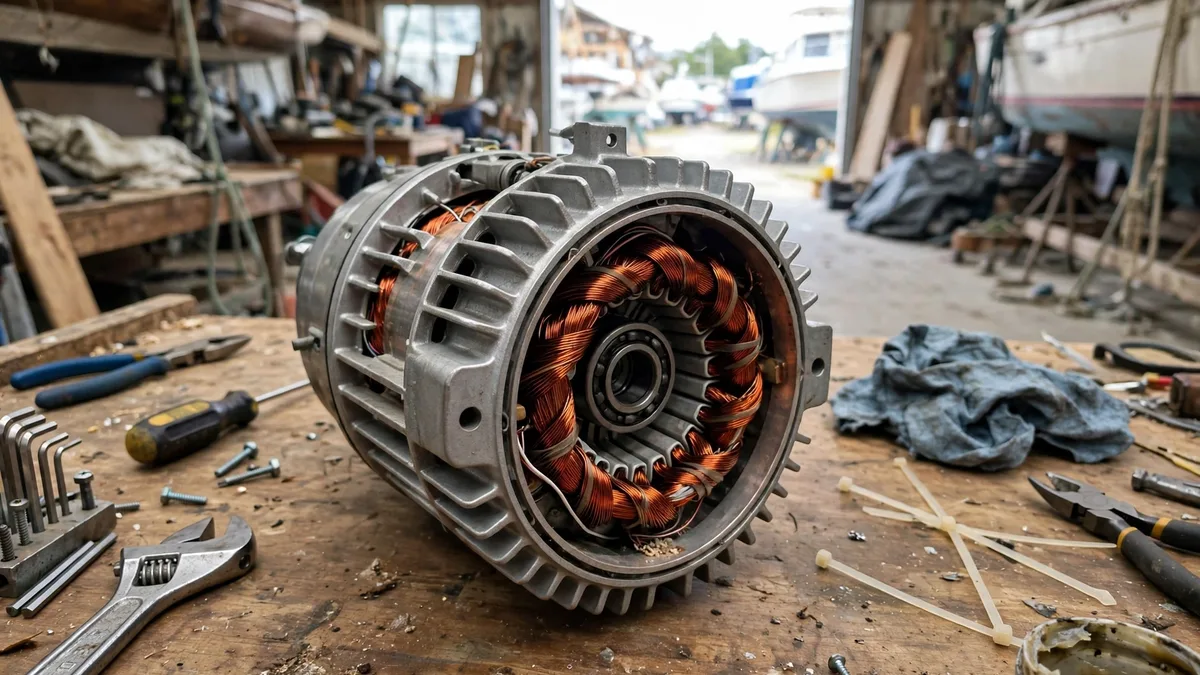
Why heat is the motor’s enemy
Heat attacks a motor in two ways. First, the insulation on the copper windings breaks down as temperature rises: most marine motors use insulation rated for around 155 degrees Celsius, and every sustained run above that rating shortens its life sharply. Second, the permanent magnets in the rotor lose strength when they get hot, and beyond a certain point that loss becomes permanent. A motor that has been cooked once never performs the same again.
Direct water cooling: the simplest answer
The simplest cooling method uses the water the boat floats in. In a direct water-cooled motor, seawater or lake water is pumped through channels in the motor housing, picks up heat, and is discharged overboard. Some designs run the water through a jacket around the stator, the stationary part of the motor, while others pass it through a heat exchanger so the motor’s own internal coolant loop never touches raw seawater. The second arrangement is more common on larger boats, because seawater is corrosive and full of grit. How an electric boat motor works explains the windings, rotor and controller that this cooling protects.
Closed-loop liquid cooling
Most larger electric boats use a closed loop. A coolant, usually a water and glycol mix, circulates through the motor housing, then through a heat exchanger, where it gives up its heat to raw seawater that is pumped in and out separately. The motor’s coolant never leaves the loop, so it stays clean and its chemistry stays controlled, while the seawater side can be built from corrosion-resistant materials and flushed easily.
The heat exchanger is the heart of this system. It is usually a stack of plates or a bundle of tubes with a large surface area, and its size decides how much power the motor can sustain. A heat exchanger that is too small becomes the bottleneck: the motor is fine, the coolant is fine, but the heat cannot cross into the sea fast enough, and temperatures creep up over a long run. Designers size the exchanger for the worst case, a hot day, warm water and full throttle, and then add margin. Temperature sensors in the windings feed back to the controller, which reduces power automatically if the coolant gets too warm, protecting the motor at the cost of speed.
Air cooling and hybrid systems
Small outboard-style electric motors often use air cooling, sometimes helped by the water around the lower unit. The motor sits in the open air above the transom, fins on the housing shed heat into the passing air, and the movement of the boat provides the airflow. It is simple, light and cheap, but it caps the power: air carries far less heat than water, so an air-cooled motor of a given size cannot sustain the output of a water-cooled one.

The controller and the battery are part of the system
The motor is not the only hot component. The controller, which turns battery direct current into the alternating current the motor needs, has power transistors that generate significant heat, and it is usually cooled by the same loop as the motor, or by its own cold plate. The battery, meanwhile, has its own thermal needs, and keeping the two apart matters. How electric yacht battery cooling works covers the battery side in detail: the cells need to stay in a narrower temperature band than the motor, so the two systems are sized and controlled separately even when they share a seawater intake.
On a well-designed boat the cooling system is planned as one thermal system, not three separate ones. A single seawater pump may feed the motor heat exchanger, the controller cold plate and the battery chiller, with valves and sensors balancing the flow. The control software watches all three temperatures and decides where the cooling goes when the load is high. At full throttle on a hot day the motor gets priority; at anchor, charging, the battery does.
What goes wrong, and how to spot it
The most common cooling failure is a blocked intake. Weed, a plastic bag or a jellyfish can choke the strainer, the flow drops, and the motor temperature climbs within minutes. The controller usually catches it first and cuts power, which the helmsman experiences as a sudden loss of speed. The fix is simple: stop, clear the strainer, and check the flow before continuing. Boats that run in weedy water often carry a second intake or a self-cleaning strainer for exactly this reason.
Design choices that make cooling work
Cooling shapes the motor itself. Motors designed for boats have cooling jackets cast into the housing, with channels that put the coolant close to the windings where the heat is made. The housing is often aluminium for its thermal conductivity, with stainless fittings where it meets seawater. Seals are double where the shaft leaves the housing, because a leak there lets seawater into the motor and coolant into the bilge at the same time.
Placement matters too. A motor low in the hull sits close to the seawater intake and the heat exchanger, so the pipe runs are short and the pump works less hard. A motor in a pod under the hull is surrounded by water on all sides, which is the best cooling of all, and is one reason pod drives are popular on electric boats. How electric boat propulsion works shows how the motor, the pod and the propeller fit together, and why the cooling is easier when the motor lives in the water rather than above it.

Keeping it cool in practice
For an owner, motor cooling is mostly a matter of routine. Check the strainer before launching, watch the temperature display during the first minutes under way, and treat a power cut or a temperature warning as a cooling problem until proven otherwise. Flush the seawater side with fresh water after use in salt, keep the coolant topped up and its chemistry fresh, and replace the impeller before it fails rather than after.


