The screen fills with a rain-soaked city at night, neon signs reflecting in puddles, every window lit, every face in the crowd rendered in detail, and the whole scene moves at a hundred frames a second without a stutter. It looks like magic, but the magic has a physical address: a slab of silicon about the size of a postage stamp, sitting under three fans inside a metal box that can weigh more than a laptop.
A gaming graphics card is not just a fast chip. It is a small supercomputer built to do one thing — draw pictures, billions of calculations at a time — and to do it while staying cool enough not to melt itself. The chip inside holds tens of billions of transistors, surrounded by memory chips, a power system, and a heavy cooler. The price on the box is the price of all of that, and of everything that had to go wrong before a good one came off the line.
Why It Costs So Much
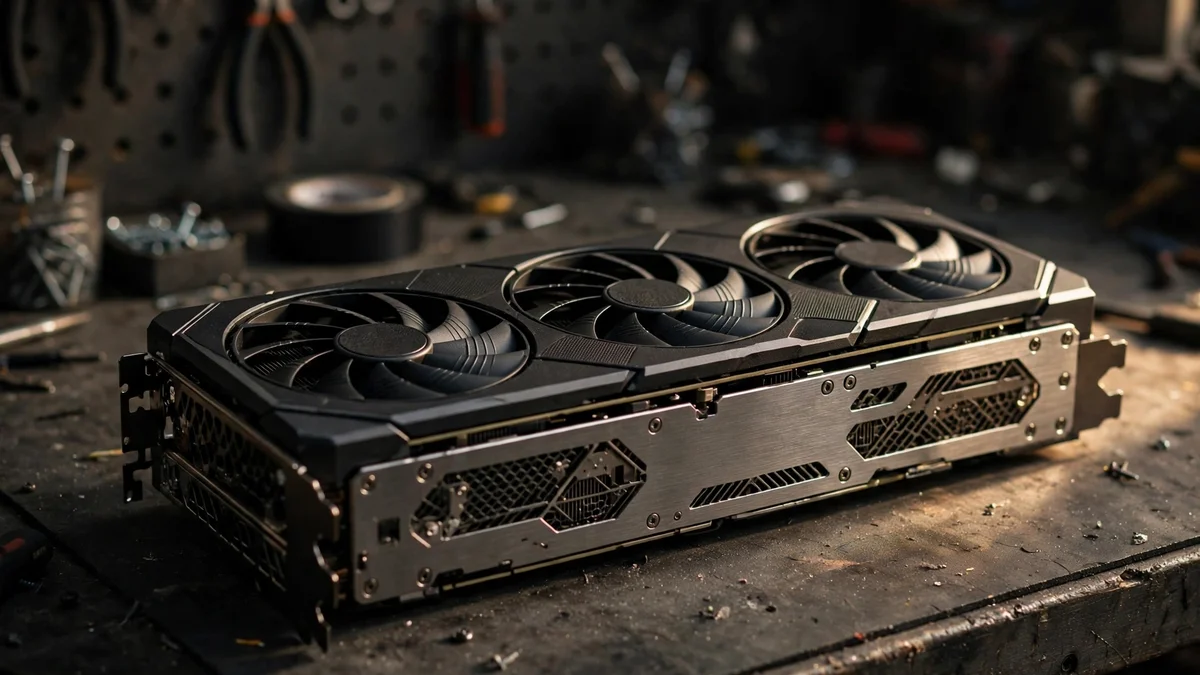
A graphics card looks like a simple slab of metal and fans, but it is a stack of expensive problems. The chip is enormous, the memory is exotic, the cooler is a piece of precision engineering in its own right, and most of the chips a factory makes never reach a shop shelf. The cost is not in the plastic shroud. It is in the silicon lottery, the yield, and the physics of moving heat.
Reason 1: The chip is enormous, and big chips fail more often
A flagship graphics processor measures roughly 600 square millimetres, several times the area of a desktop processor. Silicon wafers are never perfect, and every wafer carries tiny defects scattered across its surface. A defect landing anywhere on a chip ruins that chip, so a small chip dodges most defects and a huge chip cannot dodge any of them. A wafer that yields hundreds of small chips may yield only a few dozen good graphics processors, each carrying the cost of the dead silicon around it, a yield problem inside gaming GPU production never solves.
Reason 2: Tens of billions of transistors must all work
Modern graphics chips are built on the most advanced manufacturing processes on earth, with features measured in a few nanometres. A flagship chip contains tens of billions of transistors, and a single broken connection among them can cripple the whole device. Every hour of time on the most advanced lithography machines is extraordinarily expensive, and a graphics chip consumes far more of it than almost any other consumer product.
Reason 3: The memory is a second supercomputer
A graphics card carries its own memory, and it is not ordinary memory. Graphics memory must feed the processor with hundreds of gigabytes of data every second, far faster than the memory in a desktop computer. Those chips are stacked close to the processor on a wide, fast bus, and they are expensive to make and to test. A flagship card can carry 16 or 24 gigabytes of it, and the memory alone can cost more than an entire mid-range computer.
Reason 4: Cooling a small sun takes real engineering
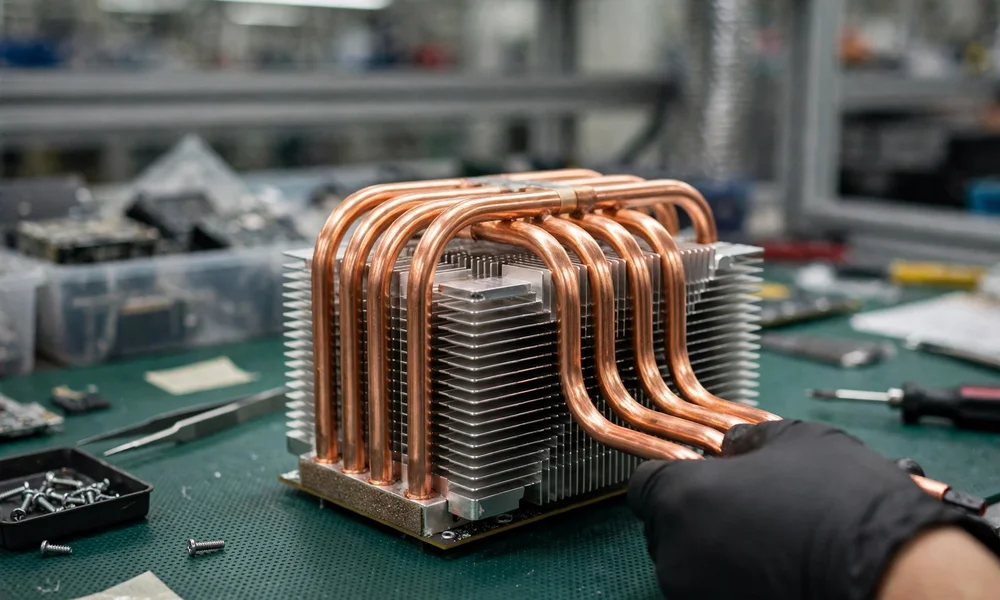
A flagship graphics card can draw 450 watts or more, roughly the power of a small kettle, and all of that energy becomes heat in a space the size of a matchbox. The cooler must move that heat away without sounding like a jet engine, so it uses copper vapour chambers, heat pipes, and fans whose blades are shaped to tolerances measured in fractions of a millimetre. The same cooling science appears in laptop vapour chamber specs, where space is even tighter. Designing a cooler that keeps a 450-watt chip at safe temperatures for years is a serious engineering project in its own right.
Reason 5: The power system is a small power station
Feeding a graphics chip hundreds of amps at a voltage lower than a single AA battery demands a power delivery system of remarkable precision. A flagship card carries a dozen or more power phases, each with its own controllers, chokes and capacitors, switching thousands of times a second to keep the voltage rock steady as the load jumps from idle to full power in milliseconds. The components are rated for heat and current far beyond what a normal circuit board sees, and they are tested under loads that would destroy lesser hardware.
Reason 6: Testing throws away the almost-good chips
Every graphics processor is tested after manufacture, and most of them are not perfect. Chips with a few faulty units are sold as cheaper models with those units switched off, which is how the product range is built, but the truly top chips — the ones with every unit working at the highest speeds — are rare. Finding them means testing every chip at full speed under full heat, discarding the ones that cannot hold it, and charging the survivors for the whole exercise. The same sorting applies to the chip’s materials, as gaming GPU materials engineering shows.
Reason 7: The market is small and the tools are enormous
Graphics processors sell in the millions, but the flagship chips sell in far smaller numbers, and the cost of designing a new one runs into billions of dollars. A new architecture takes years of work by thousands of engineers, new masks for the factory, new memory standards, and new software to make it all run. That investment is spread across a relatively small number of top-end cards, so each one carries a large share of the development cost.

Specifications
| Specification | Detail |
|---|---|
| Graphics processor | Flagship die around 600 sq mm, tens of billions of transistors |
| Manufacturing process | Advanced 4 to 5 nanometre class lithography |
| Memory | Typically 16 to 24 GB of high-bandwidth graphics memory |
| Power draw | Flagship cards around 350 to 450 watts under load |
| Cooling | Copper vapour chamber, heat pipes, two or three fans |
| Power delivery | Multiple phases, often 16 or more, with high-current components |
| Board | Multi-layer printed circuit board with heavy copper traces |
| Weight | Flagship cards often 1.5 to 2 kilograms |
Price
A flagship gaming graphics card typically costs from around $1,000 to more than $2,000 (estimate), and limited editions can cost considerably more. Mid-range cards usually fall between $300 and $600 (estimate). The price is in the enormous die, the yield losses, the memory, the cooler and the development cost.
Rare Fact
The most powerful graphics processors ever made were never sold to gamers at all. The same chip designs, stripped of their display outputs and fitted with even more memory, power the supercomputers that train artificial intelligence models, and a single one of those data-centre cards can cost ten times as much as the gaming version of the same silicon.
That is the real story behind the price tag: a chip so large that most of each wafer is wasted, memory faster than anything in a normal computer, and a cooler built to tame a small sun. It costs so much because there is no cheap way to put tens of billions of perfect transistors into a box that fits in a desktop computer.


