Picture a superyacht at anchor in a quiet bay at dusk. The wind picks up, the swell rolls in, and the boat begins to tug at its anchor. A hundred tonnes of steel, glass, and luxury are held in place by a single piece of metal on the seabed, a length of chain, and a machine the size of a washing machine hidden in the bow. If any part of that system fails, the yacht drifts — towards rocks, towards other boats, towards disaster.
A yacht anchor system is far more than an anchor and a rope. It is an engineered chain of parts: a forged anchor shaped to dig into sand or mud, a chain of calibrated high-tensile links, a windlass that can haul tonnes of steel from the seabed, a chain locker that stores it all, and a bow roller that guides it smoothly over the side.
Building an anchor system means forging steel, proof-testing chain link by link, machining a windlass that can lift a car, and assembling it all so it works in the dark, in the rain, with a tired crew. This is how a yacht anchor system is made.

How It’s Made
Step 1: Forging the anchor
The anchor begins as a billet of high-strength steel, heated until it glows orange and pressed in a forging die under thousands of tonnes of force. Forging shapes the anchor’s flukes — the broad blades that dig into the seabed — and lines up the steel’s grain so the flukes resist bending when the anchor bites. Modern anchors use scooped or concave flukes that bury themselves deeper the harder they are pulled, and their shape is refined in tank tests where engineers drag prototypes across sand, mud, and gravel. The finished forging is trimmed, ground smooth, and inspected for cracks before it moves on. The way the finished system holds a yacht in place is explained in how a yacht anchor system works.
Step 2: Galvanising or polishing the anchor
Raw steel rusts fast in salt water, so the anchor must be protected. Most anchors are hot-dip galvanised: dipped into a bath of molten zinc, which coats every surface in a thick, dull-grey layer that sacrifices itself to corrosion before the steel underneath is touched. Larger yacht anchors are often made from stainless steel instead, polished to a mirror finish that matches the yacht’s bow and resists rust on its own. Polishing is done by hand, wheel after wheel, until the flukes gleam.
Step 3: Making and proof-testing the chain
The chain is made link by link on a machine that bends steel bar into ovals, welds each link closed, and hooks the next one through before it is welded. Yacht anchor chain uses calibrated, high-tensile steel, and each link is welded with a flash butt weld that is then trimmed flush. The chain is then galvanised in the same way as the anchor, dipped link by link so the zinc reaches every surface. The chain’s role in the wider system is covered in how a ship anchor chain works, which describes the same principles on a larger scale.

Step 4: Building the windlass
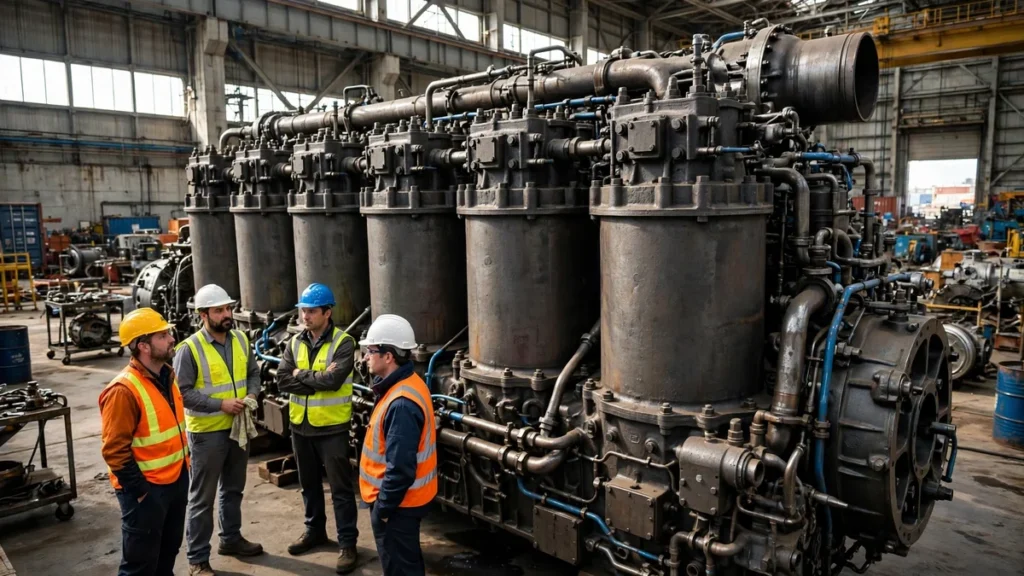
The windlass is the machine that raises and lowers the anchor, and it must lift the full weight of the anchor and chain from deep water. Its heart is a gypsy, a toothed wheel shaped to grip the chain links, driven through a gearbox by an electric or hydraulic motor. The gears are cut from bronze or hardened steel, and the gearbox is filled with oil and sealed against salt spray. The windlass body is cast from aluminium or stainless steel and machined to take the bearings and seals. Each windlass is assembled by hand and tested on a rig that lifts a dead weight equal to its rated pull, again and again.
Step 5: Fitting the bow roller and chain locker
The anchor does not simply hang over the side. It sits in a bow roller, a shaped cradle of stainless steel that guides the anchor in and out and holds it tight against the hull while under way. The roller is machined and polished, with its own bearings so it turns freely under load. A devil’s claw or chain stopper is fitted to take the load off the windlass once the anchor is set, so the machine is not left holding the yacht all night.
Step 6: Installing, testing, and sea trials
The finished system is installed in the yacht’s bow, with the windlass bolted through the deck on a reinforced foundation and wired to the helm controls. The crew then tests it in real conditions: the anchor is dropped, set, and retrieved repeatedly on different seabeds, while instruments measure the windlass load and the chain’s behaviour. Only when the system has proved itself on the water is it handed over to the owner. The windlass that does the heavy lifting is built to its own exacting standard, as shown in how a yacht winch is made.
| Main materials | Forged high-strength steel anchor, calibrated steel chain, bronze or steel windlass gears |
| Anchor finish | Hot-dip galvanised zinc coating, or polished stainless steel |
| Chain testing | Every link proof-tested above its working load |
| Windlass drive | Electric or hydraulic motor through a sealed gearbox |
| Windlass pull | Rated to lift the anchor and chain from deep water, often several tonnes |
| Bow roller | Stainless steel cradle with bearings, shaped to the anchor |
| Chain storage | Dedicated locker with drainage, plus a chain stopper to hold the load |
| Typical anchor weight | About 20 to 100 kilograms on a large yacht, far more on a superyacht |
What Does a Yacht Anchor System Cost?
A yacht anchor system is a serious investment. A forged anchor for a large yacht is estimated at roughly $1,000 to $5,000, high-tensile chain costs an estimated $15 to $40 per metre, and a windlass for a big yacht is estimated at $5,000 to $20,000. A complete system for a superyacht, with anchor, chain, windlass, roller, and installation, is estimated at $30,000 to $100,000 or more. The price reflects forged and machined parts, proof testing, and the fact that the system must work perfectly in conditions where failure could cost the boat.
A Rare Fact
Anchor chain has a surprising enemy: itself. If chain is piled into a locker in a tangled heap, it can jam when the crew tries to drop the anchor, leaving the yacht adrift while someone climbs below to untangle it. Even stranger, an anchor holds a yacht not mainly by its weight, but by digging in: a well-set modern anchor can hold a pull many times its own weight, because the seabed itself does the work. The chain matters too — its weight lying on the seabed absorbs gusts and keeps the pull on the anchor low and horizontal, which is exactly the angle that keeps it buried.

The anchor system will never be the part a yacht owner shows off. It lives in the bow, out of sight, muddy and salt-stained after every use.