A hypercar can reach 200 miles per hour and then stop, again and again, without its brakes fading — and the part that makes that possible is a disc of carbon ceramic no bigger than a dinner plate. Each time the driver brakes from high speed, the disc absorbs enough energy to heat a small house, glowing orange as its temperature climbs past 600°C. Yet it does not warp, crack, or wear away the way an ordinary steel brake disc would. It simply does the job, lap after lap, for the life of the car.
That endurance is built in the factory, over weeks, in a process that is closer to baking than to machining. The disc starts as a tangle of carbon fibres and resin, is pressed into shape, baked in a furnace for days, and finally machined to a mirror finish and balanced like a wheel. Very few factories in the world can make one, and each disc is treated as a precision part, not a consumable. Here is how a hypercar brake disc is produced.
How It’s Made
Step 1: Designing the disc
Engineers start with the car’s weight, its top speed, and the size of its wheels, then calculate how much braking energy the disc must absorb and how quickly it must shed heat. The disc’s diameter, thickness, and ventilation channels are modelled in three dimensions, and the design is tested in simulation against hundreds of braking events, from a gentle stop in traffic to an emergency stop from top speed. The friction ring, the part the brake pads grip, is designed separately from the centre bell that bolts to the wheel hub, because the two parts expand at different rates when hot. The design must also keep the disc light, since every kilogram of unsprung weight hurts the car’s handling.
Step 2: Laying up the carbon fibre
The disc begins as chopped carbon fibres mixed with a phenolic resin, pressed into a mould in the shape of a ring. Long carbon fibres are laid in layers around the ring as well, arranged so the disc is strong in every direction, because braking loads twist and bend it at once. The mixture is pressed under heat and pressure to form a green body — a rough, dark disc that is still soft enough to machine. Skilled workers check the fibre distribution by hand and by X-ray, since a thin patch or a clump of resin would become a weak spot when the disc is baked. A single disc can contain kilometres of carbon fibre.

Step 3: Baking in the furnace
The green body is placed in a furnace and heated slowly, over days, to temperatures above 1,000°C in an oxygen-free atmosphere. The resin turns to carbon in a process called carbonisation, and the disc shrinks and hardens as it does. This is the most delicate stage: heating too fast cracks the disc, and any oxygen leaking into the furnace would burn the carbon away. The furnace is watched around the clock, and the temperature is raised in small steps over many days. When the disc comes out, it is a carbon-carbon disc — strong and heat-proof, but still too soft and porous to use as a brake.
Step 4: Silicon infiltration
To turn the carbon disc into carbon ceramic, it is soaked in molten silicon at around 1,700°C. The silicon seeps into the pores and reacts with the carbon to form silicon carbide, a ceramic that is almost as hard as diamond and can survive extreme heat. The result is a disc that is far harder and more wear-resistant than carbon alone, and that keeps its friction steady even when it is glowing hot. The infiltration is done in a vacuum furnace, and the disc is weighed before and after to check the silicon has spread evenly through the whole ring. A disc that is heavy on one side is rejected.
Step 5: Machining and drilling
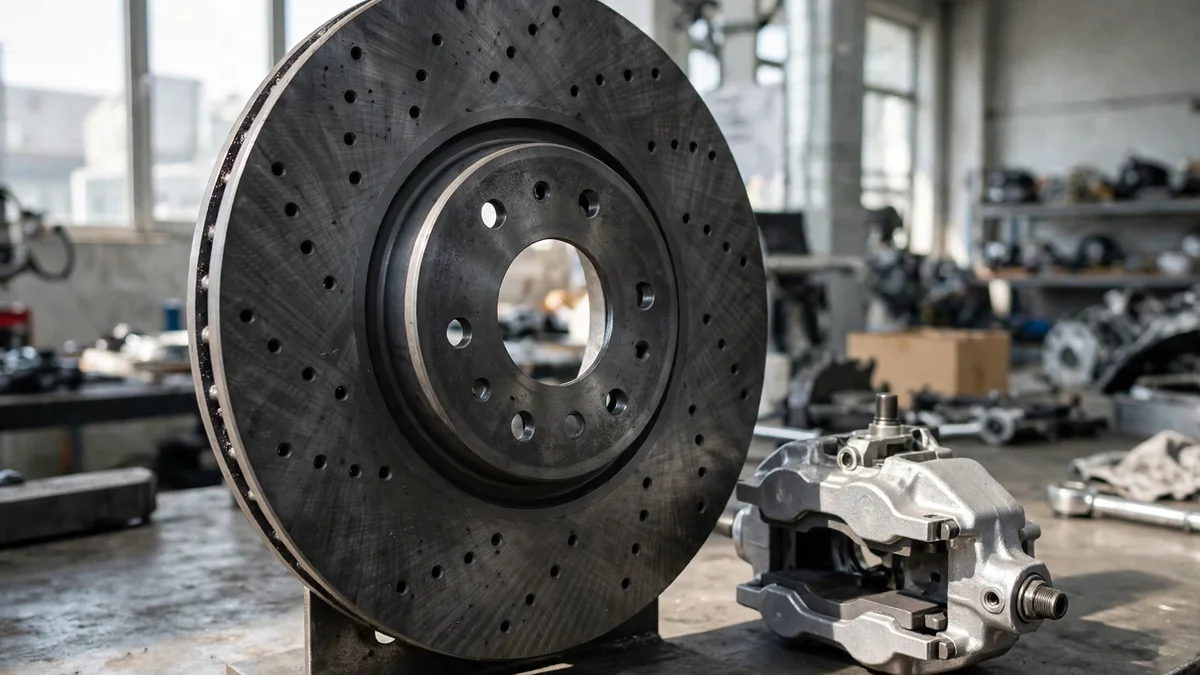
Once cooled, the disc is machined on a diamond-tipped lathe and grinder, because ordinary cutting tools cannot scratch silicon carbide. The friction faces are ground flat to within a few microns, and the ventilation holes and slots are drilled with diamond drills — the familiar pattern of holes is not decoration, but a way to clear gas and dust from between the pad and the disc. The centre bell, usually aluminium, is machined separately and bolted to the ring with floating fasteners that let the ring expand when hot without warping. The same attention to friction and heat drives the design of the pads, which are matched to each disc as a pair. The full story of how the whole brake system is built is told in how a hypercar brake disc is made.
Step 6: Balancing and testing
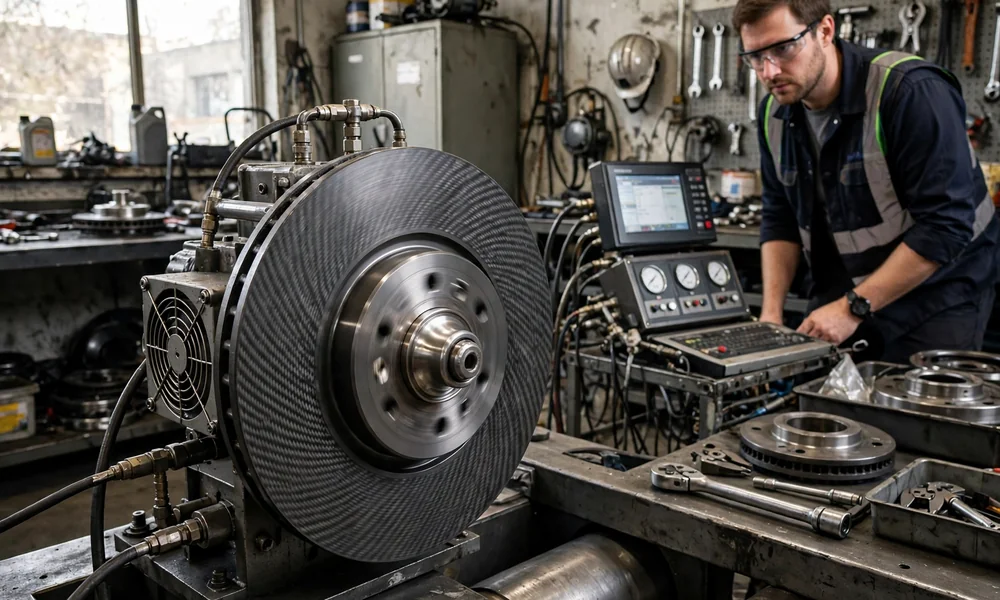
Every finished disc is balanced on a machine that spins it at high speed, and tiny amounts of material are removed until it runs true — an unbalanced disc would shake the whole car under braking. It is then tested on a brake dynamometer, a rig that spins the disc and clamps it with pads, over and over, measuring stopping power, temperature, and wear. Engineers look for hot spots, cracks, and any sign of fading as the disc heats up. Only a disc that stops consistently from cold and from glowing hot is passed, marked with its serial number, and packed for the car factory, where it will be fitted to a wheel that may never see a racetrack.
Specs
| Specification | Typical figure |
|---|---|
| Disc material | Carbon-ceramic, silicon carbide |
| Disc diameter | Roughly 390–440 mm |
| Disc weight | About 6–8 kg per disc |
| Peak temperature | Over 600°C under hard braking |
| Furnace temperature | Above 1,000°C, then about 1,700°C |
| Surface tolerance | Flat to within a few microns |
| Service life | Often the lifetime of the car |
| Build time | Several weeks per disc |
Price
A single carbon-ceramic brake disc for a hypercar is, as an estimate, roughly $5,000 to $10,000, and a full set of four with pads can cost $20,000 to $40,000. That is many times the price of a steel disc, but the carbon-ceramic disc is lighter, lasts far longer, and does not fade under repeated hard braking. These are estimates, and the real price varies by maker and model.
A Rare Fact
Carbon-ceramic brake discs were first developed for the Concorde supersonic airliner, which needed brakes that could stop a 185-tonne aircraft landing at nearly 200 miles per hour, time after time, without fading. The same material later moved into Formula 1, and then into the fastest road cars. A hypercar brake disc is, in effect, a piece of aircraft technology that happens to fit inside a wheel.
A brake disc that can glow orange and keep working is one of the quiet miracles of a hypercar, and the way it behaves on the road is explained in how a hypercar brake disc works. The carbon-ceramic material itself has its own story, told in how carbon-ceramic brakes are made. The next time a hypercar sheds 150 miles per hour in a few seconds and pulls up straight and true, remember the weeks in the furnace, the molten silicon, and the diamond grinding that made the disc under the wheel.


