Imagine a hypercar leaving a corner with all four tyres fighting for grip. The inside wheel wants to spin uselessly, the outside wheel is loaded with the car’s weight, and the engine is pouring out more torque than any single tyre could ever handle. Something has to decide, in a split second, how much power goes to each wheel — and it has to do it without the driver ever noticing. That something is the differential, a compact box of gears that sits at the heart of the drivetrain and quietly makes high performance possible.
Every car has a differential, but a hypercar’s is a different animal. It must survive forces that would shred an ordinary unit, react in milliseconds, and work in perfect step with traction control, torque vectoring, and hybrid electric motors. Some hypercar differentials can send nearly all the engine’s power to one wheel, or lock solid in a fraction of a second. They are among the most precisely machined parts on the car.
Building one is an exercise in patience. The gears are cut, ground, and polished to tolerances measured in microns, the housing is machined from a solid billet, and the whole assembly is tested under loads greater than it will ever see on the road. This is how a hypercar differential is made.
How It’s Made
Step 1: Designing the gear set on the computer
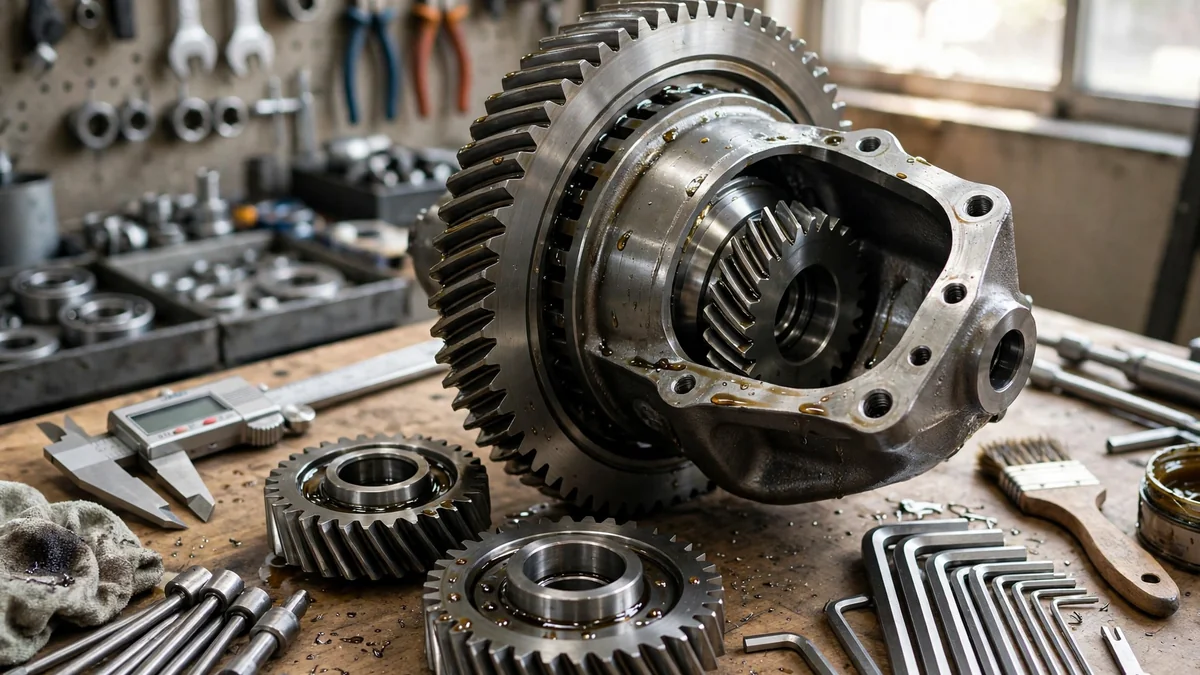
The differential starts as a simulation. Engineers model the engine’s torque, the car’s weight, the tyre grip, and the forces of hard cornering, then design a gear set that can survive all of it with a margin to spare. They choose the type — an open differential, a limited-slip unit with clutch packs, or an electronically controlled unit that can vary lock-up on the fly. The tooth shapes are optimised for strength and quiet running, because a gear that whines at speed is a gear that is wasting energy. Only when the computer says the design will live does anyone cut metal. The gearbox it works with is just as specialised, as the dual-clutch gearbox shows.
Step 2: Forging and machining the gears
The gears begin as forgings of high-strength alloy steel, heated and hammered into rough blanks. Forging aligns the metal’s grain, making the finished gear far tougher than one cut from a plain bar. Then the blanks go to gear-cutting machines, where rotating cutters carve the teeth to exact profiles. After cutting, the gears are heat-treated — hardened in a furnace, then tempered — to give them a hard wearing surface over a tough core. Finally, they are ground and lapped, a polishing process that brings each tooth to a mirror finish and a tolerance of just a few microns.
Step 3: Machining the housing from billet
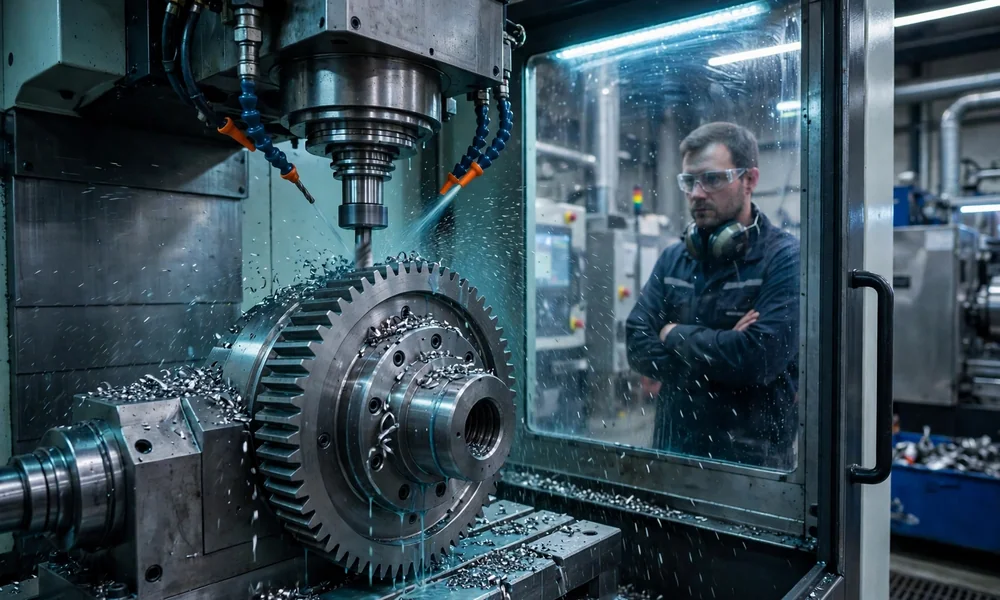
While the gears are being made, the housing is machined from a solid block of aluminium or magnesium alloy. A five-axis milling machine carves away most of the block, leaving a light, stiff case with bearing seats, oil galleries, and mounting faces machined to tolerances finer than a human hair. The housing must hold the gears in perfect alignment under enormous loads, and it must also shed heat — a differential working hard at the track can get hot enough to cook its oil. The precision here mirrors the work in hypercar suspension, where every mounting point is measured in microns.
Step 4: Assembling the clutch packs and electronics
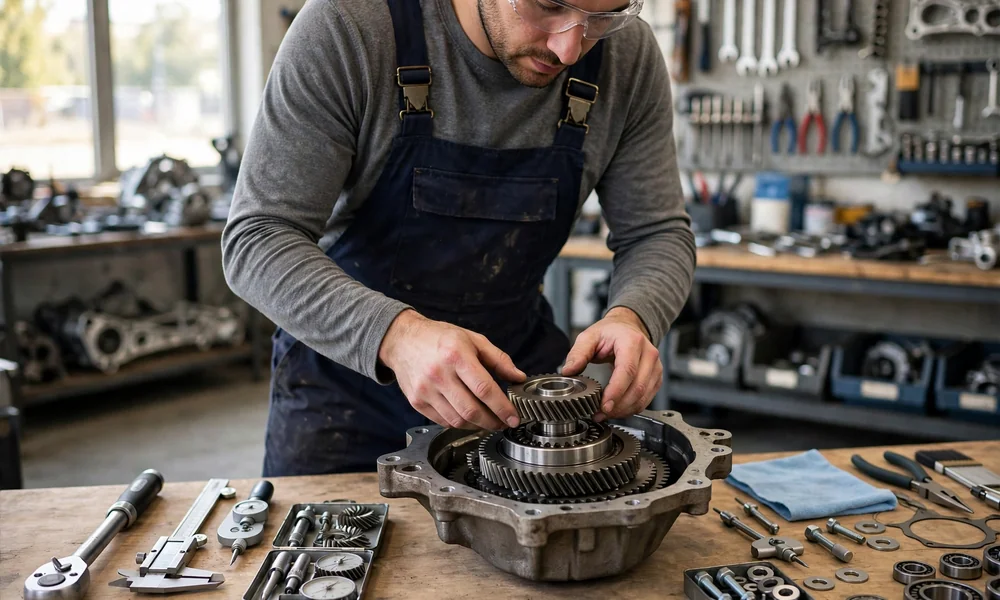
In a modern hypercar differential, the gears are only half the story. Inside the housing sit clutch packs — stacks of alternating steel and friction plates — that can be squeezed together to lock the two wheels, or released to let them spin freely. A hydraulic pump and electronically controlled valves decide how much pressure to apply, hundreds of times a second, following commands from the car’s computer. Technicians assemble the packs by hand, measuring the clearance of each stack with feeler gauges, because a clutch pack that is a fraction too tight will drag, and one that is too loose will slip. Sensors for speed, temperature, and pressure are fitted at the same time.
Step 5: Shimming, backlash, and the first spin
Assembly is where the differential becomes a precision instrument. The gears are fitted into the housing with shims — paper-thin washers — that set the exact spacing between them. Too tight, and the gears will overheat and wear; too loose, and they will clunk and chip. Technicians measure the backlash, the tiny play between meshing teeth, with dial gauges, adjusting shims until it falls within a window measured in hundredths of a millimetre. Then the unit is spun on a test rig for the first time, filled with oil, and listened to.
Step 6: Testing under load and fitting to the car
The finished differential goes to a dynamometer rig, where it is driven under loads that mimic full-throttle acceleration, hard braking, and cornering — sometimes for hours at a time. Engineers watch oil temperature, listen for noise, and check for leaks at every seal. Only after passing every test is the unit fitted to the car, bolted to the chassis and the driveshafts, and filled with its special oil. The turbocharged engines it serves are just as demanding, as hypercar turbochargers demonstrate.
| Main material | Forged alloy steel gears in a machined aluminium or magnesium housing |
| Typical weight | About 25 to 45 kilograms, depending on type and size |
| Gear tolerance | Teeth ground to within a few microns |
| Lock-up control | Electronically controlled clutch packs, adjusted hundreds of times a second |
| Torque capacity | More than 1,000 newton-metres in the most powerful cars |
| Lubrication | Special synthetic oil, cooled by fins and oil galleries |
| Backlash setting | Measured in hundredths of a millimetre with dial gauges |
| Service interval | Oil changes on a strict schedule, more often after track use |
What Does a Hypercar Differential Cost?
A hypercar differential is a bespoke part, built for one model in small numbers, so there is no standard price. A mechanical limited-slip unit is estimated at roughly $8,000 to $20,000, while an electronically controlled differential with clutch packs, hydraulics, and its own control software is estimated at $25,000 to $50,000 or more. These are estimates only, and they exclude the engineering and testing behind the design. For owners, the ongoing cost is maintenance: the special oil must be changed regularly, and clutch packs wear with hard track use.
A Rare Fact
The differential is one of the oldest ideas in the car — it was patented in the 1820s for steam carriages, long before the petrol engine existed — yet it took more than a century to become smart. Early differentials were purely mechanical and could do nothing about a spinning wheel. It was only in the 1930s that limited-slip designs appeared, and only in the last few decades that electronics let a differential think. Today’s hypercar units are the direct descendants of a gear set invented for a vehicle that had no engine at all.
The differential will never be the part a hypercar owner brags about. It has no badge, no sound, no visible drama. But every clean exit from a corner, every launch without wheelspin, and every moment the car feels planted rather than nervous comes down to this box of gears doing its sums in silence. It is the quietest genius on the car — and one of the hardest to make.