A hypercar at full speed is not really driving through the air; it is managing it. Every curve of the body, every vent and wing, is there to solve the same two problems: cut drag so the car can go faster, and create downforce so the tyres stay glued to the road.
This guide counts down ten hypercar aerodynamics features, from the obvious rear wing to the hidden channels under the floor, and explains what each one actually does. Together they explain why a modern hypercar looks the way it does, and why none of its shapes are there by accident.

Ten Hypercar Aerodynamics Features That Matter
1. The active rear wing
The active rear wing is the most visible aerodynamic feature on a hypercar, and the most honest about its job. Sensors and computers adjust it many times a second, responding to speed, steering and braking faster than any driver could.
At top speed, a hypercar’s wing can press down on the rear axle with the weight of a small car, and the wing itself must survive that load without flexing or fluttering. Our guide to hypercar spoiler specs explains the numbers behind the shape, from chord length to angle of attack.
2. The venturi floor and diffuser
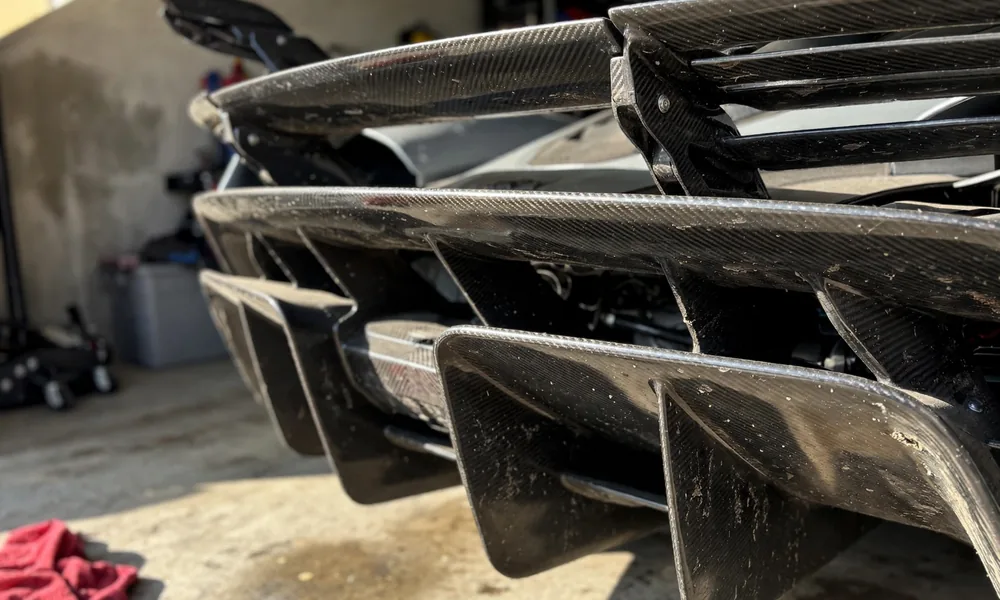
Underneath a hypercar is a carefully shaped floor that works like an upside-down wing. Air is squeezed through a narrowing channel and then released through the diffuser at the rear, speeding up as it goes. Fast-moving air has lower pressure, so the floor is effectively sucked towards the road, creating downforce without the drag penalty of a big wing.
The diffuser’s job is to slow that air back down gently, recovering pressure without letting the flow detach and turn turbulent. What happens above the floor matters too, and our look at how a hypercar aerodynamic body is built shows how the upper and lower surfaces are shaped as one system.
3. The front splitter
The front splitter is the flat blade that juts out from the bottom of the nose, and it does two jobs at once. It splits the air, sending some over the car and some under it, and it creates a low-pressure zone beneath the front of the car that pulls the nose down.
Racing cars use huge splitters; road hypercars use smaller ones, tuned to work with the rest of the body. A splitter that is too aggressive will starve the floor of air, so its size is always a compromise with the diffuser at the back.
4. Active flaps and air curtains
Active flaps are small panels in the bodywork that open and close to manage airflow where it is needed most. In front of the wheels, air curtains guide air smoothly around the tyres, one of the draggiest parts of any car.
The system is invisible to the driver, who simply feels a car that is stable at every speed. These small moving parts are a good example of how modern aerodynamics is as much software as shape.
5. The S-duct
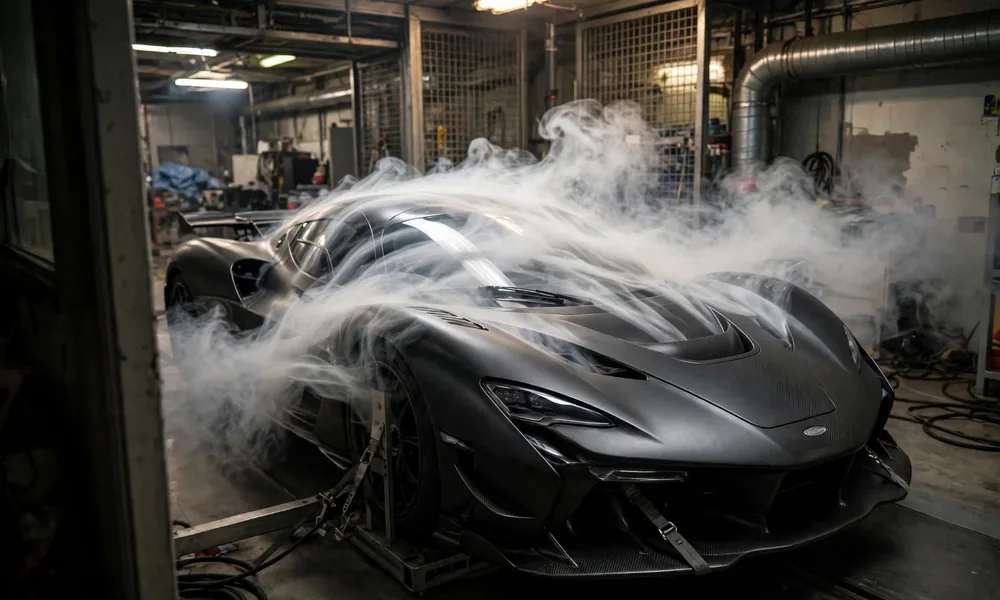
The S-duct is a hidden channel that takes air from the nose of the car, runs it up through the body and vents it out over the top of the bonnet. It solves a classic problem: air hitting the nose creates a high-pressure zone that pushes the front of the car up.
The driver never sees it, the owner never cleans it, and yet it can be worth a meaningful amount of front downforce. It is the kind of detail that separates a car shaped by a wind tunnel from a car shaped by a styling studio.
6. Side skirts and vortex generators
Side skirts seal the gap between the car’s floor and the road, keeping the low-pressure air under the car from leaking out sideways. Without them, the ground effect created by the floor would bleed away at the edges, and the downforce would drop.
Vortex generators are tiny fins that stir the air into small whirlwinds, and those whirlwinds keep the main airflow stuck to the surface instead of peeling away. Each one is small, but together they keep the airflow honest at speeds where it would rather go turbulent.
7. The roof scoop and engine intake
On a mid-engined hypercar, the engine sits behind the driver and needs air, both to breathe and to cool. The roof scoop feeds it, catching clean, fast-moving air above the cabin and ducting it down to the intake.
Engineers shape it carefully, sometimes splitting it into two channels, one for the engine and one for cooling, so the air arrives where it is needed and the wing still gets clean flow. A badly placed scoop can cost more downforce than the engine gains in power, which is why its shape is tested as carefully as the wing itself.
8. Brake cooling ducts
Hypercar brakes turn speed into heat, and at track speeds that heat is ferocious enough to melt ordinary components. Brake cooling ducts catch air from the front of the car and funnel it directly onto the brake discs and callipers, keeping them in the narrow temperature window where they work best.
Air used for cooling is air that is not flowing smoothly around the car, so the ducts are shaped to take what they need and return the rest with as little disturbance as possible. The brakes themselves are covered in our guide to how a hypercar suspension works, which explains how the car keeps its tyres and brakes in contact with the road.
9. The rear deck and Kamm tail
The rear of a hypercar is cut off sharply in a shape called a Kamm tail, named after the engineer who proved that a car does not need a long, tapered tail to be slippery. It is why hypercars look truncated at the back rather than teardrop-shaped.
It is a shape that looks abrupt and works beautifully, a reminder that aerodynamics rewards what the air wants, not what the eye expects. The Kamm tail is one of the oldest ideas in car aerodynamics, and it is still on every fast car built today.
10. Drag reduction systems
A drag reduction system, borrowed from Formula 1, lets the driver or the car itself flatten the rear wing on a straight, shedding drag and gaining speed, then restore it for the next corner. It is the final piece of the active aerodynamics puzzle.
It can be both, changing its mind several times a minute. That adaptability is what makes a modern hypercar so much faster than its predecessors, even with similar power: it is not just the engine that got better, it is the air.
The Takeaway
Hypercar aerodynamics is a balancing act, and the ten features on this list are the tools engineers use to keep that balance. The shapes will keep changing, but the goal will not: use the air, do not fight it, and let the car go faster because of the wind, not in spite of it.


