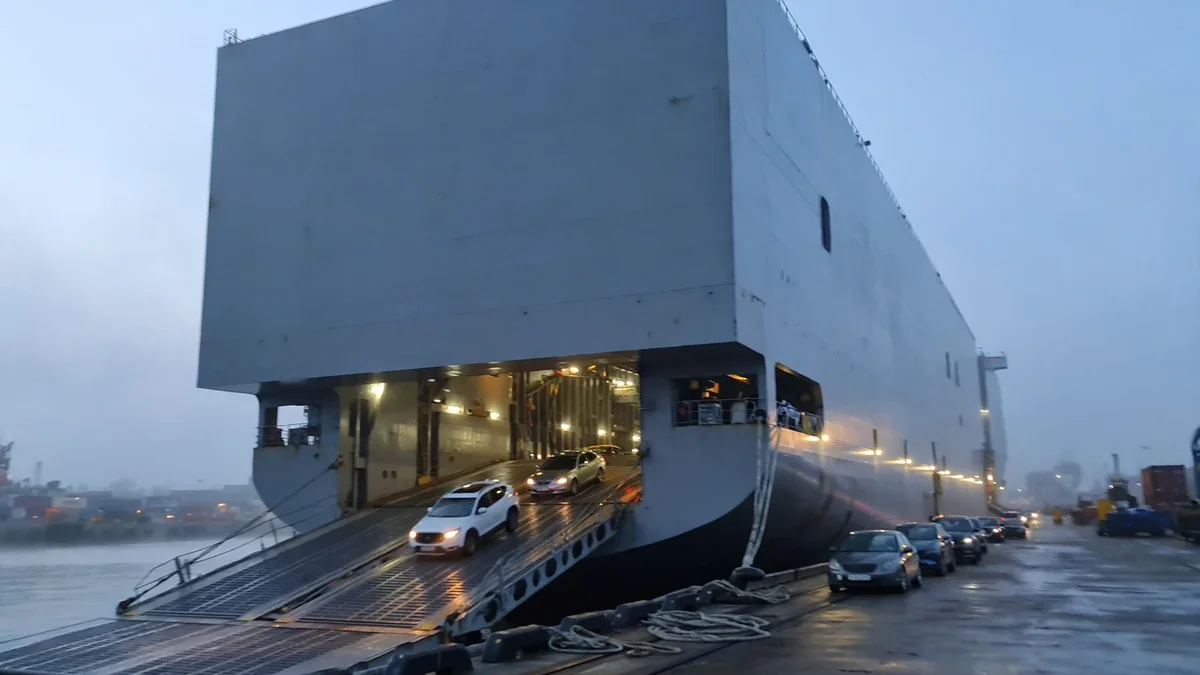
From the outside, a luxury car carrier looks like a mistake: a towering steel slab with flat sides, tiny windows and no visible cargo, more like a floating warehouse than a ship. Then the stern door swings open, a ramp drops to the quay, and cars roll aboard in a slow, endless stream, deck after deck, until the slab is full. Only then do the shape and the price make sense.
Inside is a multi-storey car park that must survive ocean storms, protect paintwork worth millions, and never catch fire. Its cargo is thousands of fuel tanks on wheels, parked centimetres apart, and the engineering keeping them safe is far more elaborate than the blank walls suggest.
How a Luxury Car Carrier Is Built
The build is a study in vertical space. Where other ships think in length and depth, a car carrier thinks in decks, and the yard’s job is to stack as many as possible without making the ship top-heavy or impossible to load.
1. The hull is a floating warehouse
The hull is built tall and slab-sided, with almost no sheer or curve, because every curve wastes parking space. Inside, the ship is divided into as many as thirteen decks, most of them fixed and a few hoistable, so the height of each level can be adjusted for tall vehicles one voyage and low sports cars the next. The decks must carry thousands of cars while flexing with the hull in heavy weather, and that steelwork is heavier than it looks.
2. Ramps and doors do the heavy lifting
Cars cannot be craned aboard in any number, so the ship loads through its own doors. A massive stern ramp, wide enough for two lanes of traffic, lowers to the quay, and internal ramps connect the decks so cars can drive to their parking spots under their own power. Ramps, hinges and hydraulics handle trucks as well as cars, and must seal watertight at sea.
3. Lashing keeps thousands of cars still
Once parked, every vehicle is lashed to the deck with wheel chocks and straps rated for the rolling and pitching of an ocean crossing. Six thousand cars means six thousand lashings, checked by hand, on every voyage. The fittings, gear and labour are a permanent cost, and one car breaking loose in a storm can damage dozens of neighbours.
4. Ventilation fights invisible danger
Thousands of cars mean thousands of fuel tanks and batteries in enclosed steel decks, and the air down there must be managed constantly. Powerful ventilation systems sweep exhaust fumes and fuel vapour out of the decks, while gas detection watches for leaks a human nose would miss. Fans, ducts and sensors run around the clock, sized for a full load in tropical heat. The daily reality of operating this floating garage is described in how a luxury car carrier works.
5. Fire protection is the ship’s obsession
Fire is the nightmare of every car carrier operator, and the ship is built around preventing one. Decks are divided by fire-resistant boundaries, drencher systems can flood a deck with water in minutes, and fixed gas systems can smother a fire where water would spread burning fuel. The most expensive protection is detection: sensors everywhere, watched constantly, because a fire found in its first minute is an incident and one found in its tenth can be a total loss. The scale of the build, and the yard work behind it, is comparable to the construction story in how a luxury container ship is made, though the cargo could hardly be more different.
6. Ballast and stability keep the slab upright
A tall, slab-sided ship full of cars is a stability puzzle. Ballast water is pumped between tanks to keep the vessel upright as cars load and discharge, while computers track the centre of gravity. Get it wrong and the ship lists, ramps jam, and loading stops. The ballast system, the stability computers and the crew training behind them are a quiet but permanent part of the price.

The Numbers Behind the Price
The table below gives the typical scale of a large modern luxury car carrier, and a sense of what each figure costs the owner.
| Specification | Typical value | Why it costs money |
|---|---|---|
| Length overall | About 200 metres | A long hull with thirteen decks stacked inside. |
| Beam | About 32 to 36 metres | Wide enough for several lanes of cars per deck. |
| Car capacity | About 6,000 to 8,000 vehicles | Every car needs a parking space, lashings and air. |
| Cargo decks | About 13 decks | Fixed and hoistable decks, all ventilated and drained. |
| Stern ramp | Two lanes, truck-rated | Hydraulics and seals built for daily heavy use. |
| Main engine | Slow-speed diesel, about 15 megawatts | One large engine, tuned for steady ocean crossings. |
| Service speed | About 18 to 20 knots | Fast enough to keep car factories supplied on schedule. |
| Crew | About 20 to 25 officers and crew | A small team running a ship the size of a warehouse. |
| Ventilation | Full-time, all cargo decks | Fans, ducts and gas detection running around the clock. |
| Build time | About two years | Two years of yard time, labour and financing costs. |
The capacity figure hides the real cost driver: the ship earns only when its decks are full, but spends on every deck whether full or not. Ventilation, fire systems and lashings cost the same on an empty sailing as a full one. For a different take on reading a ship’s numbers, the luxury barge spec sheet shows what a much simpler cargo vessel spends its money on.
What It Costs
The price of a large luxury car carrier is an estimate, because the final figure moves with steel prices, yard availability and the deck configuration the owner orders. A reasonable current estimate is roughly 80 to 110 million dollars for a large modern carrier, with the biggest and most advanced designs costing more. The hull steel is only the start: thirteen decks, hoistable panels, ramps, ventilation, drencher systems and the lashing outfit add up quickly, and two years of yard labour and financing sit on top. Running costs are high too, from stevedores loading and lashing every car to constant maintenance of ramps and ventilation.
A Rare Fact
Here is the detail that surprises most people: a car carrier’s most dangerous cargo is not the fuel in the cars, but the cars’ batteries. Modern electric vehicles carry large lithium batteries, and a damaged battery can burn hotter, longer and more stubbornly than a tank of petrol, even underwater. Operators now train crews for battery fires, stow electric vehicles apart, and carry thermal cameras to spot a warming battery early. The ship that was designed around petrol cars is being redesigned, voyage by voyage, around the cars of the next decade, and that quiet transformation is part of what the price buys.

A luxury car carrier looks like the least interesting ship in the harbour, and that is exactly the point. Its blank walls hide thirteen decks of cars, each lashed by hand, ventilated around the clock, and watched by fire systems that must never be needed. The price is not for the steel slab you see from the quay. It is for the thousands of new cars that arrive at the far end of the voyage in exactly the condition they left the factory, paintwork unmarked and batteries cool.