The door closes with a soft thunk, the outside world drops away, and then the first notes fill the cabin. A singer’s voice hangs in the air just ahead of the dashboard, a double bass walks somewhere near the front wheels, and the whole car seems to disappear, leaving only the music.
A luxury car sound system has one of the hardest jobs in audio. It must make music sound like a concert hall inside a small metal box that is moving, vibrating and full of glass, and it must do it for every seat at once. The cabin is the wrong shape, the listeners sit in the wrong places, and the noise of the road never stops.
The trick is not a single magic speaker but a whole system of parts working together: speakers placed where the cabin needs them, amplifiers with power to spare, and software that measures the cabin and tunes the sound to fit it. This is how a luxury car sound system works, from the first signal to the last note.

How a Luxury Car Sound System Works
Step 1: The source and the signal
Every note starts as a digital file, streamed from a phone or stored in the car, and the first job is to turn it into a clean electrical signal. A digital-to-analogue converter inside the head unit or amplifier reads the file and rebuilds the sound wave, sample by sample, at a quality far beyond a normal radio. The signal then travels along shielded cables to the amplifiers, kept away from the car’s power lines so that no hum or buzz creeps in along the way.
Step 2: Amplifiers with power to spare
The signal from the source is far too weak to move a speaker, so amplifiers boost it to the level the speakers need. A luxury system carries a separate amplifier channel for almost every speaker, with total power running into hundreds of watts and sometimes beyond a thousand. The amplifiers are usually hidden in the boot or under a seat, mounted on heatsinks that carry away the warmth they make. Our guide to OLED display panel specs covers the other screen the driver watches while the music plays.
Step 3: Speakers placed for every seat
A luxury car can carry anywhere from a dozen to more than thirty speakers, and each one has a job. Tweeters in the pillars and dashboard handle the high notes, mid-range drivers in the doors carry voices and instruments, and large woofers in the doors or rear shelf produce the bass. Some systems add speakers in the headliner and even in the headrests, so that the sound reaches every seat evenly instead of favouring the driver.
Step 4: The subwoofer and the low end
Bass is the hardest sound to make in a car, because low notes need large amounts of air moved slowly, and a car cabin is small. The subwoofer, usually a large driver mounted in the boot or under the rear seats, handles everything below about 80 hertz — the thump of a kick drum, the depth of a double bass, the rumble of an organ. When it is right, you feel the low notes in your chest without the rest of the music losing its shape.
Step 5: Tuning the cabin with software
No two car cabins sound the same, so every luxury system is tuned to the exact car it lives in. Microphones placed in the seats measure how test tones behave in the cabin, and software builds a map of the reflections, the dead spots and the resonances of the glass and trim. It is the same idea as a concert hall designed around its room, except the room is moving at motorway speed.
Step 6: Noise cancelling and the quiet cabin
The last piece of the puzzle is silence. Microphones in the cabin listen for the steady drone of tyres and wind, and the system plays an inverted copy of that noise through the speakers, cancelling it before it reaches your ears. This active noise cancelling works best on low, steady sounds, which are exactly the ones that tire you out on a long drive. At the same time, heavy insulation and acoustic glass keep the worst of the outside world out in the first place. Making a small speaker sound big is a craft of its own, as our guide to how luxury earbuds are made shows.
Step 7: The listener takes control
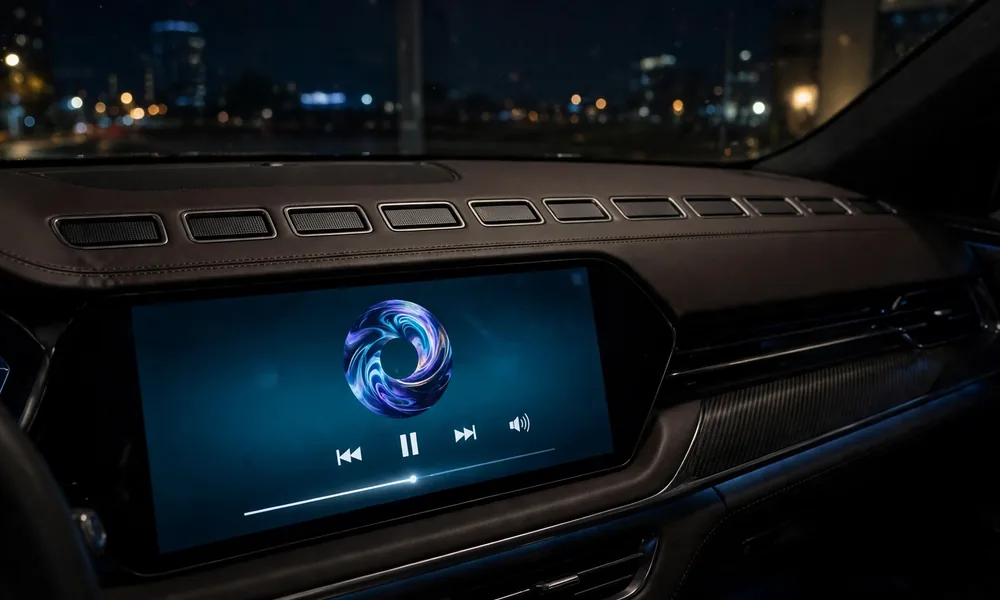
Finally, the system hands control to the person in the seat. Presets shape the sound for different tastes — one for a concert hall feel, one that brings voices forward for podcasts, one that adds warmth to older recordings. The driver can move the sound stage forward or back, raise the bass for one song and lower it for the next, all from the touchscreen or a dial on the console. The system never stops working in the background, measuring, tuning and cancelling, but from the seat it feels simple: press play, and the car becomes a room full of music. Even the smallest drivers matter in the mix, and our guide to how luxury headphones are made shows how the same ideas work at a smaller scale.
Luxury Car Sound System Specs
| Specification | Typical range |
|---|---|
| Speakers | About 12 to 30 or more |
| Amplifier power | About 600 to 1,900 watts |
| Amplifier channels | About 12 to 24, often one per speaker |
| Subwoofer | One or two large drivers, usually in the boot |
| Frequency response | About 20 Hz to 20 kHz, some beyond 40 kHz |
| Noise cancelling | Active, via cabin microphones |
| Source quality | High-resolution streaming and stored files |
| Controls | Touchscreen, console dial and voice |
What Does a Luxury Car Sound System Cost?
A premium factory sound system in a luxury car is estimated to cost roughly $3,000 to $7,000 as an option, while a flagship branded system is estimated at $7,000 to $15,000 or more. The very top systems in flagship saloons are estimated to pass $20,000 with every speaker and amplifier included. Prices are estimates only and vary by brand, speaker count and model.
A Rare Fact
Some luxury car sound systems are tuned with the help of concert hall designers, and a few use the same measurement microphones that tune real auditoriums. Engineers have even recorded orchestras sitting in the car’s seats, placing microphones where passengers’ ears would be, so the system can recreate the exact sound of the hall. The car becomes, in a small way, the room the music was played in.

A luxury car sound system works by refusing to accept the cabin it is given. It measures the room, times every speaker to the millisecond, cancels the noise it cannot block, and gives each listener the best seat in the house. It is a concert hall that moves, a studio that fits in a boot, and a quiet room all at once. The next time the music starts and the world outside fades, remember what is happening behind the trim: dozens of speakers, a thousand watts and a small army of microphones, all working so you can simply listen.


