From the observation deck of the shipyard, the container ship looks less like a vessel and more like a small town that happens to float. She is longer than three football fields, her hull a rust-red wall of steel rising ten storeys above the dry dock, and along her deck a forest of cranes and scaffolding sways in the wind.
What makes a luxury container ship different is not the cargo she carries but the way she carries it. The newest high-end vessels pair enormous capacity with the cleanest, quietest and most efficient systems ever fitted to a cargo ship: dual-fuel engines that burn methanol or liquefied natural gas, shore-power connections, advanced hull coatings, and accommodation that feels closer to a cruise ship than a freighter.

How a Luxury Container Ship Is Made
Step 1: Design, contracts and the first steel
A container ship begins years before construction, in the design office and the boardroom. The owner specifies how many containers she must carry, how fast she must sail, which ports she must fit and which emissions rules she must meet, and the naval architects turn those numbers into a design: length, beam, draught, engine power and the arrangement of holds, tanks and accommodation. Computer-controlled machines slice thousands of steel plates into precisely shaped pieces, each one barcoded and tracked.
Step 2: Block construction and the hull taking shape
Modern shipbuilding does not build a ship from the keel up in one place. It builds her in blocks, giant steel sections weighing hundreds of tonnes each, assembled in workshops and joined together in the dry dock like pieces of a puzzle. The hull is only one part of this stage: the bottom shell, the double-hull tanks and the hold structures are built as blocks, but so are the engine room, the accommodation block and the deckhouses. The hull itself is closed up relatively quickly, and the separate story of how a container ship hull is made covers that steelwork in detail. For the whole-ship build, the hull is a milestone, not the destination: once she is watertight, the real work of turning a steel shell into a working ship begins.
Step 3: The engine, the propeller and the power plant
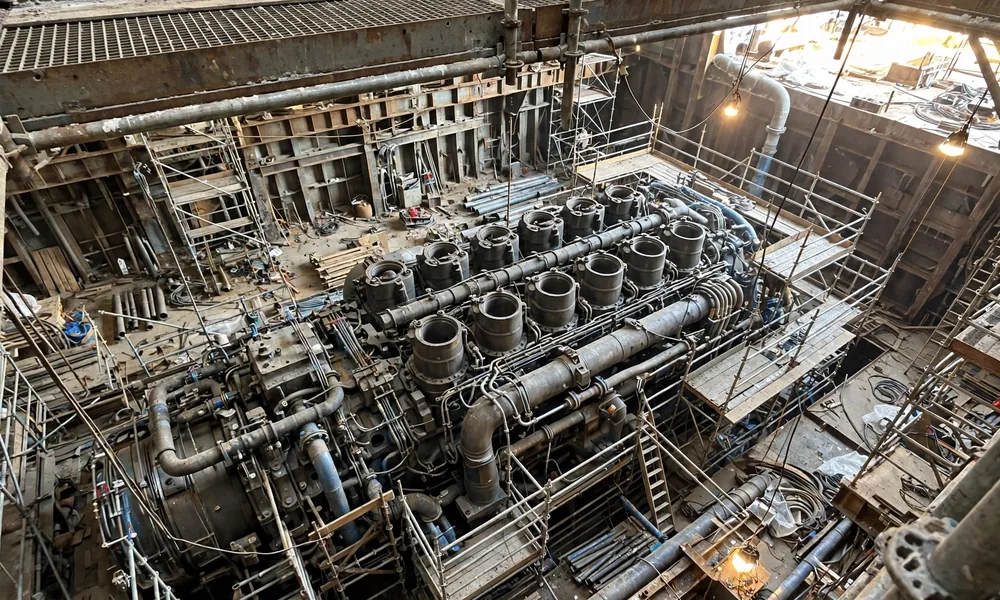
The heart of a container ship is her main engine, a slow-speed two-stroke diesel so large that engineers work inside it during maintenance, standing on the pistons to inspect the cylinders. On a luxury new-build, this engine is increasingly a dual-fuel design, able to run on conventional fuel or on methanol or liquefied natural gas, which cuts carbon emissions and lets the ship meet the strictest port rules. The engine is assembled in the engine room and bolted to the propeller shaft, a steel shaft as thick as a tree trunk that runs to the propeller. The ship propeller is a masterpiece of casting and machining, and on a ship of this size it is the single most expensive rotating part on board.
Step 4: Holds, deck fittings and the container system
While the engine room takes shape below, the cargo spaces are fitted out above. The holds are vast open steel boxes, divided by cell guides, vertical rails that hold the containers in precise stacks and stop them shifting at sea. On deck, the fittings that make container shipping possible are installed: twist locks, lashing bridges, and guides that let a crane drop a forty-foot box into place with centimetres to spare. A luxury new-build adds refinements an ordinary ship skips: reefer plugs for hundreds of refrigerated containers, each monitored from the bridge; advanced fire detection in the holds; and a ballast-water treatment system that stops the ship carrying invasive species from one ocean to another.
Step 5: The bridge, accommodation and the ship’s brain
Forward, the accommodation block rises like a white tower above the deck, and inside it the ship gains the spaces where her crew will live for months. On a premium new-build the cabins are larger and quieter than the industry standard, the mess rooms are properly finished, and the bridge is a wide, glass-fronted space with a full view over the bow. Below the consoles, the ship’s brain is installed: integrated navigation, engine control, cargo monitoring and communications, all linked by a network that lets the bridge watch everything from fuel consumption to the temperature of a single refrigerated container. The autonomous cargo ship shows where this technology is heading, with sensors and automation taking over more of the watchkeeping.
Step 6: Painting, sea trials and delivery
In the final months the ship is painted in the owner’s colours, her name is welded to the bow and stern, and the dry dock is flooded for the float-out. The first voyage is not a commercial sailing but a sea trial, in which the ship is run at full speed, stopped in an emergency crash-stop, turned in tight circles and tested in rough weather. Surveyors from the classification society ride along, checking everything from the lifeboats to the emergency generator, and the owner refuses delivery until the ship meets every contracted figure for speed, fuel consumption and noise.
Luxury Container Ship Specifications
| Specification | Typical figure |
|---|---|
| Length overall | 300 to 400 metres |
| Beam | 48 to 61 metres |
| Container capacity | 15,000 to 24,000 TEU |
| Steel used | 35,000 to 45,000 tonnes |
| Main engine power | 60,000 to 80,000 horsepower |
| Service speed | 20 to 24 knots |
| Fuel type | Dual-fuel: methanol or LNG |
| Crew | 20 to 25 people |
| Build time | 24 to 36 months |
| Service life | 25 years |
How Much Does a Luxury Container Ship Cost?
A luxury container ship is one of the most expensive single machines ever built. A mid-size new-build of around 15,000 containers with a dual-fuel engine and premium accommodation carries an estimated price of $130 million to $170 million. A flagship ultra-large vessel of 24,000 containers, with methanol fuel, shore power, advanced automation and the most efficient hull ever designed for her class, is estimated at $180 million to $240 million. Yet the economics still work, because a single voyage can carry cargo worth more than the ship herself. The luxury is not decoration; it is efficiency, reliability and the ability to keep sailing when older ships are forced into port by new emissions rules.
A Rare Fact About Luxury Container Ships
Here is something almost nobody outside the industry knows: the largest container ships are so long that the steel of the hull actually flexes as they ride over ocean waves, bending up and down by as much as a metre from bow to stern. Naval architects design for this flexing, building expansion joints into the deck and piping systems that can move without breaking, and the crew can sometimes feel the ship breathing beneath their feet in heavy weather. It is a quiet reminder that even a 400-metre steel giant is not rigid: she bends with the sea she sails on.
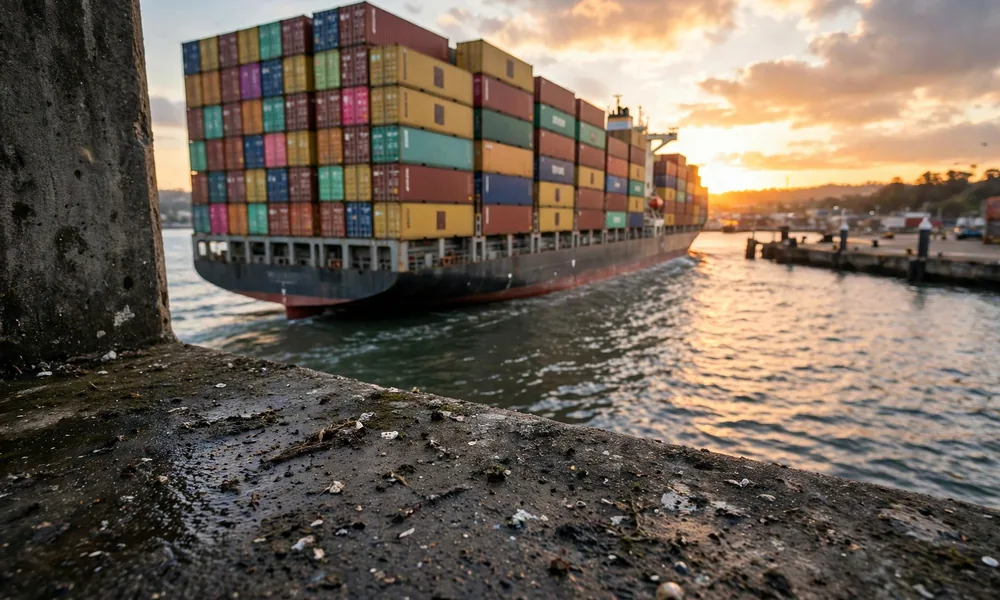
Building a luxury container ship is the closest thing the modern world has to building a city that floats. It takes thousands of people, tens of thousands of tonnes of steel, an engine the size of a house and two years of relentless work, and the result is a machine that moves a substantial share of everything the world buys and sells. The next time a container ship slides past on the horizon, remember she was built block by block, by a small city of people who will never sail on her.


