On a dirt track at dusk, a rider approaches a jump, pedals hard twice, and leaves the ground. There is no chain clatter, no engine buzz, just the sound of tyres on dirt and the soft rush of air. The bike hangs in the air for a moment, lands cleanly, and accelerates away from the landing without a single extra pedal stroke. To the crowd it looks like an ordinary BMX, small and light and built for tricks. Underneath, it is carrying a motor, a battery and a computer that all work together to make that jump feel effortless.
A luxury electric BMX is a machine built around a contradiction: it must be light enough to jump and spin like a normal BMX, yet strong enough to carry a motor and a battery that can launch it out of a berm at full speed. Here is how it works, from the frame that holds it together to the controller that decides how much help the rider gets.
How It Works
Step 1: The frame carries the power
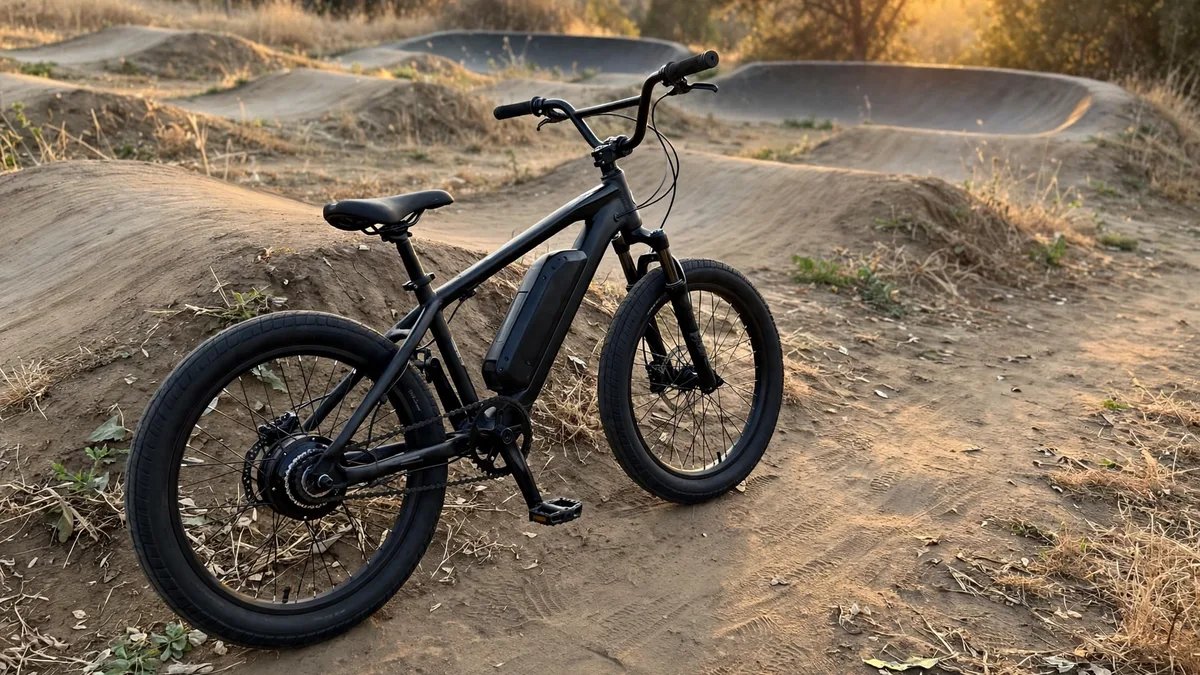
Everything starts with the frame, and on a luxury electric BMX it is made from chromoly steel or aluminium, built to take the shock of hard landings again and again. The frame is smaller and stronger than the frame of an ordinary electric bike, with thick tubes at the head and the bottom bracket, because a BMX lands jumps on its front wheel as often as its back. The motor and the battery are mounted low and central, inside or beside the frame, so the bike keeps its balance in the air, and the cables run inside the tubes, where they cannot be snagged by a foot or a branch.
Step 2: The motor gives instant torque
The motor is the heart of the bike, and on a luxury electric BMX it is usually a compact hub motor in the rear wheel or a small mid-drive unit at the pedals, producing between 500 and 1,500 watts. What matters most is not the power but the torque, the twisting force that pushes the bike forward, and an electric motor gives its full torque from a standstill, which is exactly what a BMX rider needs coming out of a slow corner or up a steep ramp. The motor is sealed against dust and mud, because a BMX spends its life on dirt tracks, and it is cooled by the air rushing past it as the bike moves.

Step 3: The battery hides in plain sight
The battery is the part of the bike that has to disappear. On a luxury electric BMX it is usually a slim lithium pack hidden inside the down tube or in a small case under the frame, holding between 300 and 700 watt hours, which is enough for an hour or two of hard riding on a track. The cells are packed in a tough case that can survive a crash, and a battery management computer watches the temperature and the charge of every cell, shutting the pack down if it gets too hot or too low.
Step 4: The controller and throttle decide the help
Between the battery and the motor sits the controller, a small computer that decides how much power the rider gets and when. The rider controls it with a thumb throttle or with a pedal-assist sensor that measures how hard the rider is pushing, and the controller smooths the power so the bike accelerates cleanly instead of jerking forward. Most luxury electric BMX bikes offer several modes, from a gentle eco setting that stretches the battery to a full-power mode that gives everything the motor has, and the rider can switch between them with a button on the handlebars.
Step 5: Brakes, tyres and suspension keep it safe
Power is only useful if the bike can stop, and on a luxury electric BMX the brakes are hydraulic discs, strong enough to halt the bike from full speed in a few metres, even on a dusty track. The tyres are wide and knobbly, chosen for grip on dirt and on concrete, and they are run at a low pressure so they soak up small bumps before the rider feels them. Most electric BMX bikes have a short-travel suspension fork at the front, with adjustable damping, so the landing from a jump does not jar the rider’s wrists, and the rear stays rigid, because a BMX rider needs to feel exactly what the back wheel is doing.
Step 6: The ride, the jump and the landing
Put it all together and the ride feels like this: the rider pedals twice, the torque sensor feels the push, and the controller feeds power to the motor in the same instant, so the bike leaps forward without a pause. On the straight the motor hums quietly, on the jump the light frame and the low battery keep the bike level in the air, and on the landing the fork and the tyres take the shock while the motor is already pulling again. The battery drains fastest on the climbs and the accelerations, and the rider learns to save it for the jumps that matter, switching to eco mode on the flat.

Luxury Electric BMX Specifications
The figures below describe a typical luxury electric BMX. Smaller and larger machines differ in power and range, but the way they work is the same.
| Specification | Typical luxury electric BMX | What it means |
|---|---|---|
| Motor power | 500 to 1,500 watts | A compact hub or mid-drive motor, with instant torque. |
| Motor torque | 60 to 120 newton metres | The push that launches the bike out of a corner. |
| Battery capacity | 300 to 700 watt hours | Hidden in the frame, enough for an hour or two of hard riding. |
| Range | 40 to 80 kilometres | Shorter on a track, longer on flat ground in eco mode. |
| Top speed | 40 to 50 kilometres per hour | Limited by the controller, not by the motor. |
| Weight | 18 to 24 kilograms | Light enough to jump, heavy enough to carry a motor and battery. |
What It Costs
A luxury electric BMX costs an estimated $3,000 to $8,000, depending on the motor, the battery and the frame, with the most exclusive hand-built models costing more. Those are estimates, not quotes, and they reflect a light strong frame, a sealed motor and a battery that must survive jumps and crashes. The numbers behind that price are laid out in luxury electric BMX specs explained, and the reasons the price is so high are covered in why a luxury electric BMX is so expensive.
A Rare Fact
Here is a detail most people never guess. A luxury electric BMX can be quieter than the rider’s own breathing, yet it can out-accelerate a small motorcycle from a standstill, because an electric motor gives its full pulling force the instant the rider pushes, while a petrol engine has to spin up first. That silence changes how the bike is ridden: riders practise late into the evening without disturbing anyone, and they hear the tyres, the wind and the track instead of an engine. The silence comes at a price, which is why the cost is so high, and it is also true of its fatter-tyred cousin, as how a luxury electric fat bike works shows.


