A BMX bike is supposed to be simple. Twenty-inch wheels, a single gear, no suspension, no frills, just a small steel frame built to be jumped, spun and crashed without complaint. It is the bicycle as a toy, a tool for tricks and for teenagers, and for decades it was also the cheapest proper bicycle you could buy. So when a luxury electric BMX appears with a price tag in the thousands, the first reaction is disbelief. How can a bike with no gears and no suspension cost as much as a good motorcycle?
The answer is that the simplicity is an illusion. Making a tiny, single-gear bicycle carry a motor and a battery, survive repeated landings from height, and still feel like a BMX takes a surprising amount of engineering. The frame must be stronger than a normal BMX frame, the motor must be small enough to hide, and every part must be built to a standard that a skate park will test ruthlessly. This article breaks the price down, explains where the money goes, and ends with a fact that explains why this small machine has such a large following.
Where the Money Goes
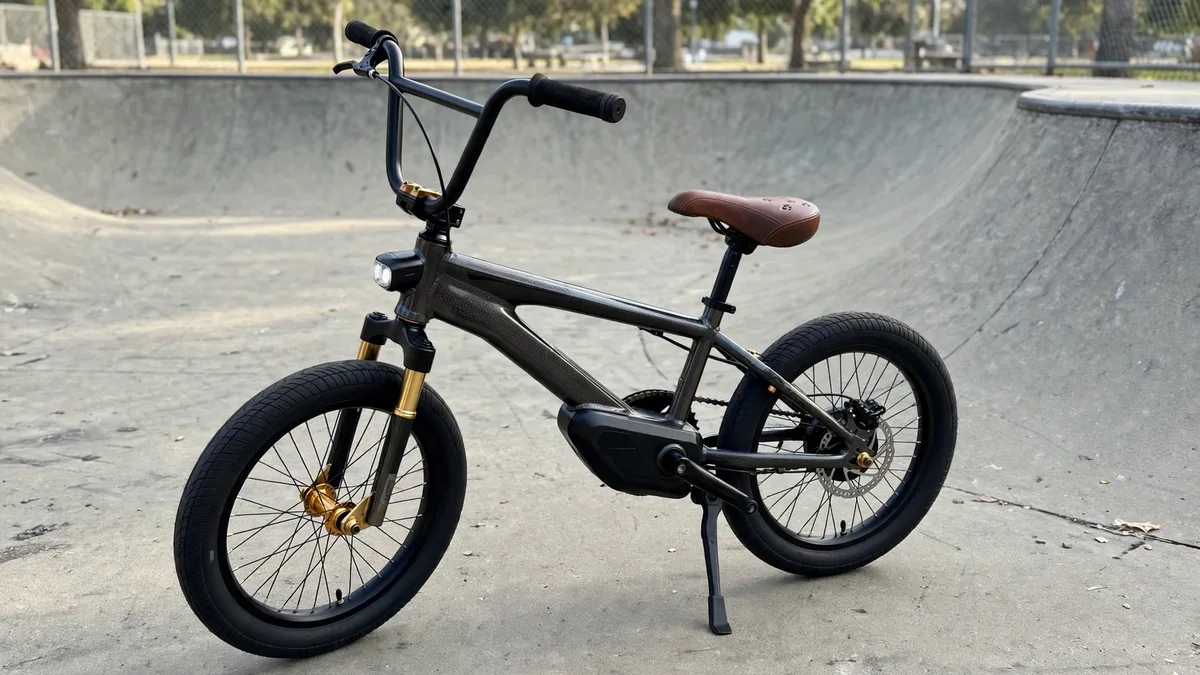
The cost of a luxury electric BMX is dominated by three things: the frame, the motor system, and the wheels. The frame must be built from chromoly steel or titanium, welded by hand, and strong enough to survive landings that would fold a normal bicycle in half. The motor must be tiny, light and powerful, and the battery must fit inside a frame tube that was never designed to hold one. Everything else, from the handlebars to the pedals, must be made to the same standard, because a BMX is ridden hard and crashed often, and a weak part fails quickly and publicly.
The table below gives an estimated breakdown of where the price of a top-end model goes. These are estimates, not a manufacturer’s price list, and they vary between brands, but they show why a machine with so few parts can cost so much: each part is doing a harder job than its equivalent on a larger bike.
| Part of the bike | Estimated share of the price | Why it costs that much |
|---|---|---|
| Frame and fork | About 25 to 30 percent | Hand-welded chromoly or titanium, reinforced for jumps, built to hold a battery inside. |
| Motor and battery system | About 25 to 30 percent | A compact hub or mid-drive motor and a slim battery, with electronics that survive impacts. |
| Wheels and tyres | About 15 percent | Small, heavily built wheels with double-walled rims and strong spokes for hard landings. |
| Brakes and controls | About 10 percent | Hydraulic disc brakes and a gyro that lets the bars spin fully without tangling cables. |
| Finishing parts and labour | About 10 to 15 percent | Handlebars, saddle, pedals, assembly and testing by builders who ride the bikes themselves. |
Small Wheels Take a Big Beating
The twenty-inch wheel is the defining feature of a BMX, and it is also the reason the bike must be built so strongly. A small wheel is stiffer and stronger than a large one, which is good, but it also hits every bump harder, because it cannot roll over obstacles the way a big wheel can. Every landing, every drop, every case of a jump landed short sends a sharp shock through the wheels, the frame and the rider. A normal bicycle would not survive a week of that treatment. A BMX is designed for it, with thick spokes, double-walled rims, a solid axle and tyres that act as the only suspension the bike has.
Adding electricity to that punishment is the hard part. The motor and battery must survive the same shocks, ride after ride, without a wire shaking loose or a cell cracking. Builders protect the battery inside the frame, pot the electronics in resin, and use connectors that lock in place. The electric dirt bike faces a similar problem on a larger scale, with a full suspension system to absorb the blows, while the electric recumbent bike shows how a motor can be fitted to a machine with an unusual shape. On a BMX, there is no suspension to hide behind, so every part must be tough on its own.

The Motor Must Disappear
The power itself is modest by electric bike standards, typically 250 to 500 watts, and that is deliberate. A BMX does not need to go fast in a straight line. It needs a short burst of help to get up to speed for a jump, to climb back up a ramp, or to keep rolling between tricks without pedalling hard. The motor fills in those moments and then steps back, letting the rider do the rest. That restraint is what keeps the bike feeling like a BMX, and engineering restraint into a machine is often more expensive than simply adding power.
Hand-Built in Small Numbers
Small-batch building also means hand work. Frames are welded one at a time, wheels are built by hand, and each bike is assembled, checked and test-ridden by the person who built it. That care shows in the finish: paint that survives scrapes, welds that look like they were laid by a craftsman, and a bike that feels tight and solid from the first ride. The electric trike is another small-market machine with the same economics, where a narrow audience and careful building push the price well beyond what the parts alone would suggest.
So What Does One Actually Cost?
A luxury electric BMX typically costs an estimated $3,500 to $7,000, with custom and limited-edition models reaching further. That estimate covers a hand-welded frame, a compact motor and battery system, heavily built wheels, hydraulic brakes and the labour of a small workshop. It is a lot of money for a bike with one gear and no suspension, and it will never make sense as a way to get to work. It makes sense only as a machine for riders who love BMX, who want to ride longer sessions with less effort between tricks, and who are willing to pay for a bike that survives what they throw at it.
For everyone else, a normal BMX costs a fraction as much and does most of the same things, just with more pedalling. The electric version is not a replacement for the ordinary BMX. It is a specialist machine for a specialist rider, and its price reflects that it is built by specialists, in small numbers, to a standard that a skate park will test on the first day.
A Rare Fact Worth Knowing
Here is a fact that explains the BMX itself: the sport was born in California in the 1970s, when children began racing their bicycles around dirt tracks built to look like motocross courses, imitating the motorcycle riders they admired on television. They had no proper bikes for it, so they stripped down ordinary bicycles, fitted wide handlebars and knobbly tyres, and called them BMX, short for bicycle motocross. The first proper BMX frames were built in garages, by riders who needed a bike that could survive a jump. Fifty years later, the luxury electric BMX is still built for those same riders, just with a motor quietly helping them get back up the ramp for one more run.