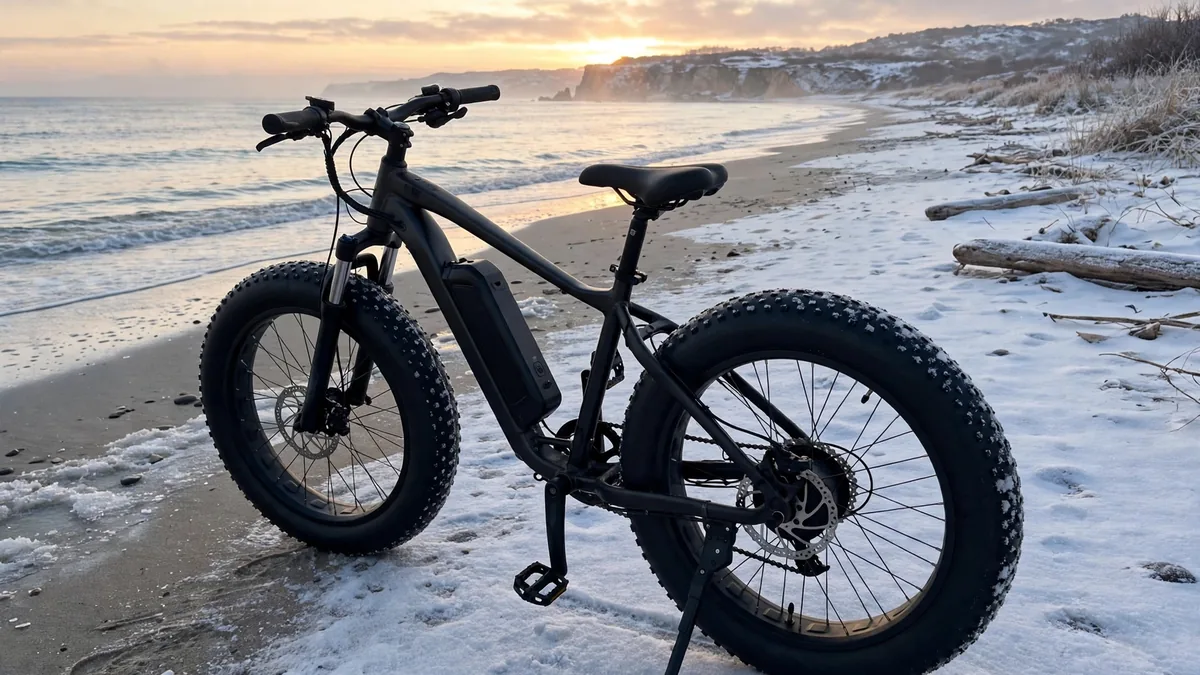
The beach at dawn is empty except for the tide line and a set of tyre tracks wider than a man’s hand. They run straight across wet sand where an ordinary bicycle would sink to its hubs, then turn up a dune and disappear into the soft stuff at the top. The rider who made them is already far away, pedalling easily through terrain that would stop almost any other bike. The secret is not fitness. It is four inches of rubber, a silent motor and a frame built like a bridge.
A luxury electric fat bike is the go-anywhere machine of the e-bike world. It was designed for snow, sand, mud and rock — the surfaces that defeat normal tyres — and the electric motor turns it from a slow slog into a genuinely capable explorer. The luxury versions add the details that make hard terrain comfortable: carbon forks, belt drives, internal batteries and finishes that survive salt, grit and freezing rain without looking tired.
Building one well is harder than it looks. A fat bike’s tyres are so wide that everything else — frame, forks, hubs, chain line — must be stretched around them, and the motor must deliver enormous low-speed torque without overheating in deep snow. Here is how the best ones are made.
How It Is Made
Step 1: The frame is widened around the tyres
A fat bike starts with a simple problem: its tyres are around four inches wide, roughly double a mountain bike tyre, so the frame must be far wider at the rear and at the fork. Designers use a bottom bracket shell over 100 millimetres wide and rear spacing of 170 to 197 millimetres, which pushes the chain outwards and forces every part of the drivetrain to be rethought. The frame itself is usually hydroformed aluminium, with huge clearances and reinforced chain stays, because a tyre clogged with snow can throw off a surprising amount of weight.
Step 2: The motor is chosen for torque, not speed
On sand and snow, top speed is irrelevant; what matters is torque at walking pace. Luxury fat bikes therefore use a powerful mid-drive motor, often rated at 250 watts for road legality but capable of far higher peak torque, sometimes over 100 newton-metres. The motor sits low in the frame and drives the chain directly, which lets the rider use the gears to multiply its force on the steepest, softest climbs. The controller is tuned for a gentle, progressive delivery, because a sudden surge on ice or wet sand simply spins the wheel and digs the bike in deeper.

Step 3: The battery is built for cold weather
Cold is the enemy of lithium batteries: at freezing temperatures a cell can lose a fifth of its usable energy or more. Luxury fat bikes fight back with large packs — often 720 watt-hours or bigger — mounted inside the down tube, where the frame shields them from wind chill. The cells are high-quality, low-resistance types that hold their voltage in the cold, and the battery management system warms the pack slightly during charging.
Step 4: Wheels and tyres are the real engineering
The tyres are the heart of a fat bike. They are four to five inches wide, run at astonishingly low pressures — sometimes as little as five pounds per square inch on snow — and spread the bike’s weight over a huge contact patch so it floats rather than sinks. The rims are wide, often 80 millimetres or more, and on luxury builds they are drilled or cut out to save weight, with the holes covered by rim tape. Studded tyres are available for ice, with hundreds of tiny carbide studs pressed into the tread.
Step 5: Suspension, brakes and the belt drive option
A fat tyre is itself a form of suspension, but luxury builds often add a suspension fork with around 100 millimetres of travel to smooth out frozen ruts and rocks. Hydraulic disc brakes with large rotors are essential, because wet snow and sand can glaze a small rotor in minutes. The drivetrain is usually a wide-range one-by-twelve setup, though the most exclusive fat bikes use a belt drive paired with an internal gear hub — silent, clean, immune to salt corrosion and able to shift while stationary, which is a blessing when you have stalled in deep snow and need a lower gear to restart.
Step 6: Finishing for salt, grit and freezing rain
The final stage is protection. Frames are anodised or powder-coated in deep, muted colours, and every bolt is stainless steel. Cables are routed internally to keep them out of slush, and the motor and battery seals are tested against water jets. Each bike is ridden on sand and, where possible, snow before it leaves the factory, with technicians checking that the motor does not cut out under sustained low-speed load and that the tyres hold their seal at very low pressure. A luxury fat bike is expected to come home caked in salt and mud and still shift cleanly the next morning.
| Specification | Typical luxury electric fat bike |
|---|---|
| Frame | Hydroformed aluminium, titanium or carbon fibre |
| Motor | Mid-drive, 250 W rated, over 100 Nm peak torque |
| Battery | 720 Wh or larger, cold-resistant cells |
| Tyres | 4 to 5 inches wide, run as low as 5 psi |
| Weight | About 24 to 30 kg with battery |
| Drivetrain | 1×12 gears or belt drive with internal hub |
| Range | About 60 to 120 km depending on terrain and cold |
| Brakes | Hydraulic discs with large rotors |
How Much Does One Cost?
Estimates for luxury electric fat bikes generally fall between about $5,000 and $11,000, with titanium-framed or fully custom builds reaching $14,000 or more. The large battery, the powerful motor and the wide, specialised wheels all push the price up, and the small production volumes mean little is shared with mainstream bikes. A buyer is paying for range in conditions where other bikes cannot move at all: a winter commute across a frozen lake, a beach patrol at low tide, or a desert crossing where the sand never firms up.
Running costs are modest. The belt-drive versions need almost no maintenance beyond a wash, and even chain versions survive well if rinsed after salt exposure. The battery is the expensive consumable, typically lasting several years and hundreds of charges before its capacity fades noticeably, and most premium builders sell replacements that slot into the same frame.

A Rare Fact
Here is something few riders know: the fat bike was not invented for beaches or snow. The earliest wide-tyre bikes were built in the late 1980s for racing across the Alaskan wilderness, where riders needed to cross muskeg and tundra that swallowed normal wheels. The first successful designs used two rims welded side by side to make a single super-wide wheel, and the tyres were sewn together from two ordinary tyres. The luxury electric versions of today still carry that same idea — float, don’t fight — except the motor now does the fighting for you.
That heritage is why a luxury electric fat bike feels so different from other e-bikes. It is not trying to be fast or elegant; it is trying to go where nothing else can, quietly and without fuss. For the broader picture of how these machines are put together, see how a luxury electric bike is made, and for a load-carrying cousin built on similar ideas, read how a luxury electric cargo bike is made. The classic starting point for the whole family is how a luxury electric bicycle is made.