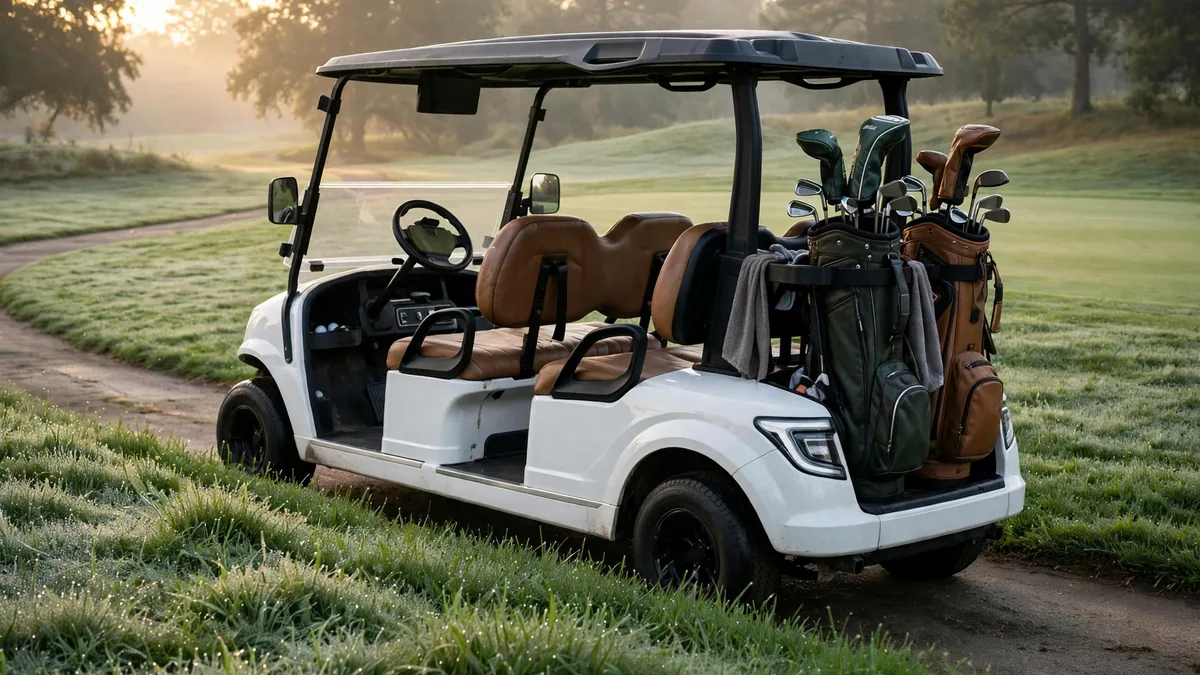
Early morning on the course, the dew is still on the fairways and the only sound is birdsong and the soft whir of tyres on the path. A golf cart glides past the first tee, carrying two players and their clubs, and it does so without a puff of exhaust or a rumble to disturb the quiet. It is a small machine, but on a luxury course it is expected to behave like a much bigger one: smooth, silent and comfortable for eighteen holes.
A luxury electric golf cart looks simple, and that is the point. Under its friendly body sits a complete electric vehicle in miniature — a battery, a motor, a controller, suspension and brakes — all tuned for slow speeds, steep hills and a full day of stop-start driving.
The engineering is modest in size but serious in intent, and most of it is hidden under the seats and the floor. This is how a luxury electric golf cart works, from the battery beneath your feet to the wheels on the path.
How a Luxury Electric Golf Cart Works
Step 1: The battery under the seat
The heart of the cart is its battery, usually a lithium pack tucked beneath the rear seat or under the floor. A luxury cart carries a larger pack than a basic one, giving it the range to cover thirty-six holes and the power to climb hills without slowing down. The battery management system watches each cell, keeping the charge balanced and cutting power if anything runs too hot or too low. Charging is as simple as plugging into a wall socket overnight, and a full charge typically takes six to eight hours. The pack itself is built much like a bigger car’s, as our guide to how an EV battery pack is made explains.
Step 2: The controller thinks for the cart
Between the battery and the motor sits the controller, a small electronic box that decides how much power the motor gets and when. Press the pedal gently and the controller feeds the motor a little current; press it hard and it opens the flow, but always smoothly, so the cart pulls away without a jerk. The controller also manages regenerative braking, limits the top speed to the course rules, and protects the battery from being drained too far. A good controller is the difference between a cart that feels refined and one that lurches.
Step 3: The motor and the drive
Most luxury electric golf carts use a single electric motor mounted at the rear, driving the back wheels through a small gearbox and differential. The motor is a compact unit, often an AC induction or permanent magnet design, chosen for quiet running and strong low-speed torque — exactly what a cart needs to start on a hill with a full load. Top speed is usually limited to about 25 to 30 kilometres per hour, which is fast enough for the course and slow enough to be safe. The same kind of motor does the work in bigger machines too, and our guide to how an e-bike mid-drive motor works shows the idea at a smaller scale.
Step 4: Suspension for the fairway
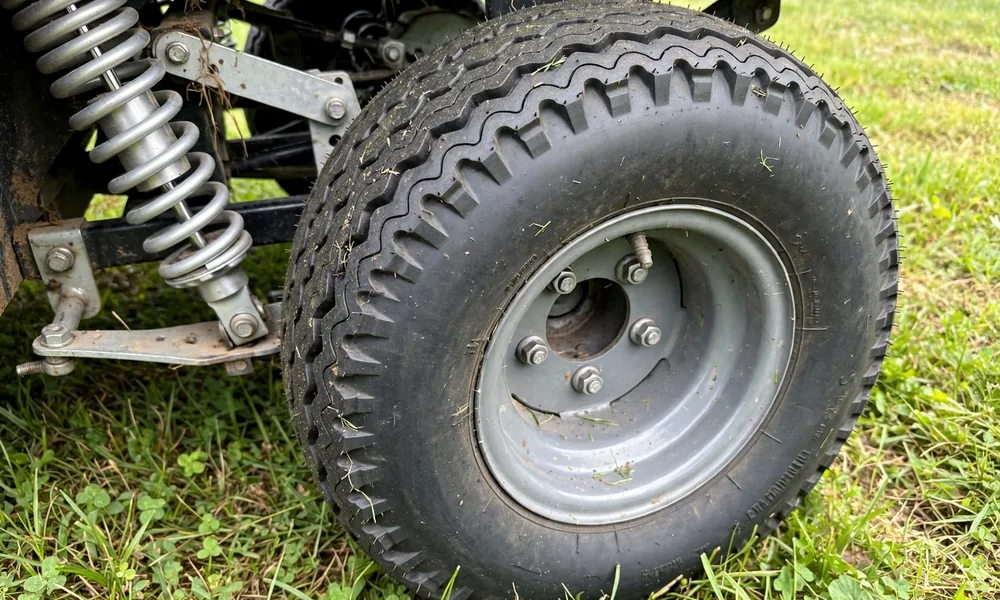
A golf course is not a smooth road. Paths dip, fairways undulate and the cart must cross grass, gravel and sometimes mud, all while keeping its passengers comfortable and the clubs still. Luxury carts use independent front suspension with coil springs and shock absorbers, and a leaf or coil-sprung rear axle, tuned soft so that bumps are swallowed rather than passed on to the seats. The tyres are wide, low-pressure turf tyres that spread the load so they do not cut into the grass.
Step 5: Brakes that recover energy
When the driver lifts off the pedal, the motor runs in reverse as a generator, slowing the cart and feeding a little energy back into the battery. This regenerative braking handles most of the slowing on a course, and the mechanical brakes — usually drums or discs on the rear wheels, sometimes all four — only take over for firm stops and for holding the cart still on a slope. The blend of electric and mechanical braking is tuned so the pedal feels the same every time, whether the battery is full or nearly empty.
Step 6: Steering, lights and the details
Steering in a luxury cart is a simple rack-and-pinion system, light enough to turn with one hand and precise enough to thread a narrow path between trees. Around it, the details add up: LED headlights and tail lights for early morning and evening rounds, a horn, indicators, mirrors, and a dashboard showing battery level, speed and distance. Many luxury carts add a touchscreen with course maps and distances, a cooler for drinks, and USB charging for phones. A cart that costs more than some used cars needs a reason, and our guide to why a luxury golf cart costs so much explains where the money goes.
Step 7: A full day on one charge
Put it all together and a luxury electric golf cart will run all day on a single charge, covering thirty to sixty kilometres of paths and fairways depending on the hills and the load. The battery, controller and motor work as one system, sipping energy at low speed and recovering a little on every downhill. There is no fuel to buy, no oil to change and almost nothing to service beyond tyres, brakes and the occasional battery check. It is the quietest machine on the course, and the one the course could least do without.
Luxury Electric Golf Cart Specs
| Specification | Typical range |
|---|---|
| Battery | Lithium, about 4 to 8 kWh |
| Motor power | About 3 to 5 kW |
| Top speed | About 25 to 30 km/h |
| Range per charge | About 30 to 60 km |
| Seating | Two or four passengers plus two golf bags |
| Charging time | About 6 to 8 hours from a wall socket |
| Suspension | Independent front, coil or leaf rear |
| Brakes | Regenerative plus drum or disc, with parking brake |
What Does a Luxury Electric Golf Cart Cost?
A luxury electric golf cart is estimated to cost roughly $10,000 to $18,000, while a four-seater with lithium batteries, a touchscreen and custom trim is estimated at $18,000 to $30,000 or more. Street-legal versions with lights, mirrors and seat belts cost more still. Prices are estimates only and vary by battery, seating and options.
A Rare Fact
Some luxury golf carts can drive themselves back to the clubhouse. A few high-end courses use carts with GPS and self-driving features that follow the fairway on their own, park themselves at the charging station and even return to the player when called from a phone. The humble golf cart, one of the slowest vehicles on the road, is quietly becoming one of the most automated.

A luxury electric golf cart is a small machine doing a serious job. It carries people and clubs across a whole course in silence, climbs hills without fuss, sips its battery all day and asks for almost nothing in return. Its parts are modest — a battery, a controller, a motor, some springs and brakes — but they are tuned with the same care as a car ten times its size. The next time one glides past on the path, listen for it. You will hear almost nothing, and that is the whole point.


