The rickshaw pulled away from the hotel gate without a sound, gliding past the traffic with its passengers sitting high above the road, a soft breeze coming through the open sides. There was no engine noise, no smell of fuel, and no vibration through the seat. The driver tapped a small touchscreen, the motor hummed a little louder, and the little three-wheeler climbed the hill as if the slope did not exist.
A luxury electric rickshaw is a small vehicle with a big job: carrying people through crowded streets in comfort, quietly and cheaply. Its spec sheet is full of figures about motors, batteries and range, and most of them are easy to misread. This is what a luxury electric rickshaw spec sheet means, number by number.
The spec sheet at a glance
- Motor: roughly 3 to 8 kW, brushless electric, driving the rear wheels
- Battery: roughly 5 to 10 kWh, usually lithium-ion
- Range: roughly 80 to 150 km per charge
- Top speed: roughly 40 to 60 km/h
- Seating: driver plus three to six passengers
- Payload: roughly 300 to 500 kg including passengers
- Charging time: roughly 3 to 6 hours on a standard charger, faster on a fast charger
- Ground clearance: roughly 15 to 20 cm
- Turning radius: roughly 2.5 to 3.5 metres
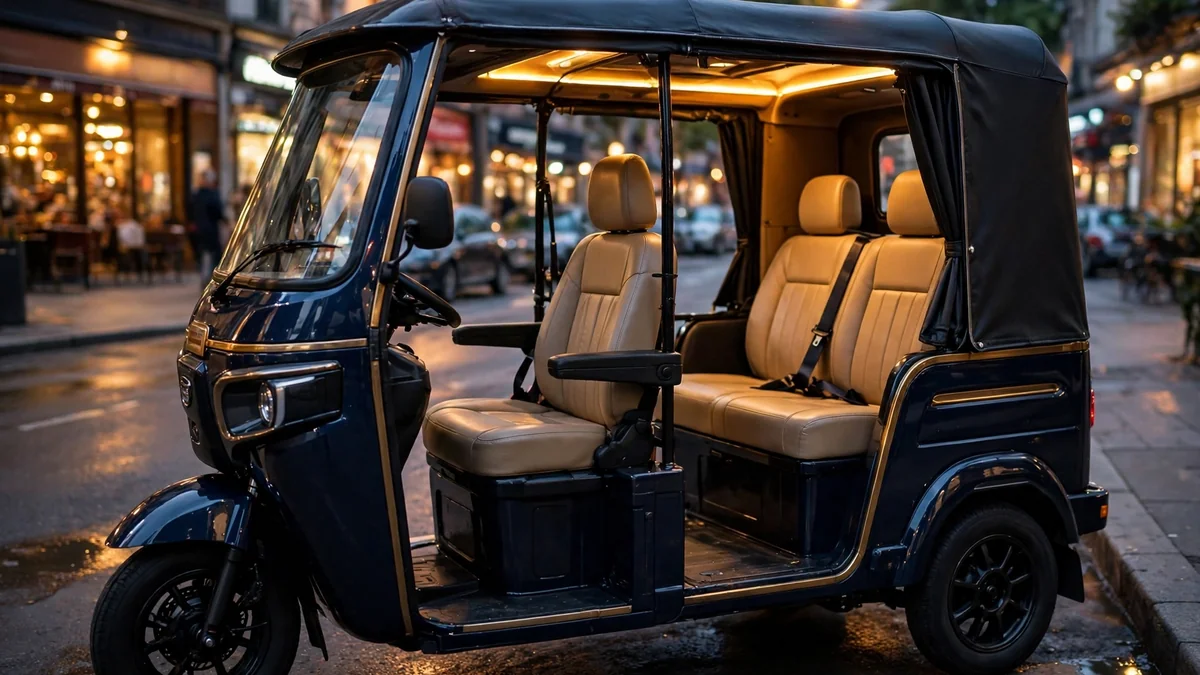
- Body: steel frame with a canopy roof and weather curtains
- Weight: roughly 400 to 650 kg without passengers
- Price: roughly $3,000 to $12,000, with luxury models above that
Motor power: why kilowatts matter more than speed
The motor of a luxury electric rickshaw is rated at roughly 3 to 8 kW, which sounds small next to a car, yet it is plenty for a light three-wheeler carrying passengers through a city. Electric motors deliver their full torque from a standstill, so the rickshaw pulls away smoothly even when fully loaded, and it climbs hills without the straining and gear-changing of a small petrol engine.
The motor is almost always brushless, which means it has no brushes to wear out and needs very little maintenance. It drives the rear wheels through a simple differential, and many luxury models add regenerative braking, which feeds a little energy back into the battery every time the driver slows down. That recovered energy is small on each stop, but over a day of city driving with hundreds of stops, it adds up to real range.
Battery and range: the numbers that decide the working day
The battery is the most expensive part of the rickshaw, and its size is given in kilowatt-hours, usually roughly 5 to 10 kWh on a luxury model. A kilowatt-hour is a unit of energy, and the bigger the number, the further the rickshaw can travel before it needs charging. A 10 kWh battery holds roughly twice the energy of a 5 kWh one, and in practice that means roughly twice the range, though the weight of the bigger battery eats a little of the gain.
Range of roughly 80 to 150 km per charge is measured in gentle test conditions, and the real figure depends on the load, the hills and how often the air conditioning or lights are used. A rickshaw carrying six passengers up and down hills in hot weather will travel less far than the same machine carrying two people on flat roads, and drivers learn their real range within the first week. The battery technology is the same lithium-ion chemistry found in larger vehicles, and its behaviour is explained in the guide to e-bike battery specs explained, where capacity, voltage and real-world range are decoded.
Seating, payload and the passenger experience
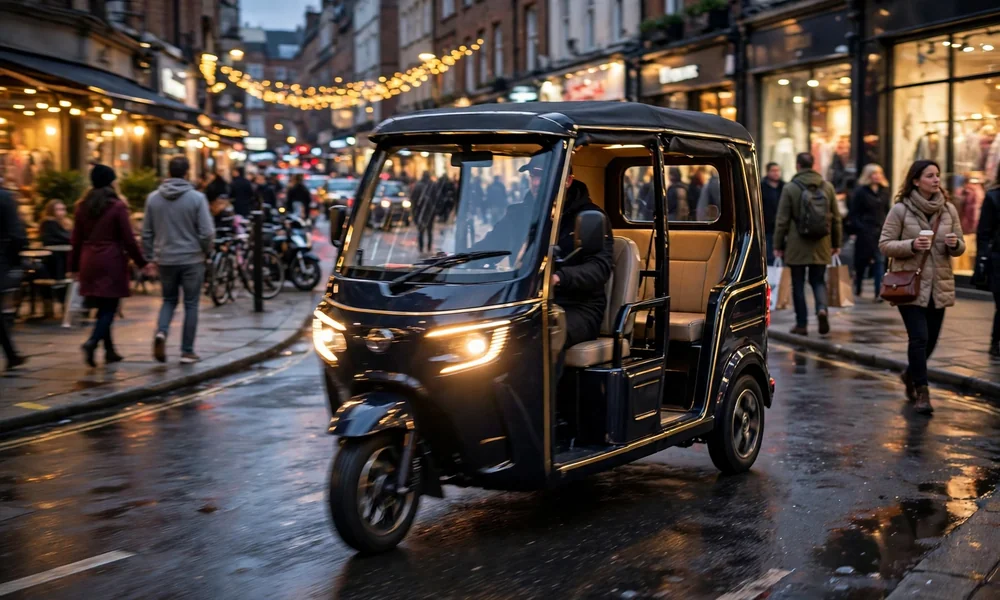
A luxury electric rickshaw seats the driver plus three to six passengers, depending on the layout, and the luxury difference is in the seats themselves. Where a basic rickshaw has a hard bench, a luxury one has padded seats with backrests, armrests and a little legroom, and the floor is flat so passengers can step in easily. The canopy roof keeps off the sun and rain, and weather curtains can be pulled down in a storm.
Payload of roughly 300 to 500 kg including passengers is the safe working limit, and it is set by the strength of the frame, the suspension and the brakes. Overloading a rickshaw wears out the motor and battery faster and makes the brakes less effective, so the payload figure is a safety number as much as a comfort one. The way the frame, motor and body are assembled is described in the guide to how a luxury electric rickshaw is made.
Turning radius and clearance: built for crowded streets
A turning radius of roughly 2.5 to 3.5 metres means the rickshaw can turn around in a narrow street, which is essential in old city centres and hotel courtyards where a car would need a three-point turn. The three-wheel layout helps here, because the single front wheel can steer sharply, and the short wheelbase keeps the whole vehicle nimble.
The dashboard, lights and small technology
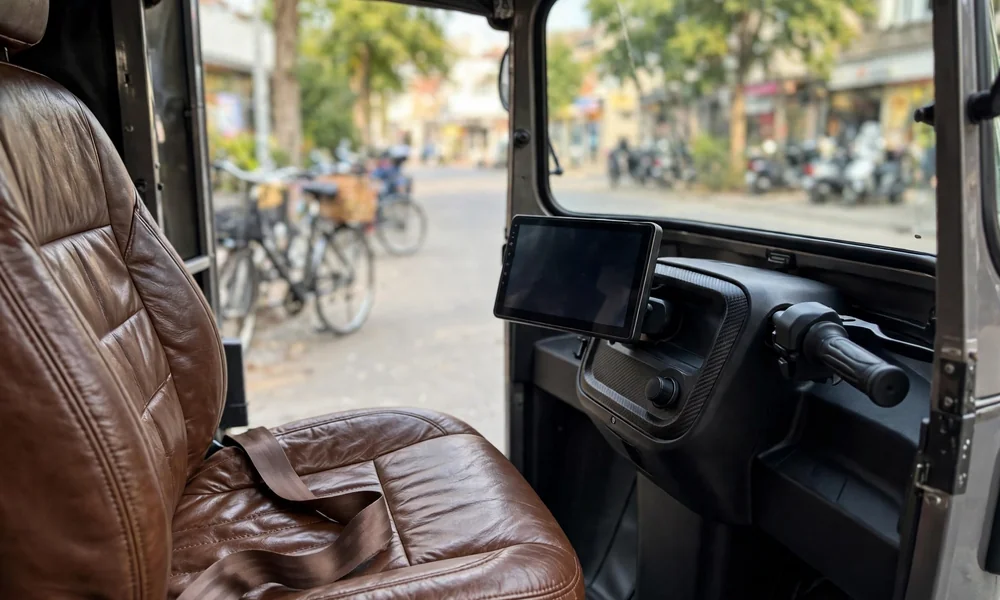
The dashboard of a luxury electric rickshaw is a small touchscreen or digital display showing speed, battery level, range and warnings, and it is the driver’s main source of information. Some models add a reversing camera, a fare meter and a USB charging point for passengers, and the best ones add a small speaker system and LED lighting that makes the vehicle feel more like a small lounge than a taxi.
The same electric technology, scaled down to two wheels, is described in the guide to how a luxury e-bike is made, where the motor, battery and controller work together in a much smaller package. The rickshaw is essentially that system grown up: a bigger battery, a bigger motor and room for passengers, with the same quiet, clean character.
Price: what the money buys
A luxury electric rickshaw costs roughly $3,000 to $12,000 as an estimate, with the most luxurious models going higher, and the money goes into the battery, the motor, the seating and the finish. The battery alone can be a third of the price, and a bigger, longer-lasting lithium-ion battery is the single most expensive upgrade a buyer can choose.
The running costs are where the electric rickshaw earns its keep. Electricity costs far less per kilometre than petrol, the motor has almost no moving parts to wear out, and there is no oil to change and no exhaust to repair. A driver who covers 100 km a day can save a large sum over a year compared with a petrol rickshaw, and that saving is often what pays for the higher purchase price of the luxury model.
A rare fact worth knowing
Some luxury electric rickshaws are fitted with a small solar panel on the canopy roof, and it is not there to charge the main battery. It trickle-charges the small 12-volt battery that runs the lights, the horn and the dashboard, so those systems keep working even if the main battery is low. It is a modest addition, yet on a long working day it means the driver never has to worry about the lights dying on the way home, and it is the kind of thoughtful detail that separates a luxury rickshaw from a basic one.