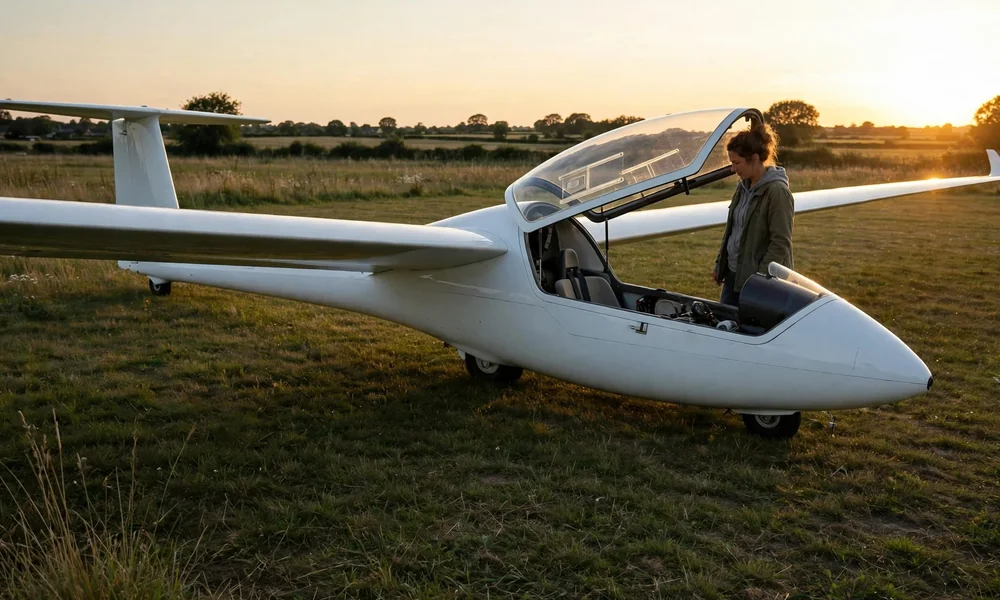
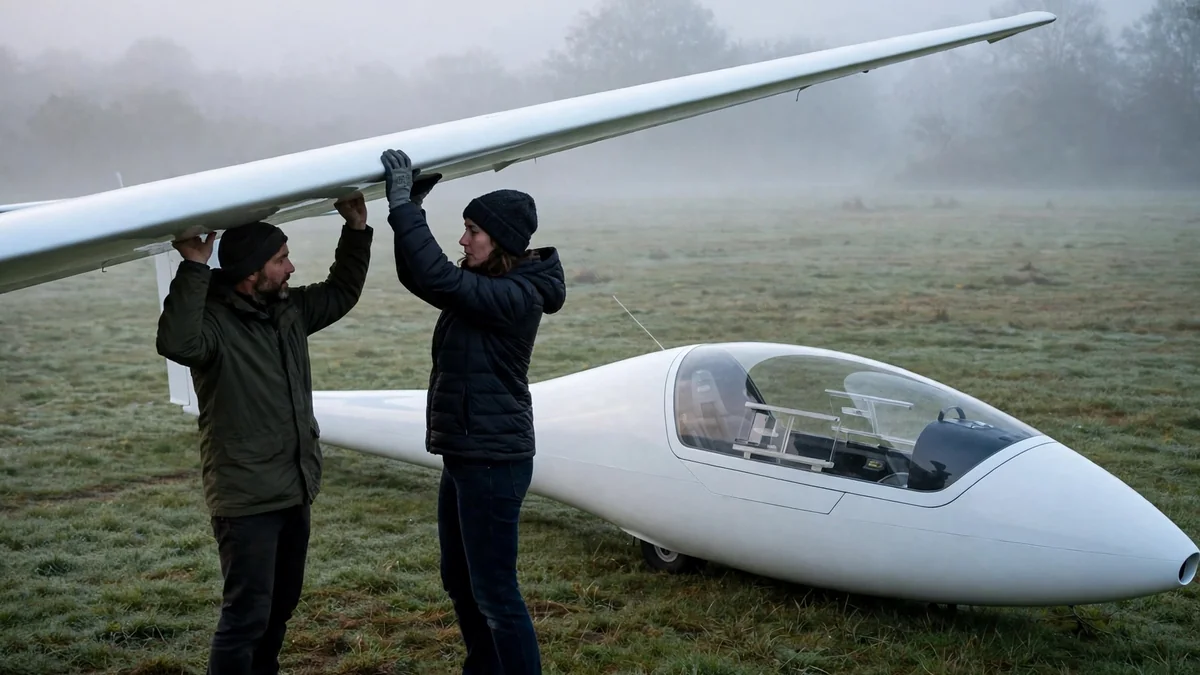
On a grass airfield at first light, a long white wing is being lifted by two people, one at each tip, while a third walks beside it, checking the smooth skin for the smallest bump. The wing is longer than the whole fuselage, thin as a knife, and so light that a strong gust could lift it off the ground. A winch at the far end of the field winds in, the wing rises, and in a few seconds the glider is in the air, climbing steeply, silently, with no engine at all. Then the cable falls away, and the glider is alone in the sky, flying on nothing but air.
A luxury glider, also called a sailplane, is an aircraft with no engine that stays in the air by riding rising currents of warm air. The luxury versions carry one or two people in a leather-lined cockpit with a panoramic canopy, a retractable engine for emergencies, and instruments that would suit a jet.
How a Luxury Glider Works, Step by Step
Step 1: The wing makes lift from thin air
Everything starts with the wing. A glider’s wing is long, thin and perfectly smooth, often spanning fifteen to twenty metres, and it is shaped so that air moving over the top travels faster than air moving underneath, which pushes the wing upward. The wing is built from carbon fibre and glass fibre, light enough to lift by hand and strong enough to carry the whole aircraft through a steep turn. The wing is the engine, and its only fuel is the air itself.
Step 2: Launch by winch, tow or self-launch
A glider cannot take off on its own, so it is launched in one of three ways. The most common is a winch launch: a steel cable is clipped to the nose, a powerful winch at the far end of the field winds it in, and the glider is pulled up the field and into the air like a kite, climbing steeply to about three hundred metres before the pilot releases the cable. The second way is an aero tow, where a small powered aircraft tows the glider up to height on a rope, and the glider releases and flies away. The third way is found on the luxury gliders themselves: a small retractable engine, usually a two-stroke or an electric motor, is hidden in the fuselage behind the cockpit, and it pops out to launch the glider and then folds away again, leaving the aircraft clean and silent.
Step 3: Thermals lift the glider higher
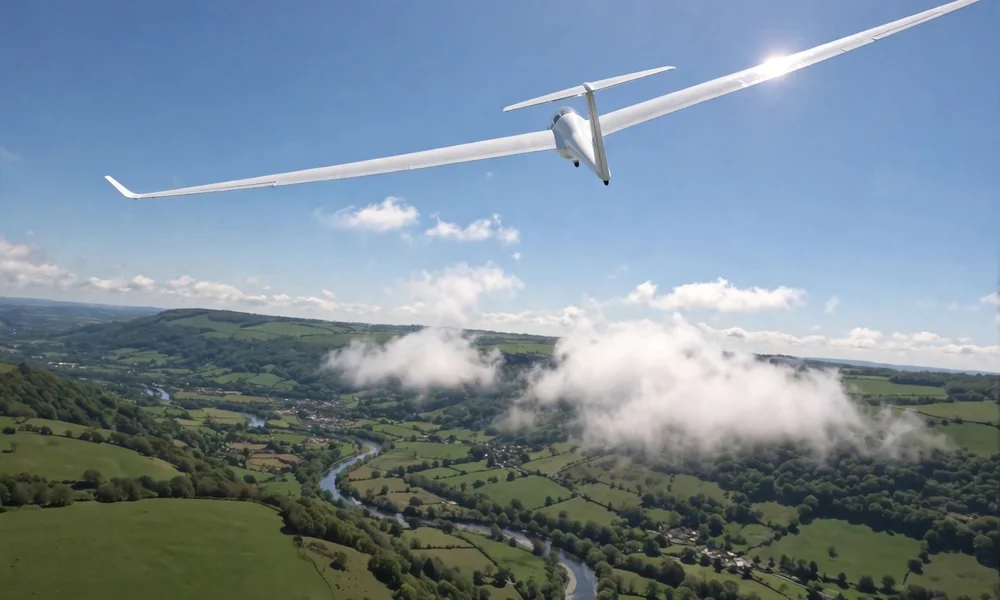
Once it is in the air, a glider stays up by finding thermals, columns of warm air rising from sun-heated ground. A field, a town or a dark hillside warms the air above it, and that air rises in an invisible chimney, sometimes at several metres a second. The art of reading the sky, of knowing which cloud has a thermal under it and which is just decoration, is the heart of gliding, and it is a skill that takes years to learn.
Step 4: Ridge lift and wave lift carry it further
Thermals are not the only lift in the sky. When wind blows against a hill or a mountain ridge, the air is forced upward, and a glider can fly along the ridge in the rising air for hours, barely losing height, sometimes flying faster than the wind itself. The same patient reading of wind and weather shapes the flying of the great lighter-than-air craft described in the guide to how a luxury airship works.
Step 5: The controls steer a silent aircraft
A glider is steered with the same controls as any aircraft, but everything is lighter and more sensitive. The stick moves the ailerons on the wings to roll and the elevator on the tail to pitch up and down, and the rudder pedals turn the nose left and right. Airbrakes on top of the wings can be opened to spoil the lift and steepen the descent for landing, and the flaps can be lowered to slow the glider down. There is no throttle to push, no engine note to listen to, and no fuel gauge to watch, so the pilot’s whole attention is on the air, the instruments and the landing field ahead. The waterborne cousin of this silent, wind-driven flight is the yacht described in the guide to how a luxury sailboat is made, which also moves on the wind alone, only on water instead of air.
Step 6: The cockpit, the instruments and the landing
Up front, the cockpit of a luxury glider is a small, beautiful space. The pilot sits in a reclined leather seat under a huge clear canopy that gives a view in every direction, and the panel holds a variometer, an altimeter, a speedometer, a compass and a GPS moving map, with a radio and, in the newest gliders, a screen that shows the weather and the position of other gliders. Landing is a careful, quiet affair: the pilot picks a field, flies a circuit, opens the airbrakes, and touches down on a single wheel under the fuselage, rolling to a stop on the grass. The way the finished aircraft is launched and flown is also shared with the seaplane described in the guide to how a luxury seaplane works, which takes off from water and lands on it again, while a glider takes off from a field and comes home to one.
Specifications at a Glance
| Feature | Typical Luxury Glider |
|---|---|
| Wingspan | 15 to 20 metres |
| Glide ratio | About 40 to 50 to 1 |
| Top speed | About 250 kilometres per hour |
| Stall speed | About 70 kilometres per hour |
| Seats | One or two, leather, reclined |
| Launch | Winch, aero tow or self-launch engine |
| Empty weight | About 300 to 450 kilograms |
| Instruments | Variometer, GPS, radio, oxygen system |
What a Luxury Glider Costs
As an estimate, a luxury glider might cost roughly $150,000 to $300,000, with the carbon-fibre wing, the retractable engine and the hand-finished cockpit accounting for most of the price. The most advanced two-seat gliders, with a full glass cockpit and a self-launching engine, could cost an estimated $400,000 or more. Those are estimates, and the running costs are among the lowest in aviation: there is no fuel to buy on most flights, no engine to overhaul every few years, and a glider can be kept in a trailer and rigged by two people in twenty minutes.
A Rare Fact
The glider is older than the aeroplane. In the 1890s, a German engineer named Otto Lilienthal built gliders from wood and cloth and flew them from a hill near Berlin, making more than two thousand flights before he was killed in a crash in 1896. After the First World War, when Germany was forbidden to build powered aircraft, German pilots turned to gliding instead, and they became the best glider pilots in the world, flying for hours and crossing whole countries on thermals alone. The luxury glider of today, with its carbon wing and its glass cockpit, is the great-grandchild of Lilienthal’s wooden wings, and it still flies the way he did: silently, on the air, with no engine at all.
A luxury glider is a machine that proves how little you need to fly: a long wing, a small cockpit, and a pilot who can read the sky.