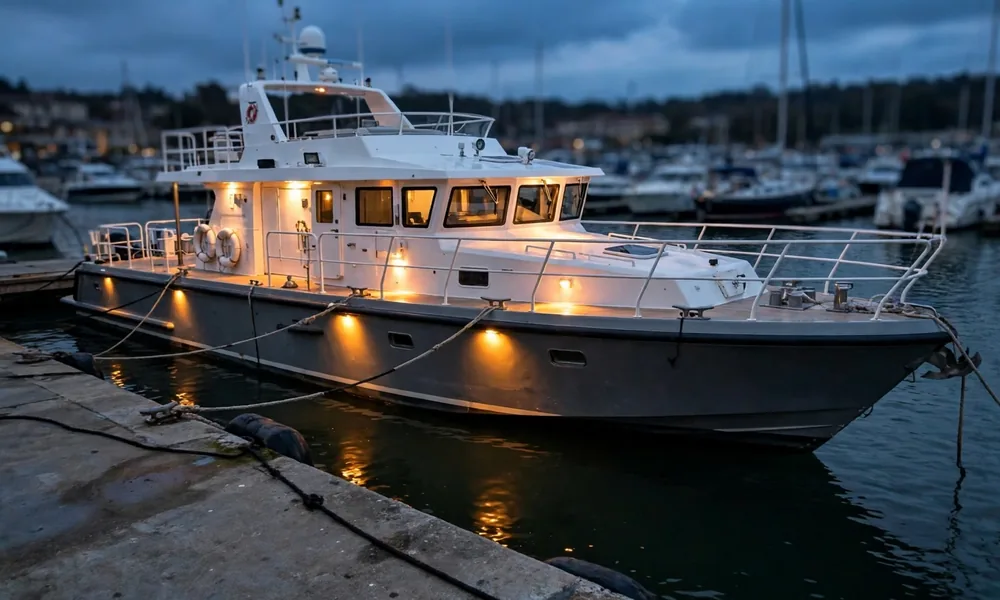
The harbour is quiet at dawn when the patrol boat slips past the breakwater and opens the throttles. The low growl rises to a snarl, the bow climbs onto the plane, and within a minute a vessel the size of a small house is doing forty knots across the bay. It is the result of two years of cutting, welding, wiring and testing.
A luxury patrol boat is a hybrid in the truest sense. It is built to chase, to intercept and to hold station in weather that sends other boats home, and at the same time it is built to be lived in: air-conditioned cabins, a proper galley, teak decks and a saloon where guests sit in comfort while the boat does forty knots outside.

How a Luxury Patrol Boat Is Made
Step 1: The design and the hull lines
Every patrol boat starts on a screen, in the naval architect’s office, where the hull lines are drawn and redrawn until the numbers work. The brief is contradictory: the boat must be fast, which argues for a light, fine hull, and tough, which argues for heavy structure. The compromise is a deep-V hull with a sharp entry forward, hard chines amidships and a wide flat transom, a shape that slices through chop at speed and planes cleanly once the throttles open. The pilot boat shares much of this DNA, since both boats are built to work hard in rough water and come home safely.
Step 2: Cutting and welding the aluminium hull
Most luxury patrol boats are built from marine-grade aluminium, chosen because it is light, strong and does not rust. The plates arrive in stacks, are marked out by computer-controlled plasma cutters and shaped on rollers into the curved panels of the hull. The keel is laid first on a building jig, then the frames and stiffeners go up like the ribs of a whale. Welders join the shell plates to the frames in a set sequence, so the heat of welding does not pull the hull out of shape; a distorted hull is a slow hull, and there is no fixing it later.
Step 3: Engines, jets and the machinery spaces
With the hull complete, the machinery goes in, and this is where a patrol boat differs most from an ordinary yacht. The engines are usually a pair or trio of high-output diesels, each producing well over a thousand horsepower, mounted low and amidships on flexible mounts that soak up vibration. Many luxury patrol boats use waterjets instead of propellers, drawing water in through an intake under the hull and firing it out of a steerable nozzle at the stern. The waterjet propulsion system is the heart of the boat, and the yard’s engineers spend weeks aligning it, because a millimetre of misalignment at the intake can cost knots at the top end.

Step 4: The bridge, sensors and mission systems
Above the machinery, the wheelhouse takes shape as the boat’s nerve centre. A luxury patrol boat’s bridge looks less like a yacht helm and more like a compact operations room: displays for radar, chart plotting, engine monitoring and thermal cameras, a communications suite that talks to shore stations and other vessels, and a helm designed so one person can drive the boat hard while watching everything at once. Below, the owner’s cabin, guest cabins, galley and saloon are fitted out with the same care as a superyacht, with joinery, upholstery, air conditioning and sound insulation. Outside, the boat is a machine for speed and surveillance; inside, it is a quiet, comfortable place to live for days.
Step 5: Fitting out, painting and sea trials
Fitting out is the longest and most detailed stage, when hundreds of small jobs converge: deck hardware, hatches, railings, tenders and davits, navigation lights, lifesaving equipment, and the teak decking that gives the boat its luxury finish. Then comes launch and sea trials. The boat is slipped into the water, the engines are run up, and the trial crew measures what matters: top speed, acceleration, fuel consumption, turning circles, stopping distances and noise levels. The boat is run again and again until she meets the contract numbers. The luxury tugboat goes through a similar trial regime, even though its work is towing rather than chasing, because any working vessel with a luxury fit-out must prove its performance before the owner signs.
Step 6: Delivery and the first patrol
Once the trials are passed and the snag list cleared, the boat is handed over. The owner and crew receive training on the systems, the yard’s engineers stay aboard for the first days, and the boat begins the life she was built for: fast passages between islands, escorting a superyacht, or simply the pleasure of a boat that can outrun the weather. For a security operator it means patrols, interceptions and long hours on station. Either way, the first real patrol is the true test of the build. The best luxury patrol boats make it look easy, which is exactly why they are so hard to build.
Luxury Patrol Boat Specifications
| Specification | Typical figure |
|---|---|
| Length overall | 18 to 30 metres |
| Beam | 4.5 to 6.5 metres |
| Hull material | Marine-grade aluminium |
| Engines | 2 to 3 high-output diesels |
| Total power | 2,400 to 4,800 horsepower |
| Propulsion | Waterjets or surface-piercing propellers |
| Top speed | 38 to 50 knots |
| Cruising speed | 28 to 35 knots |
| Range at cruise | 400 to 800 nautical miles |
| Crew and guests | 4 crew, up to 8 guests |
| Build time | 18 to 30 months |
How Much Does a Luxury Patrol Boat Cost?
A luxury patrol boat is priced like the hybrid it is: part military workboat, part superyacht. A smaller 18-metre boat with twin engines and a comfortable but modest interior carries an estimated price of around $3 million to $5 million. A 24-metre boat with triple engines, waterjets, a full sensor suite and a superyacht-grade interior is estimated at $7 million to $12 million. At the top end, a 30-metre flagship with long-range tanks and a bespoke interior can be estimated at $15 million to $25 million. Buyers accept this because nothing else does the same job: a conventional yacht cannot chase at forty knots, and a plain patrol boat cannot host guests in comfort.
A Rare Fact About Luxury Patrol Boats
Here is a detail most people never learn: some luxury patrol boats are built with a hull feature borrowed from racing boats called a stepped hull, where the bottom has one or two small steps running across it. At speed, air is drawn under the hull at each step, creating a cushion that reduces drag and lets the boat go faster on the same power. The trick is invisible from outside and almost impossible to photograph, yet it can be worth several knots. It is a reminder that beneath the polished paint and the leather seats, a luxury patrol boat is still a racing machine at heart.
The luxury patrol boat exists because two worlds collided: the world that needs a boat to be fast, tough and ready for anything, and the world that expects a boat to be beautiful and comfortable. Building one means refusing to compromise on either side, and the yards that succeed treat the engine room and the saloon with equal seriousness.