On a mountain road in the early morning, a pickup truck is doing three jobs at once. It is towing a small trailer up a long climb, its cabin is quiet enough for a phone call, and the driver is sitting in a leather seat that would not look out of place in a saloon car. A decade ago a truck that could tow this much rode like a farm vehicle. This one rides like a car that happens to have a load bed.
That is the trick of the luxury pickup truck: it is a working vehicle that refuses to feel like one. Under the leather and the screens sits a ladder frame, a big engine and a suspension tuned for two very different lives. This is how a luxury pickup truck works, from the engine to the tailgate.

Step 1: The engine turns fuel into pulling power
Everything starts under the bonnet, where a large petrol V8 or a turbocharged diesel makes the power the truck needs. A luxury pickup engine is tuned for torque at low revs, because towing a trailer up a hill is about steady pulling force, not high speed. The turbocharger forces extra air into the cylinders, the fuel injectors spray a fine mist at enormous pressure, and each explosion pushes a piston down with enough force to move tonnes.
The engine is cooled by a large radiator and an oil cooler, because a truck pulling a heavy load on a hot day makes far more heat than a car cruising on a motorway. The whole unit sits on soft mounts that absorb its vibration, which is why the cabin stays calm even when the engine is working hard.
Step 2: The gearbox chooses the right gear for the load
From the engine, power flows to the gearbox, and on a luxury pickup this is usually a ten-speed automatic that thinks ahead. It watches the throttle, the speed, the slope of the road and the weight of the trailer, then picks the gear that keeps the engine in its strongest range. On a steep climb it holds a low gear; on a flat motorway it slips into a high gear and lets the engine relax.
The gearbox also does the quiet work of towing. A tow mode changes the shift points, holds gears longer on hills and uses engine braking on the way down, so the brakes do not overheat. The smoothness comes from clutches inside the gearbox that hand over from one gear to the next without a jolt, the same idea at the heart of a dual-clutch gearbox, where two clutches take turns so the power never really stops flowing.
Step 3: Four-wheel drive splits the power
After the gearbox, the power reaches a transfer case, a tough little gearbox that splits it between the front and rear axles. In normal driving the truck sends most of its power to the rear wheels, which is efficient and calm. When the road turns to mud, gravel or snow, the driver can send power to all four wheels, and the truck grips where a two-wheel-drive car would spin.
Low range is the secret weapon. By engaging a second, much lower set of gears, the truck can crawl over rocks or pull a boat out of the water at walking pace, with the engine barely above idle. Locking differentials can then force the left and right wheels to turn together, so that a wheel in the air does not steal all the power while the wheel on the ground does nothing.
Step 4: The chassis and suspension carry the load
Underneath it all is a ladder frame, two long steel rails joined by cross members, built to bend slightly rather than snap when the truck hits a pothole with a tonne in the bed. The frame is the reason a pickup can tow and haul far more than a car-based SUV, and it is also the reason the ride used to be rough.
The luxury part is the suspension. Coil springs or air suspension at the rear replace the stiff leaf springs of old work trucks, and adaptive dampers read the road hundreds of times a second, softening for a pothole and firming up for a corner. It is a gentler version of the thinking behind a hypercar suspension, tuned not for a racetrack but for a truck that must ride smoothly empty and still carry a full load without sagging.
Step 5: The brakes stop the whole train
A luxury pickup with a trailer can weigh more than five tonnes, and stopping that weight is a serious job. Large ventilated disc brakes sit at all four wheels, gripped by multi-piston calipers, and a trailer brake controller lets the driver apply the trailer’s own brakes from the cab so the trailer never pushes the truck sideways.
The electronics help too. Anti-lock brakes keep the wheels turning so the driver can still steer in an emergency, and stability control watches for a swaying trailer and brakes individual wheels to straighten it out. The same obsession with stopping power that shapes the best hypercar brakes applies here, except the truck must stop not just itself but everything it is towing.
Step 6: The cabin and the load bed finish the job
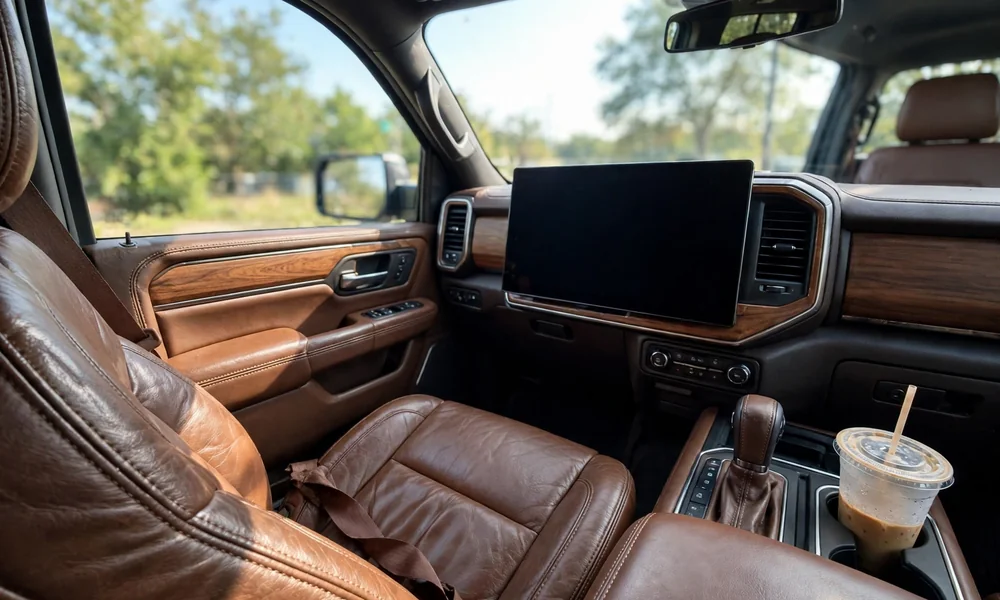
The last step is the part the owner touches every day. The cabin is a proper luxury interior: leather seats that heat and cool, a large touchscreen with navigation and phone mirroring, and sound insulation that keeps the wind and the engine out. The rear seats fold to reveal a flat load floor, and there are power sockets and storage bins throughout.
Outside, the load bed is lined, lit and fitted with tie-down points, a power tailgate and sometimes a built-in step. The bed is the reason the truck exists, but the cabin is the reason its owner chooses this truck over a cheaper one. Together they make a vehicle that can carry a tonne of gravel on Saturday and take the family to dinner on Saturday night.
The spec sheet at a glance
| Specification | Typical luxury figure |
|---|---|
| Engine | 5.0 litre V8 petrol or 3.0 litre diesel |
| Power | 400 to 450 horsepower |
| Torque | 700 to 950 Nm |
| Gearbox | Ten-speed automatic |
| Drive | Four-wheel drive with low range |
| Towing capacity | Up to 6 tonnes braked |
| Payload | Up to 1 tonne in the bed |
| Fuel tank | 130 to 140 litres |
| Suspension | Coil or air springs, adaptive dampers |
| Brakes | Ventilated discs, trailer brake controller |
| Cabin | Leather, heated and cooled seats, touchscreen |
| Weight | 2.5 to 2.8 tonnes |

What it costs, and a rare fact
A luxury pickup truck costs an estimated $70,000 to $110,000, depending on the engine, the trim and the options, with the most exclusive models costing more. For that money the buyer gets a vehicle that tows like a truck, rides like a car and is trimmed like a luxury saloon.
Here is the rare fact the spec sheet never mentions. The ladder frame under a luxury pickup is designed to flex on purpose, twisting slightly over rough ground so that all four wheels stay in contact with the earth, and engineers test it by driving the truck over a course of bumps that twist the frame thousands of times. A frame that was perfectly rigid would be stronger on paper and worse on a real road.