Open the spec sheet for a luxury sportfishing yacht and the numbers look like a foreign language. Length overall, beam, draft, displacement, deadrise, fuel capacity, cruise speed, range, livewell volume, tower height. Each figure seems small on its own, yet together they decide whether the boat will chase a marlin fifty miles offshore in comfort or beat its crew senseless on the ride home. It is a contract written in engineering.
Picture a morning in the cockpit of a well-specified sportfisher. The lines are in the water before sunrise, the outriggers are set, and the crew watches teasers skip across a flat sea. The captain nudges the throttles and the boat holds twenty-eight knots without a shudder, while the tower lookout scans a mile ahead. Nothing about that morning is luck. The speed, the ride, and the range were decided months earlier, in a shipyard.

How a luxury sportfishing yacht is built
Step 1: The hull takes shape
Everything starts with the hull, a deep-V design built from fibreglass resin-infused over a foam or balsa core, or cold-moulded from layers of wood and epoxy. The deadrise, the angle of the V at the transom, is usually between eighteen and twenty-four degrees. A sharper V cuts through waves instead of slamming into them, which is why the ride feels soft even at speed. The trade is stability at rest: a sharper V rolls more at the dock.
Step 2: Power goes in
Most luxury sportfishers in the fifty to seventy-foot range run twin or triple diesel inboards, each producing between one thousand and two thousand horsepower, driving the boat through shafts or pod drives. The engines sit low in the hull, under the cockpit sole, where their weight keeps the centre of gravity down. Builders leave room around each engine for service. Fuel tanks are fitted around the engines, often holding one thousand to three thousand gallons.
Step 3: The cockpit becomes a workplace
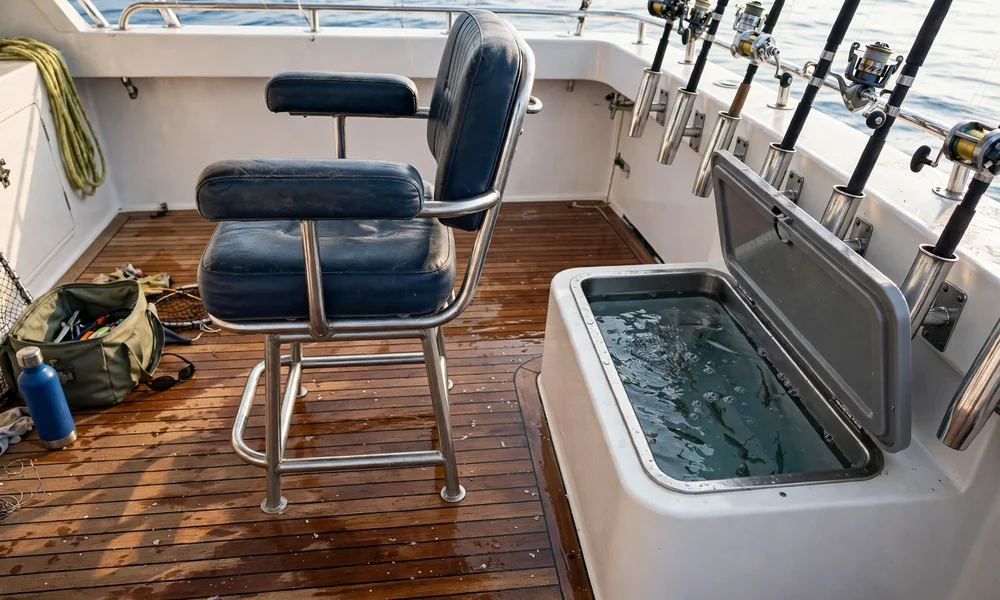
The cockpit is where the fishing happens, and on a luxury boat it is a purpose-built workspace dressed in teak or synthetic decking. The sole is self-draining, with large scuppers that clear a wave over the transom in seconds. Livewells are plumbed into the transom and cockpit sides, holding fifty to two hundred gallons of circulating seawater to keep bait alive for hours. A tuna door is cut into the transom so a big fish can come aboard without being lifted over the gunwale, and the fighting chair sits on a reinforced fitting built to take hundreds of pounds of strain.
Step 4: The tower and the helm go up
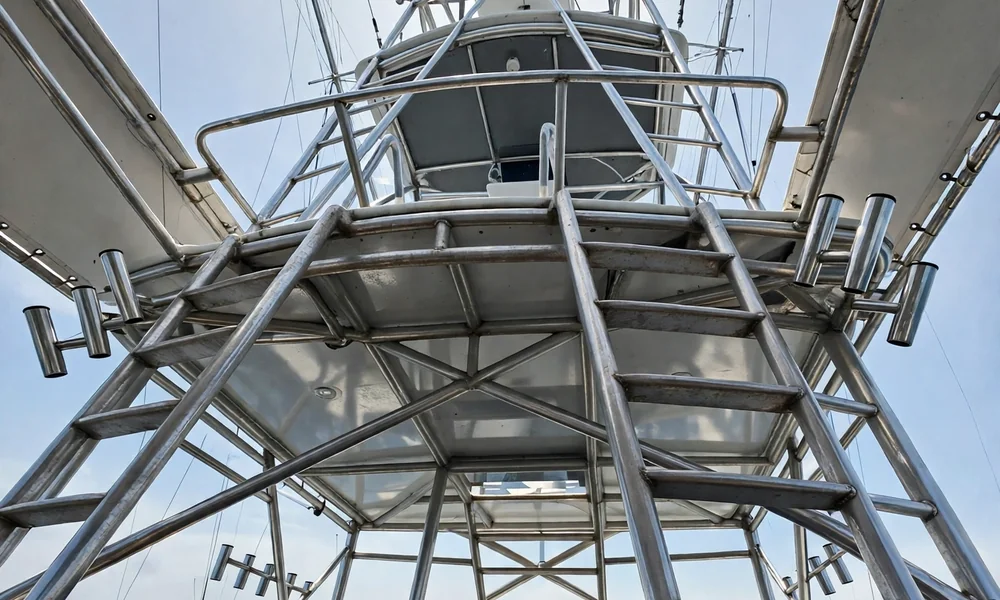
Above the cockpit sits the flybridge, and above that, on many boats, a tuna tower that lifts the lookout thirty feet or more above the water. The tower is built from welded aluminium tube, light enough not to upset stability and strong enough to carry two people and a full set of controls. From up there, a lookout can spot birds, weed lines, and surface activity invisible from the deck, which is why serious anglers call the tower the most valuable fishing tool on the boat. The helm carries screens for navigation, sonar, radar, and engine data, with analogue gauges as backup.
Step 5: The interior is fitted out
Below deck, the luxury part of the name earns its keep. The saloon has hand-built joinery in teak or walnut, a galley with full-size refrigeration and a proper stove, and a dinette that converts for extra sleeping space. Cabins sleep four to eight people, with air conditioning throughout and enough sound insulation that the engines are a murmur. The finish looks like a small hotel, but every fitting is chosen to survive life at sea: latches that will not rattle loose, fabrics that resist salt and sun, and floors that can be hosed down after a long day.
Step 6: Systems, sea trial, and tuning
The last step is the least visible and the most important. Generators, watermakers, air conditioning, stabilisers, and electronics are installed, wired, and tested. Gyroscopic stabilisers are now common, spinning a heavy flywheel at high speed to cancel much of the roll at rest and underway. Then the boat goes to sea for trials, where the builder checks speed, fuel burn, noise, and handling against the spec sheet. Props are tuned and trim tabs adjusted before handover.
Reading the spec sheet
The headline numbers tell a story if you know how to read them. Length overall decides dockage, but waterline length sets the hull speed and the ride. Beam, the width, sets stability and interior volume: a wide boat is steadier and roomier but needs more power. Draft decides where the boat can go, and displacement, the weight, ties everything together. A heavier boat needs more horsepower for the same speed, but it rides more softly. Here is how a typical sixty-foot luxury sportfisher reads.
| Specification | Typical figure | What it means |
|---|---|---|
| Length overall | 60 feet (18.3 m) | Total length, bow pulpit included |
| Beam | 17 ft 6 in (5.3 m) | Width; stability and interior space |
| Draft | 4 ft 6 in (1.4 m) | Depth below waterline when loaded |
| Displacement | 55,000 lb (25 t) | Weight; heavier rides softer |
| Deadrise at transom | 21 degrees | Hull V angle; sharper, softer ride |
| Engines | Twin 1,600 hp diesels | 3,200 hp via shafts or pods |
| Cruise speed | 30 knots | Comfortable fast cruising speed |
| Top speed | 38 knots | Maximum speed, calm conditions |
| Fuel capacity | 1,800 gal (6,800 L) | Sets range with cruise speed |
| Range | 450 nm at cruise | Distance before refuelling |
| Livewell capacity | 120 gal (454 L) | Live bait, circulating seawater |
| Generator | 21 kW | Powers air conditioning, systems |
What it costs
A new luxury sportfishing yacht in the fifty to seventy-foot range typically costs an estimated $3 million to $8 million, depending on the builder, the customisation, and the electronics package. A fully custom boat from a famous yard can pass an estimated $10 million, and the tower, stabilisers, and top-end sonar can add an estimated $500,000 or more. Fuel alone can cost an estimated $3,000 to $5,000 for a long day offshore, and yearly upkeep typically adds an estimated 10 percent of the boat’s value. All prices here are estimates.
A rare fact
The most expensive single item on some sportfishers is not the engines or the hull. It is the tower. A full tuna tower, built from welded aluminium and fitted with duplicate controls, steering, and electronics so the boat can be run from thirty feet up, can cost an estimated $250,000 or more. Retrofitting one is far harder than ordering it from the start, because the tower’s loads must be carried down through the flybridge and into the hull, so builders that plan for a tower reinforce the deck from the first drawing.
The Takeaway
A luxury sportfishing yacht’s spec sheet is a working document, not a list of boasts. Length, beam, draft, displacement, and deadrise describe the hull and the ride. Power, fuel, cruise speed, and range describe what the boat can actually do in a day. Livewell volume, rod holders, and the tower describe how seriously the boat takes fishing. Read the numbers in that order and check them against a sea trial. If you want the build story, read how a luxury fishing yacht is made, and for a close cousin, expedition yacht specs explained stretches the same ideas for long-range travel, while the best yacht toys and tenders ranked covers what rides along once the fishing is done.


